


Stand in Jamaica in the middle of the 18th century and you are not simply looking at an island. You are looking at an engineered landscape.
Every acre has been surveyed, claimed, fenced, drained, planted, mortgaged, inherited, and defended. Jamaica at this moment is Britain’s most profitable colony, and that wealth is not abstract. It is rooted in land — vast sugar estates carved into hillsides and plains, worked by enslaved Africans, administered by overseers, and recorded obsessively in ledgers and diaries.
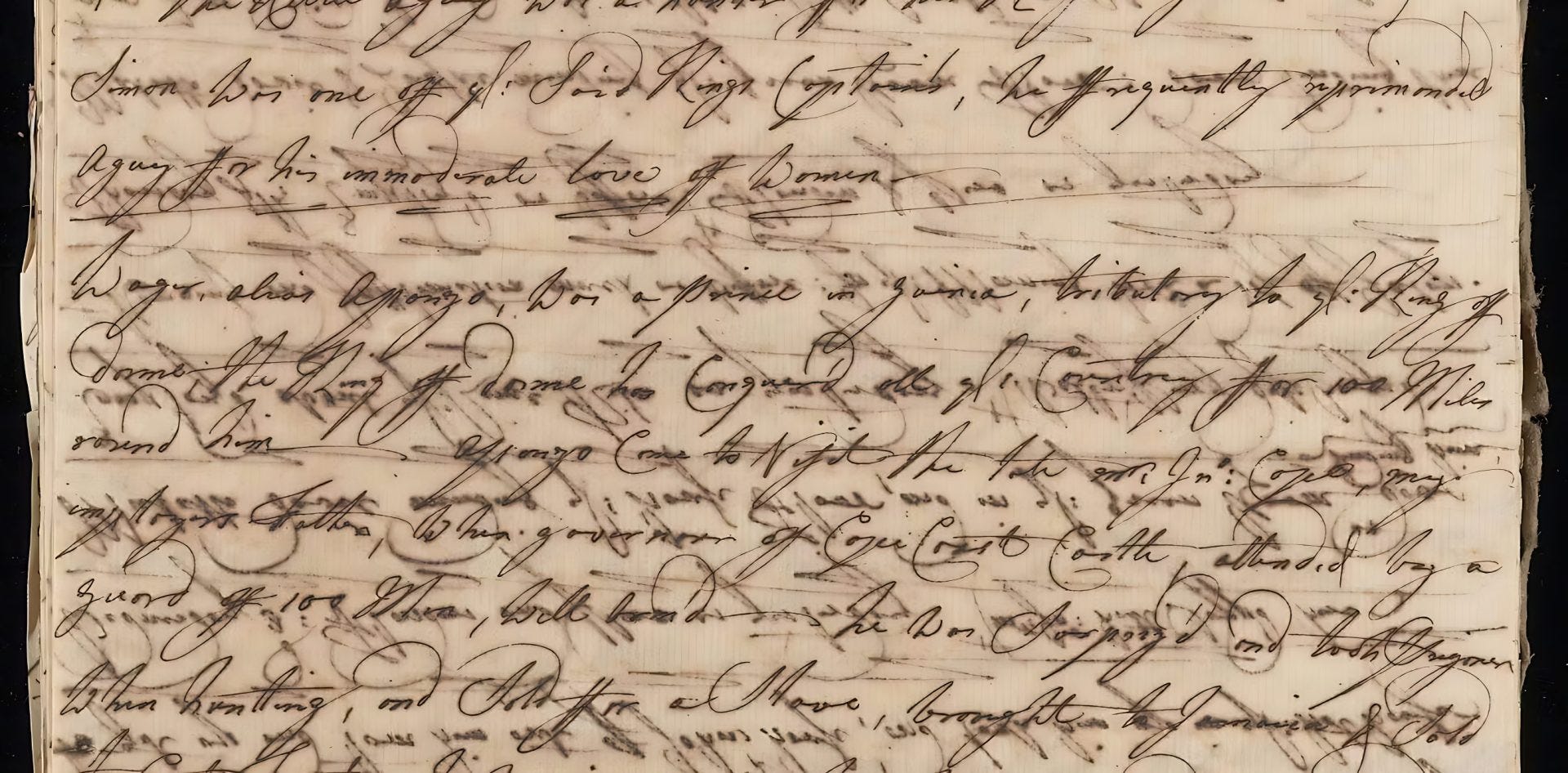
One of those diaries, belonging to Thomas Thistlewood, contains just 134 words about a man called Apongo. And yet, those words open a rare window into how land, identity, and resistance collided in colonial Jamaica.
Apongo — also known as Wager — was not recorded as a worker, a valuation, or a line item. He appears instead as a problem: a man whose past did not fit neatly into the categories the plantation system relied upon.
18th-century enslaver named Thomas Thistlewood describes Apongo as a prince from a West African state and said to have paid tribute to a larger kingdom he called “Dorme”. From there, Apongo was sent on a diplomatic mission to Cape Coast Castle, the headquarters of British trading operations on the African coast. It was a place not unlike Jamaica’s great houses — formal, fortified, and built to manage extraction.
But the journey did not end in diplomacy. Apongo was seized, enslaved, and transported across the Atlantic to Jamaica — to a colony where land generated unimaginable wealth, and human beings were treated as movable property within it.
Once on the island, Apongo tried to reclaim something most Jamaicans of the time were denied: freedom. He even encountered the same British governor he had previously met in Africa, now presiding over a landscape of estates and enslaved labour. His appeals failed.
Eventually, Apongo did what many before and after him would do. He resisted.
Between 1760 and 1761, Jamaica’s plantation system was shaken by Tacky’s Revolt — the largest enslaved uprising in the British Empire before the 19th century. It spread across estates, disrupted production, destroyed property, and terrified planters whose wealth was inseparable from land control.
Apongo was one of its leaders. He died in the rebellion.
Over 60 white colonists were killed. More than 500 enslaved Africans lost their lives. Hundreds more were deported. The revolt exposed something deeply unsettling: that the very landscape designed to control people could also be used against its owners.
Why this matters for Jamaican land history
Thistlewood’s brief note about Apongo is unusually detailed because most enslaved Africans were stripped of identity on arrival. Names were replaced. Origins blurred into broad labels like “Coromantee” or “Popo”, tied loosely to regions rather than people.
These classifications mattered to plantation owners. They believed certain groups were better suited to certain types of labour, more or less rebellious, more or less “valuable”. This was racialised property management.
But Apongo resists that logic.
The kingdom Thistlewood called “Dorme” has long puzzled historians. Some believe it refers to Dahomey, in present-day Benin. Others argue Apongo was Ghanaian, given the strong Ghanaian leadership documented in Jamaican rebellions. Recent scholarship shows that “Dorme” was indeed a contemporary Jamaican term for Dahomey — and that diplomatic travel between Dahomey and Cape Coast did occur during this period.
Still, the question remains unresolved: how did a man possibly linked to Dahomey become a leader in a rebellion largely associated with people from today’s Ghana?
The most convincing answer is also the most unsettling for colonial record-keeping: Apongo’s identity was not fixed. He likely moved between political worlds, languages, and cultures long before he ever set foot in Jamaica. The neat ethnic categories used by planters were administrative tools, not lived realities.
Land remembers, even when records fail
Apongo’s story survives not because the system valued him, but because it could not fully contain him.
Jamaica’s real estate history is not only about titles, estates, and transfers. It is about who was allowed to own land, who worked it without claim, and who understood its value deeply enough to challenge the order built upon it.
The plantations Apongo moved through no longer function as sugar estates. Some are ruins. Some are towns. Some are still held in families whose wealth began there. But the land itself carries the memory of resistance as much as extraction.
In that sense, Apongo belongs to Jamaica’s property history — not as an owner, but as someone who exposed the fragility of a system that treated land as everything and people as expendable.
And sometimes, a few lines in a diary are enough to remind us that landscapes are never neutral. They are designed. They are contested. And they are shaped, quietly and violently, by those forced to live within them.
This article reflects historical research and interpretation. It does not seek to assign blame, but to explore how land and power have shaped Jamaica’s past and continue to influence its present.