

Buying Property in Jamaica in 2026: What the Process Really Looks Like

In Jamaica, property has always meant more than bricks and mortar. It represents stability, legacy, and, for many families at home and abroad, a long-held aspiration to own a piece of the island they call home.
After a challenging hurricane season, the country has once again shown what Jamaicans know well — likkle but wi tallawah. Small in size, but strong in spirit. Communities have been rebuilding, systems have kept moving, and the property market, while cautious, remains active and resilient.
Against that backdrop, buying or selling real estate in Jamaica in 2026 continues to be both an opportunity and a responsibility. The process is well-established, but it is not always well understood. Many buyers and sellers step in armed with partial information — a tax rate quoted here, a bank estimate there — only to discover later that timelines, costs, or legal obligations were misunderstood.
The result can be unnecessary stress, avoidable delays, and financial strain at precisely the moment when clarity matters most.
This guide is intended to change that. It sets out, in plain terms, how property transactions in Jamaica actually work — the stages involved, the government taxes and fees, the role of attorneys and lenders, and the realities that affect how long a transaction may take. Whether you are buying with cash, arranging a mortgage, selling a long-held family property, or purchasing from overseas, the aim is simple: to help you understand what is likely to happen, when it happens, and why it matters.
Because when you understand the process, you are not merely reacting to it — you are navigating it.
Important Disclaimers for Readers
Government rates and fees can change through Budget measures or agency updates. Figures should always be confirmed at the time of transaction.
The Stamp Office may assess taxes based on market value, not only the stated purchase price, particularly for family transfers or non-arm’s-length sales.
Professional fees (attorneys, surveyors, valuers, agents) are market-based and vary depending on complexity, location, and urgency.
Bank and lender fees differ by institution and borrower profile; written loan estimates are essential.
A Structured Process — Not a Shortcut
Despite common belief, property transactions in Jamaica are not informal affairs. They follow a clearly sequenced legal and administrative path involving attorneys, government agencies, and, where applicable, financial institutions.
From pre-approval and written offers, through Agreements for Sale, title searches, stamping, registration, and final possession, each stage exists for a reason. Skipping steps or rushing documentation often leads to delays rather than speed.
That structure has proven its value even in periods of national disruption. In recent months, as Jamaica has balanced recovery with continuity, land registration, banking, and legal systems have continued to function — sometimes slower than ideal, but steadily.
Again: likkle but wi tallawah.
Costs: What Buyers and Sellers Often Underestimate
One of the most persistent myths in Jamaican real estate is that the purchase price tells the full story. It does not.
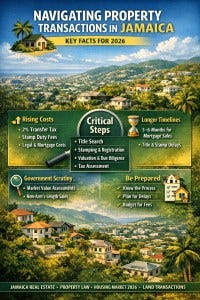
Buyers must budget not only for the deposit, but for stamp duty, registration fees, legal costs, valuations, and — if financing is involved — mortgage-related charges. Cash buyers typically face lower overall costs, while mortgage-backed purchases can push totals into double-digit percentages of the purchase price.
Sellers, particularly those using real estate agents, must account for transfer tax, commission, and legal expenses. In many open-market sales, total vendor costs can approach 10–12 per cent, though this varies widely by transaction.
None of these figures are designed to surprise — but they often do.
Overseas Buyers and the Diaspora
Jamaica continues to attract strong interest from overseas Jamaicans and foreign nationals. The law permits non-citizens to purchase most residential and commercial property without special approval.
However, every person involved in a property transaction — Jamaican or foreign — must have a Tax Registration Number (TRN). Foreign nationals can legally obtain one, and doing so does not, by itself, make a person tax-resident.
What overseas buyers should expect is time: time for document notarisation, apostilles, courier services, and coordination across borders. Using experienced local attorneys is not optional; it is essential.
Why Understanding the Process Matters
There is no single “standard” property transaction in Jamaica. Every title carries its own history. Some are clean and straightforward; others involve probate, missing documents, or long-standing informal arrangements.
But what remains constant is the framework within which all transactions must operate. Once that framework is understood, the process becomes far less daunting — even in a climate shaped by recovery, rebuilding, and cautious optimism.
Jamaica has always found a way forward. The property market is no different.
With the right information, realistic expectations, and professional guidance, buying or selling property in Jamaica in 2026 can be a confident, well-ordered experience — not an anxious one.
And that, perhaps, is the quiet strength of the system: steady, resilient, and built to endure.