

Jamaica’s Distressed Property Market May Be Sending Early Economic Warning Signs
A review of publicly available foreclosure and private treaty property listings suggests mounting pressure at the lower end of Jamaica’s housing market as global instability, rising costs and economic

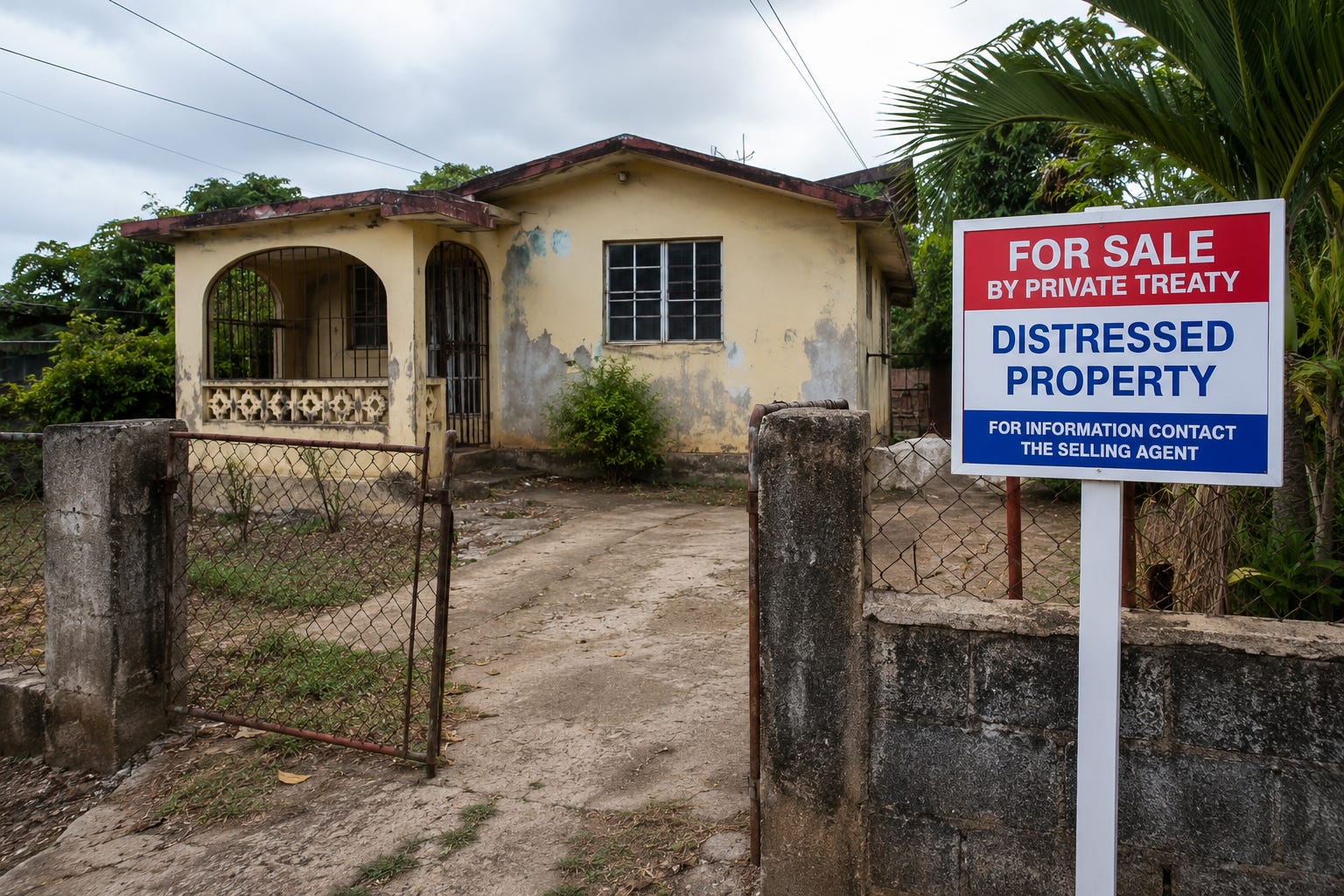
The analysis sampled only publicly visible foreclosure and private treaty listings.
The data does not represent the entire Jamaican property market.
Jamaica’s wider housing market likely contains between 5,000 and 7,000 properties listed for sale overall across various platforms and agencies at any given time.
Within the sampled distressed-property review, 206 publicly visible foreclosure and private treaty listings were identified.
Additional distressed assets may also exist on bank recovery portals or in private channels outside publicly searchable systems.
The signals are subtle, but increasingly difficult to ignore.
A review of publicly available foreclosure and private treaty property listings across Jamaica suggests that lower-priced distressed assets are moving through the market at significantly faster rates than higher-end properties, potentially reflecting growing affordability pressure and financial strain among sections of the population.
The analysis focused specifically on foreclosure and private treaty properties visible through publicly accessible listing systems and recovery channels. It did not attempt to measure the entire Jamaican housing market.
At any given time, Jamaica’s wider property market may contain an estimated 5,000 to 7,000 residential and commercial listings across agencies, developers and online platforms. Against that broader backdrop, the distressed-property sample identified just over 200 publicly visible foreclosure and private treaty listings.
The actual number of distressed or financially pressured properties nationwide remains unknown.
Some distressed assets may never appear publicly. Others may be managed directly through bank recovery units, private negotiations, attorney channels or internal restructuring arrangements before reaching open listing systems.
Still, the publicly visible sample offers a useful snapshot into one segment of the market now attracting increasing attention.
TABLE: DISTRESSED PROPERTY SAMPLE OVERVIEW
Total distressed-property listings sampled: 206
Active distressed listings: 136
Under-offer distressed listings: 70
Under-offer share of sampled distressed market: 34%
Median asking price across all sampled distressed listings: J$25 million
Median active distressed listing price: J$30 million
Median under-offer distressed listing price: Approximately J$17.75 million
The pricing split may be one of the most important findings.
Distressed properties moving under offer were considerably cheaper than those remaining active on the market, suggesting that demand is concentrating heavily in lower-price categories.
TABLE: UNDER-OFFER SHARE BY PRICE RANGE
Under J$5 million: 79%
J$5 million to J$10 million: 47%
J$10 million to J$15 million: 55%
J$15 million to J$20 million: 50%
J$50 million to J$100 million: 9%
J$100 million and above: 8%
In practical terms, lower-priced distressed assets appear to be moving far more aggressively than luxury properties.
That pattern may reflect several overlapping realities:
• stronger demand for lower-cost housing,
• investors searching for discounted opportunities,
• affordability constraints pushing buyers downward,
• and financially pressured sellers attempting quicker exits.
The parish-level breakdown also points toward differing regional pressures.
TABLE: UNDER-OFFER SHARE BY PARISH
St Catherine: 55%
St Elizabeth: 50%
Clarendon: 47%
St Andrew: 22%
St James: 15%
The stronger activity in St Catherine, Clarendon and St Elizabeth may partly reflect continued migration toward relatively more affordable housing markets outside Kingston’s premium urban core. But it may also reveal where financial pressure is increasingly concentrated among working and lower-middle-income households.
The broader economic backdrop adds further complexity.
Jamaica continues navigating hurricane recovery costs, elevated insurance premiums, inflationary pressure and rising utility expenses. At the same time, escalating tensions involving the United States, Iran and Israel have heightened global concerns surrounding oil supply disruption and imported inflation.
For Jamaica, where fuel, transportation and imported goods remain deeply interconnected with daily economic life, those pressures spread rapidly through household finances.
Higher fuel costs raise transportation expenses. Transportation affects food prices. Food inflation weakens disposable income. Disposable income affects mortgage affordability, rental stability and consumer resilience.
Housing markets often begin reflecting those pressures before official economic statistics fully capture them.
Yet caution remains essential.
The data reviewed does not prove Jamaica is experiencing a nationwide foreclosure surge or housing collapse. The sample reflects only publicly visible foreclosure and private treaty activity and should not be interpreted as a complete picture of the national market.
Jamaica’s property market also behaves differently from larger developed economies.
Families frequently absorb financial shocks privately. Overseas relatives often provide support. Owners rent sections of homes, restructure obligations or quietly attempt sales before formal repossession occurs.
As a result, financial stress can remain partially hidden for extended periods.
What the current figures may represent, therefore, is not panic, but pressure.
Not a market collapse, but the emergence of quieter warning signs inside parts of Jamaica’s housing economy as global uncertainty and local affordability challenges continue to collide.
Disclaimer: This article is based on a limited review of publicly available foreclosure and private treaty property listings and is intended for general informational and journalistic discussion purposes only. The sampled data does not represent the entire Jamaican property market and should not be interpreted as definitive evidence of a nationwide foreclosure trend or housing crisis. Some distressed properties may exist outside publicly accessible listing systems. Readers should seek independent financial, legal or professional advice before making property or investment decisions.