

Jamaica’s Unfinished Story of Freedom, Health, and Reparatory Justice
Jamaica’s call for reparations is no longer about the past — it is about survival in the present.


The words were measured, diplomatic, almost restrained. But the meaning behind them was anything but.
At the Organization of American States in Washington, Jamaica’s ambassador called on the world to move beyond remembrance and toward reparatory justice. Not reflection. Not apology. Action.
It was not the first time.
And that is precisely the problem.
For nearly two centuries, Jamaica — and the wider Caribbean — has asked, argued, pleaded, reasoned, and now demanded that the legacy of slavery be addressed not as history, but as a living system with consequences still unfolding. From emancipation in 1838, to the philosophy of Marcus Mosiah Garvey, to parliamentary motions, CARICOM frameworks, and now international diplomacy — the call has been repeated in different voices, across generations.
Yet the condition remains.
Because what was never repaired was never truly ended.
There is a quiet myth that slavery belongs safely in the past — a closed chapter, acknowledged, regretted, but resolved.
It is not.
Jamaica was one of the most intense slave societies in the British Caribbean. Hundreds of thousands of Africans were forced into a system designed not simply to extract labour, but to break identity, suppress dignity, and reduce human beings to economic units. When emancipation came, it did so without land, without compensation for the enslaved, and without any meaningful restructuring of the society that had profited from their suffering.
The structure remained. Only the language changed.
And that structure still speaks today.
You can see it in the economy.
You can see it in land ownership.
But perhaps most quietly — and most powerfully — you can see it in health.
Across Jamaica, the Caribbean, the United Kingdom, and the United States, people of African descent disproportionately suffer from hypertension, diabetes, and cardiovascular disease. These are often framed as lifestyle conditions — diet, exercise, individual choice.
But that explanation is too small.
Because it ignores the weight of history carried in the body.
“This is not about blaming the past for everything,” says Dean Jones, founder of Jamaica Homes. “It’s about recognising that the past didn’t disappear — it settled into the present. It shaped where people live, what they earn, what they eat, how they are treated, and even how their bodies respond to stress.”
The science increasingly reflects this. Chronic stress — driven by inequality, instability, and systemic pressure — alters the body over time. It raises blood pressure, disrupts metabolic systems, and increases vulnerability to disease. This is not abstract. It is measurable. It is visible.
And it is inherited — not genetically in the simplistic sense, but structurally, environmentally, socially.
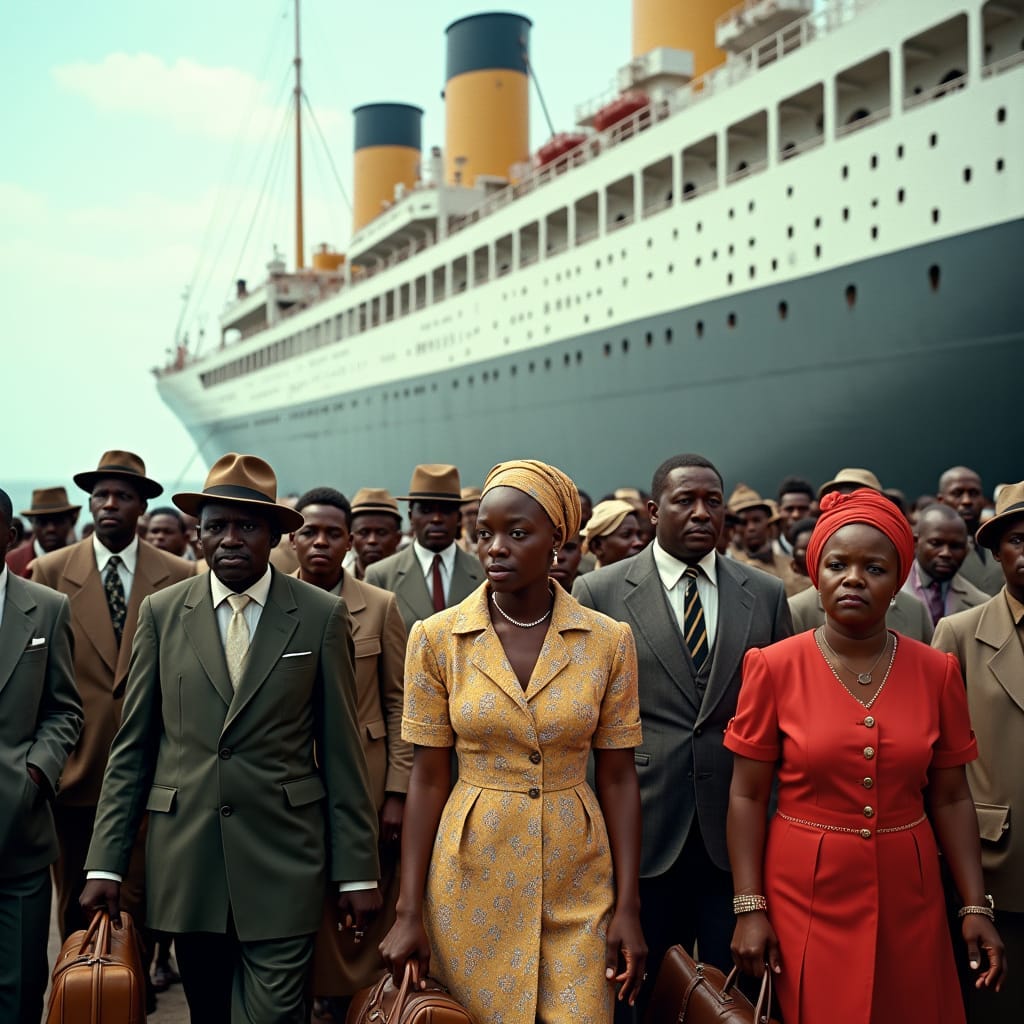
Then came Windrush.
After the war, Jamaicans travelled to Britain, answering a call to rebuild the “mother country.” They arrived not as strangers, but as citizens of an empire they had already helped sustain.
And yet, many were met with hostility, exclusion, and discrimination.
Housing was denied. Jobs were limited. Communities were marginalised.
A second journey. A second struggle.
“I come from that story,” Jones says. “You leave one system shaped by inequality, and you step into another that reminds you — in different ways — that you are still on the outside of power. That does something to a people. It builds resilience, yes. But it also builds pressure.”
That pressure does not vanish.
It accumulates.
This is why reparations matter.
Not as a symbolic gesture. Not as a financial transaction alone. But as a recognition that the damage was not momentary — it was structural, and it continues.
The Caribbean’s case, led through CARICOM and national bodies, has matured. It is no longer simply moral. It is legal, economic, and increasingly scientific. It speaks of development gaps, education deficits, cultural erasure, and yes — health disparities.
When Jamaica calls for reparatory justice today, it is not asking the world to look backward.
It is asking the world to look honestly at what is still here.
“Reparations is not about revenge,” Jones says. “It’s about repair. If a system caused harm — and that harm is still measurable today — then addressing it is not optional. It’s responsibility.”
And yet, the hesitation remains.
Global powers acknowledge history, but stop short of commitment. Statements are issued. Regret is expressed. Frameworks are discussed.
But action — the kind that changes outcomes — remains limited.
So the question grows louder:
When does remembrance become responsibility?
Or more pointedly:
At what point does continued delay become its own form of injustice?
Jamaica is a small nation.
But it is not a minor voice.
It sits at the intersection of history and consequence — a place where the past is not distant, but present, visible, and measurable in everyday life. In its people. In its systems. In its challenges.
And in its resilience.
Because Jamaica has never stopped pushing forward. It has built, created, migrated, adapted, and endured. It has given culture to the world. Music. Language. Identity. Spirit.
But resilience should not be mistaken for resolution.
Survival is not the same as justice.
The call made in Washington this month was not new.
That is precisely why it matters.
Because repetition, over time, becomes something else.
It becomes evidence.
Evidence that the issue has not been resolved.
Evidence that the system has not been repaired.
Evidence that the consequences are still unfolding.
And perhaps most importantly —
Evidence that the next step can no longer be talk.
“There comes a point,” Jones says, “when history stops being something you study and starts being something you’re still living through. I think we’ve reached that point.”
The question now is not whether the case has been made.
It has.
The question is whether the world is prepared to respond.
Or whether, decades from now, another voice — in another room, in another country — will stand up and say the same words again.
And still be waiting.