

Storms Ahead, Lessons Unlearned?
Forecasts point north—but Jamaica sits directly in the path, where resilience is tested long before storms reach the United States

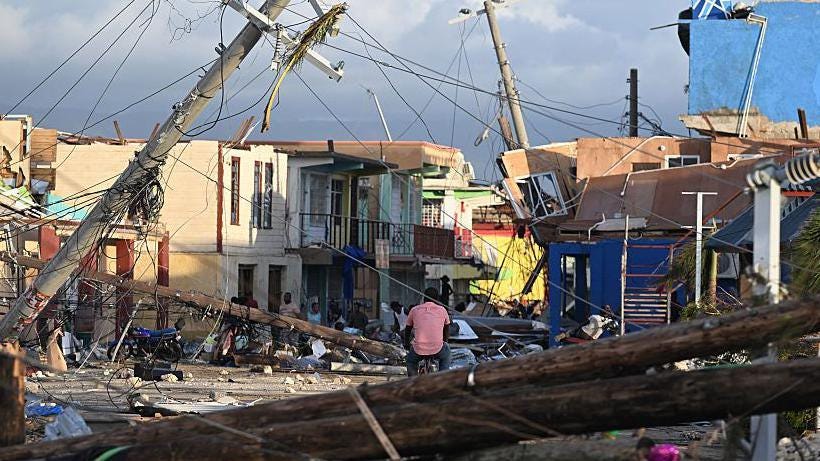
A new hurricane season forecast suggests a relatively moderate year for the Atlantic, with 11 to 16 named storms and several expected to strengthen into hurricanes. Up to five of those systems could directly affect the United States.
But in Jamaica, where storms often pass first or nearby, the question is less about how many will make landfall elsewhere and more about what happens when even one does.
The Caribbean remains central to the development and movement of Atlantic storms. Warm ocean temperatures—highlighted again in this year’s outlook—continue to create conditions for rapid intensification, sometimes just days or hours before landfall.
That risk is not theoretical.
Communities across Jamaica are still recovering from recent hurricane impacts, including the damage left behind in 2025. In places along the south coast, rebuilding continues, unevenly, shaped as much by financial limits as by engineering advice.
Preparedness, at a national level, has improved over time. Early warnings are clearer. Emergency coordination is more structured. Public messaging is more consistent.
But resilience is ultimately built at the household level.
And that is where the gap remains.
After storms, rebuilding decisions are rarely made in ideal conditions. Materials are chosen based on availability and cost. Repairs are often immediate rather than strategic. In many cases, homes are restored to what they were before—not necessarily to what they need to become.
This is not a failure of awareness. It is a reflection of constraint.
For many households, the priority is to restore stability as quickly as possible. Structural upgrades - stronger roofing systems, improved drainage, elevation changes- require resources that are not always accessible.
Over time, this creates a pattern that is difficult to break. Each storm exposes similar vulnerabilities. Each recovery cycle risks reinforcing them.
The implications extend beyond individual homes.
Hurricanes test the broader housing system - how land is used, how buildings are constructed, and how well communities can absorb and recover from shocks. In formal developments, planning standards may offer some protection. Elsewhere, especially in more informal settings, exposure remains higher.
This unevenness shapes outcomes.
A single storm can produce very different consequences depending on where and how people live. For some, recovery is measured in weeks. For others, it stretches into years.
The current forecast also carries a familiar caution. Even in seasons expected to be less active overall, conditions can still support powerful storms. Warm waters across the Caribbean basin increase the likelihood that systems strengthen quickly, sometimes close to land.
That reduces preparation time.
It also raises the stakes for what already exists on the ground.
Jamaica does not need multiple storms to face serious disruption. One is enough.
And if storms are projected to move toward the United States this year, Jamaica remains part of that same corridor—exposed to the same waters, the same atmospheric conditions, and often the earliest impacts.
The difference lies not in geography, but in readiness.
There is evidence of progress. More homeowners are taking precautions. More attention is being paid to building practices. More conversations are happening about resilience.
But there is also continuity.
Rebuilding continues, in many cases, along familiar lines. Economic pressures remain decisive. And the balance between immediate needs and long-term resilience is still difficult to achieve.
Forecasts can outline the season ahead. They can estimate numbers, probabilities, and risks.
What they cannot determine is how a country responds when those risks become reality.
In Jamaica, that response will not be shaped only by preparation in the days before a storm.
It will be shaped by the decisions made long before it arrives—and long after it leaves.