

Jamaica is richer than Haiti, based on commonly used economic indicators like GDP as of April 2024 (Gross Domestic Product) and GDP per capita.
Here’s a quick comparison (as of the most recent data):
| Indicator | Jamaica | Haiti |
|---|---|---|
| GDP (nominal) | ~$17–18 billion USD | ~$14–15 billion USD |
| GDP per capita | ~$5,800 USD | ~$1,800 USD |
| Human Development Index | Medium (rank ~115) | Low (rank ~163) |
| Economic Stability | More stable | Less stable, crisis-prone |
| Tourism & Remittances | Major contributors | Remittances are significant |
Summary:
- Jamaica has a higher income per person, more developed infrastructure, a stronger tourism sector, and better overall development indicators.
- Haiti remains the poorest country in the Western Hemisphere, with ongoing challenges like political instability, natural disasters, and poverty.
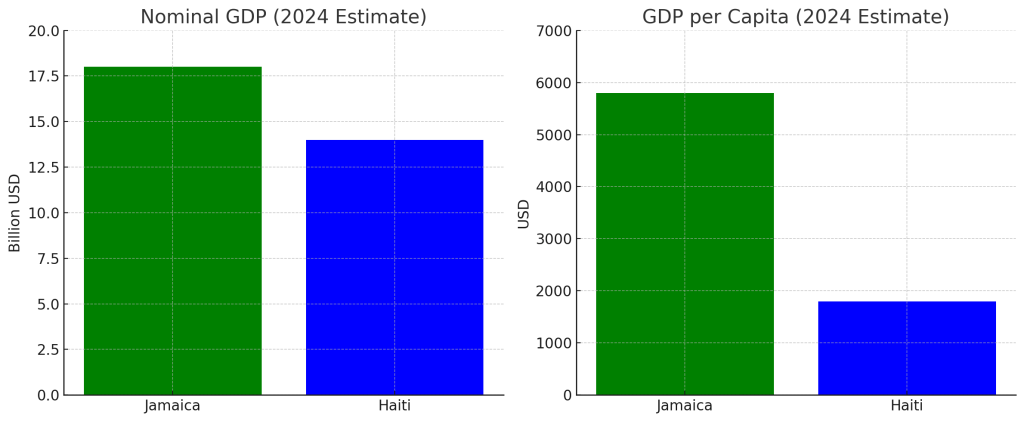
Here’s a visual comparison of Jamaica and Haiti in terms of nominal GDP and GDP per capita (2024 estimates):
- Jamaica has a higher total GDP and significantly higher income per person.
- This reflects stronger infrastructure, a more developed tourism industry, and greater economic stability.
Here’s a brief historical breakdown of how the economic gap between Jamaica and Haiti developed:
Colonial Roots
- Jamaica (British colony): Benefited from British investments in infrastructure, education systems, and later, a smoother transition to self-governance after independence in 1962.
- Haiti (French colony): Gained independence in 1804 after a successful slave revolt—the first of its kind. However, Haiti was punished economically, forced to pay reparations to France (modern equivalent: billions of dollars) well into the 20th century, draining national resources.
Post-Independence Economic Trajectories
- Jamaica developed key sectors such as bauxite mining, tourism, and agriculture, supported by British systems of governance and post-colonial ties.
- Haiti, in contrast, faced international isolation, lack of foreign investment, weak institutions, and recurring political instability.
Natural Disasters
- Both countries are hurricane-prone, but Haiti has suffered more severe impacts due to its weaker infrastructure and slower disaster response systems.
- The 2010 earthquake in Haiti caused widespread devastation, killing over 200,000 people and wiping out decades of progress.
Modern Day
- Jamaica still struggles with debt and crime but maintains a functional democracy, stable economy, and global tourism appeal.
- Haiti remains the poorest country in the Western Hemisphere, with frequent government collapses, gang control, and chronic poverty.
Summary Table
| Category | Jamaica | Haiti |
|---|---|---|
| Colonial Power | Britain | France |
| Year of Independence | 1962 | 1804 |
| Reparations Paid? | No | Yes – to France (crippling debt) |
| Natural Disasters | Frequent hurricanes | Earthquakes + hurricanes |
| Current Economy | Tourism, mining, remittances | Remittances, subsistence farming |
| Political Stability | Moderate | Very low (frequent coups & unrest) |
Disclaimer: This article is for informational purposes only and does not constitute legal or financial advice. Please note: Jamaica Homes is not authorized to offer financial advice. The information provided is not financial advice and should not be relied upon for financial decisions. Consult a regulated mortgage adviser for guidance.
Discover more from Jamaica Homes News
Subscribe to get the latest posts sent to your email.
