

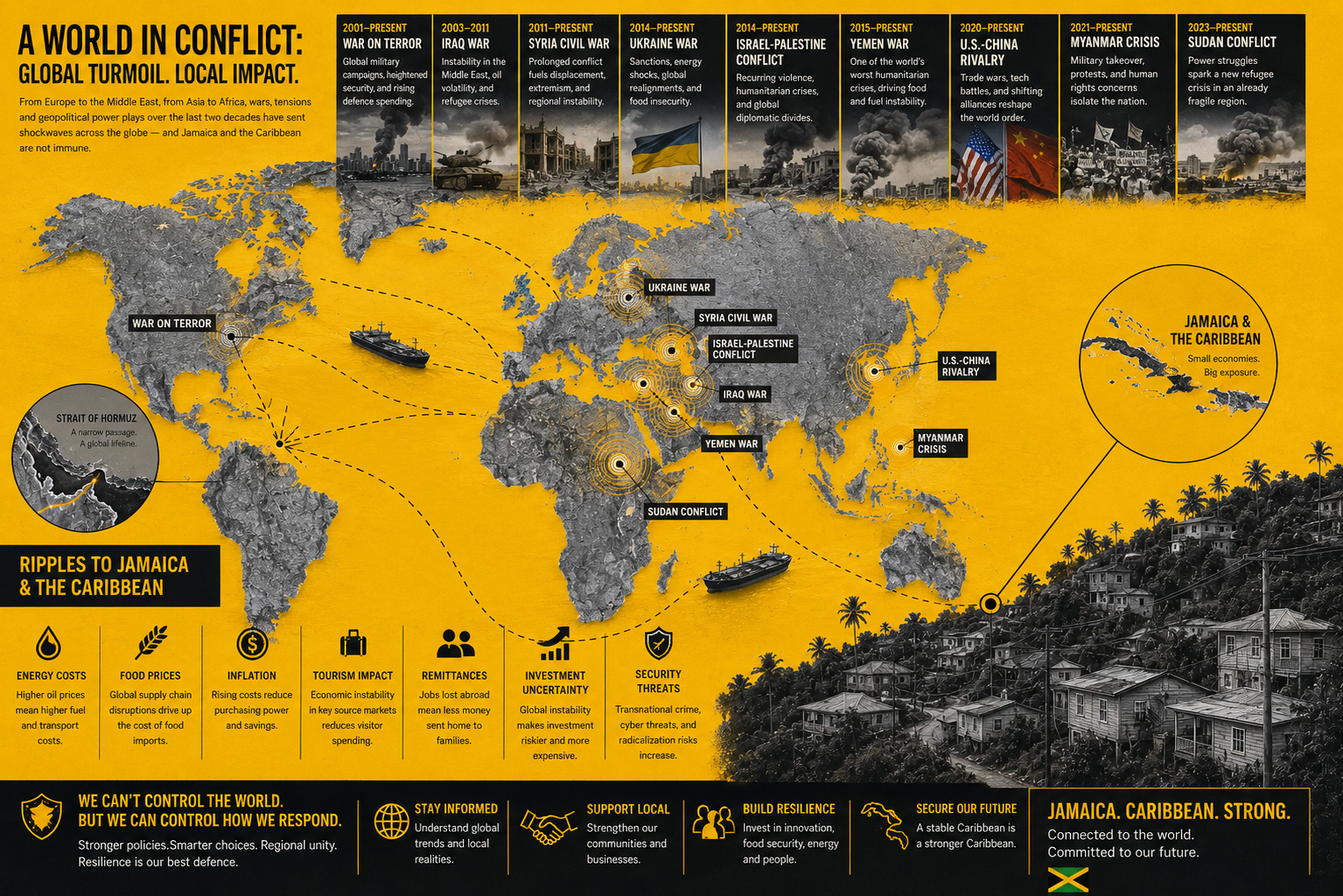
Jamaica Homes Global Conflict & Caribbean Impact Review | Published 3 July 1999 | Reporting Period: 3 April – 2 July 1999
Quarterly Briefing
- NATO’s air campaign against Yugoslavia, launched on March 24 to stop Serbian ethnic cleansing of Kosovo’s Albanian population, ends on June 10 when Milosevic agrees to withdraw Serbian forces from Kosovo; the 78-day campaign involves 38,000 sorties and the destruction of Yugoslav military and civilian infrastructure; NATO ground forces (KFOR) begin deploying on June 12; over 850,000 displaced Kosovo Albanians begin returning; the campaign is NATO’s first major combat operation and its first intervention in a sovereign state without a Security Council mandate, provoking sustained debate about humanitarian intervention’s legal basis.
- India discovers in May that Pakistani army soldiers and Kashmiri militants had infiltrated positions on the Indian side of the Line of Control in the Kargil district of Jammu and Kashmir during the winter; the Kargil War that follows involves fighting at elevations above 5,000 metres in some of the most extreme conditions of any modern conflict; India launches air and ground operations to recapture the infiltrated positions; the conflict between two nuclear-armed states produces significant casualties; Pakistani forces withdraw in late July following intense US pressure on Prime Minister Nawaz Sharif.
- Two student gunmen at Columbine High School in Jefferson County, Colorado kill 12 fellow students and a teacher and wound 21 others on April 20 before dying by suicide; the attack is the deadliest school shooting in US history and produces an immediate national debate about gun control, violent video games, social isolation and school security; the debate produces significant emotional intensity but limited legislative change; Columbine establishes the school shooting as a recurring feature of American life with resonances far beyond the United States.
- The Rambouillet peace conference for Kosovo, convened by the US and EU in February and March, had failed to produce an agreement as the Serb delegation refused to sign; the NATO bombing campaign began three days after the conference’s collapse; the military outcome — Serbian withdrawal and NATO administration of Kosovo — achieves the conference’s stated objectives without a negotiated agreement; the precedent of military intervention producing outcomes that negotiation failed to achieve will be debated for years.
- Nigeria holds its first civilian presidential election since 1983 on February 27; former military ruler Olusegun Obasanjo wins with 62 per cent of the vote; his inauguration on May 29 marks Nigeria’s return to democratic governance after sixteen years of military rule; the transition is significant for West Africa and for the African continent’s broader democratic trajectory; Nigeria’s oil wealth and regional influence make its political stability a matter of continental importance.
- The Caribbean monitors the Kosovo campaign and its aftermath with the complex perspective of small states dependent on international law and multilateral institutions; NATO’s decision to act without Security Council authorisation — because Russia and China would have vetoed a resolution — raises a precedent that small states find unsettling; the humanitarian justification is accepted but the circumvention of the UN framework that Caribbean diplomacy relies upon is a concern; the balance between sovereignty and humanitarian intervention has not been resolved by Kosovo, only sharpened.
Prologue: The War That Ended
The end of NATO’s Kosovo campaign on June 10 was less a peace settlement than a military capitulation by Milosevic under the sustained destruction of Yugoslav infrastructure. The campaign had lasted 78 days longer than NATO planners had initially expected; the first days’ assumption that Milosevic would yield quickly proved wrong; the alliance had continued bombing through political pressures that included Russian opposition, the accidental bombing of the Chinese Embassy in Belgrade on May 7 and sustained debate within member states about the legality and proportionality of the campaign. The end came when Milosevic’s calculation shifted: the damage was no longer sustainable, and no Russian or Chinese rescue was coming.
Kargil and the Nuclear Dimension
The Kargil War was fought at altitudes and in conditions that made normal military logistics nearly impossible; the Indian Army’s infantry assault on Pakistani-held peaks along the ridgeline above Kargil involved some of the most demanding combat since Korea. The conflict’s nuclear dimension — India and Pakistan had both tested nuclear devices in May 1998 — was present throughout. Pakistani nuclear signals intelligence was monitored closely by the US; intense American diplomatic pressure on Nawaz Sharif was the primary mechanism for the eventual Pakistani withdrawal. The war ended without escalation to a level that would have tested the nuclear threshold; but the speed with which a border incursion had escalated to a point of nuclear risk was deeply alarming to strategic analysts worldwide.
For the Caribbean, the Kargil conflict’s significance was primarily as a demonstration that nuclear-armed states could fight conventional wars. India and Pakistan were both significant sources of Caribbean diaspora communities; the conflict generated anxiety in those communities. More broadly, a South Asian war between nuclear powers, however it resolved, would have had oil market implications that Caribbean import-dependent economies could not escape.
Looking Ahead
Kosovo’s administration under UNMIK and KFOR is beginning the extraordinary task of rebuilding a province while managing the return of displaced populations and preventing reprisals against the Serb minority; the province’s final status remains entirely unresolved. Kargil’s end has not resolved the Kashmir dispute; the underlying tensions between India and Pakistan will not disappear with the withdrawal. East Timor’s independence referendum is scheduled for August 30; its outcome and the Indonesian response will define the next chapter of Southeast Asian decolonisation. For the Caribbean, the summer tourism season is proceeding well; the economic backdrop is favourable as the US economy continues its long expansion.
Jamaica Homes Global Conflict & Caribbean Impact Review is published quarterly, examining how wars, geopolitical tensions and major international crises have shaped Jamaica, the Caribbean and their economies.
Discover more from Jamaica Homes News
Subscribe to get the latest posts sent to your email.
