

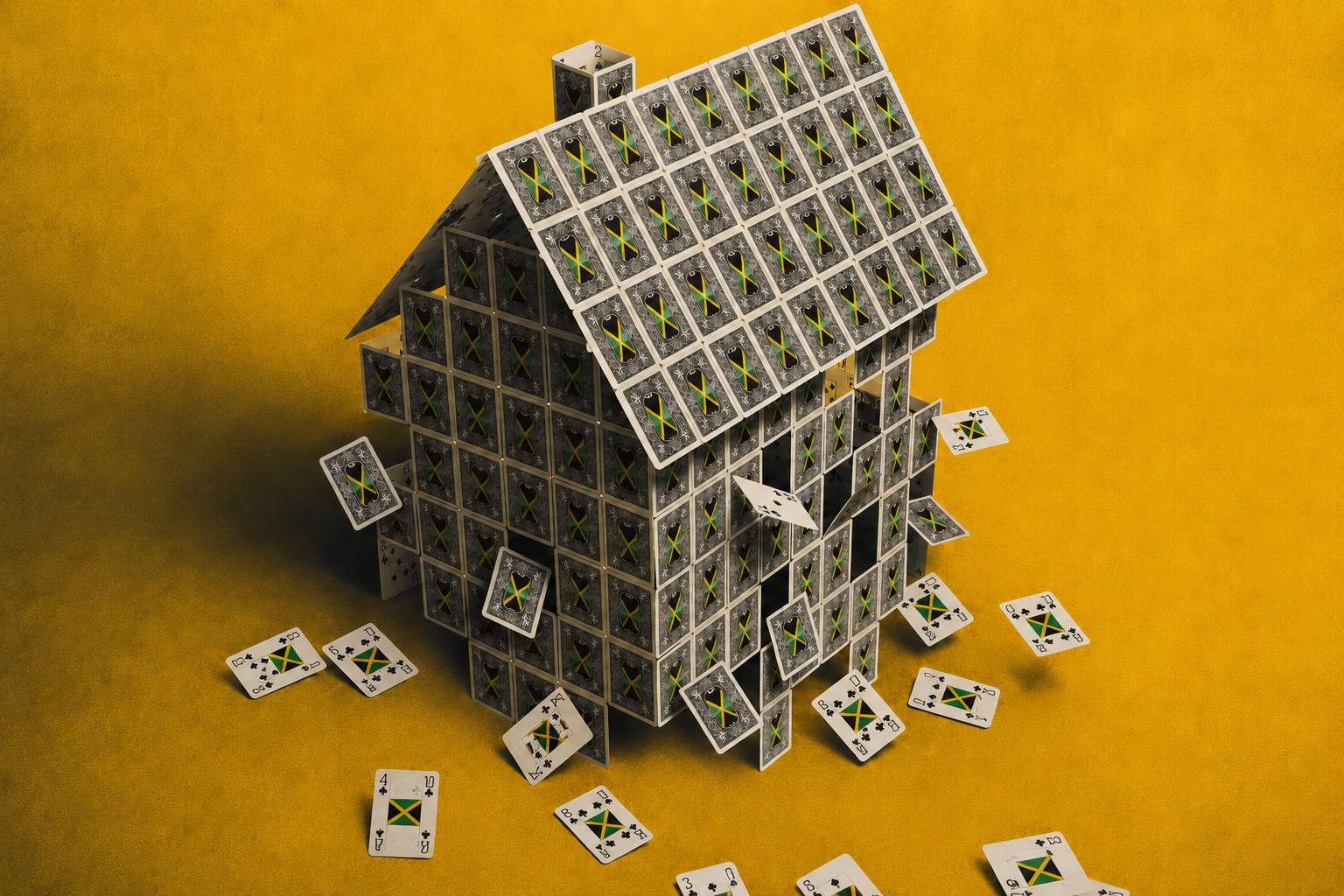
There is a Jamaican expression — “hard time no easy” — that captures something the economists’ spreadsheets never quite manage to convey. The hardship is not abstract. It is the contractor who has not had a new build commission since 2010. It is the developer with a completed townhouse scheme that has been 40 percent unsold for three years. It is the estate agent who has reduced her listing fees twice and is considering a third reduction just to keep clients. It is, above all, the prospective first-time buyer who earns just enough to almost qualify for a mortgage, who watches the NHT balance accumulate and the qualifying property list grow shorter, and who has concluded that homeownership is a destination that keeps moving further away no matter how fast they walk toward it. That is Jamaica’s property market in the summer of 2014. And understanding it requires first reckoning with the extraordinary thing that happened to Jamaica’s economy in 2013.
In May 2013, after months of fraught negotiation and two debt restructurings in four years, Jamaica signed a four-year Extended Fund Facility agreement with the International Monetary Fund. It was not the first time Jamaica had turned to the Fund — this was the fourteenth IMF programme in the country’s post-independence history. But it was arguably the most consequential, because the conditions it imposed were among the most demanding ever agreed by a Caribbean economy, and because the alternative — a disorderly debt default that would have severed Jamaica from international capital markets entirely — was genuinely credible. The government that signed was not doing so from a position of strength. It was doing so because there was no other viable path.
The programme’s centrepiece was a primary budget surplus target of 7.5 percent of GDP. To maintain that surplus, the government cut expenditure across virtually every budget line, froze public sector wages, and accelerated tax collection initiatives. The fiscal adjustment was rapid and deep. And its effect on a domestic economy that was already fragile — GDP had contracted by approximately 0.2 percent in fiscal year 2012/13 and grew by only 0.2 percent in calendar year 2013 — was precisely what you would expect: it made a weak situation weaker before the programme’s stabilising effects could take hold.
Reckoning With 2013: The Year Everything Stopped
The property market of 2013 is best understood as a market in suspended animation. The debt crisis that had been building since 2008 had finally produced its defining institutional response — the IMF programme — but that response, necessary as it was, came with a transitional cost that the property market absorbed with particular acuity. Mortgage rates were still high. Building society rates through 2012 had been running at around 10.2 percent. Commercial bank mortgage rates were closer to 10.5 percent. At those rates, on a J$10 million loan over twenty years, a borrower was committing to monthly payments of approximately J$96,500-J$99,000 — figures that, against the income levels prevalent in the Jamaican formal sector, excluded a substantial majority of potential buyers from formal mortgage finance.
The NHT — that great constant of the Jamaican housing market, the institution that has financed more Jamaican homes than any other single entity — was lending at administered rates that remained well below commercial market levels, but its loan ceiling of J$4.5 million had been eroded by years of construction cost inflation to the point where it could finance only the most modest of new builds or the purchase of small, older properties in secondary locations. The gap between what the NHT could offer and what a decent new townhouse actually cost was not a gap that most NHT contributors could bridge from personal savings. It required supplementary borrowing at commercial rates, and the arithmetic of stacking an NHT loan at 3-6 percent with a top-up from a building society at 10-plus percent rarely produced an affordable combined payment.
Construction sector activity, which is perhaps the most direct proxy for property market vitality, was running well below its pre-crisis levels. Real estate and construction together had been growing at roughly 36 percent in nominal terms in the boom year of 2006-07 and at around 30 percent in 2008. By 2010 they had collapsed to single-digit growth. By 2012-2013, construction starts were minimal. Developers who had committed to schemes before the crisis were either completing them slowly, using the minimum possible capital to avoid throwing good money after bad, or sitting on land banks and hoping that the market would eventually return.
The Debt Number That Defines This Moment
Jamaica’s public debt in 2013 stood at approximately 150 percent of GDP. Write that number out and contemplate what it means. For every dollar that the Jamaican economy produces in a year, the government owes one dollar and fifty cents to its creditors — domestic holders of government bonds, international bondholders, multilateral institutions, bilateral lenders. The interest on that debt consumes, in years of high borrowing costs, more than half of government revenue. Every year that the government runs a primary surplus, the numerator of the ratio falls. Every year that GDP grows, the denominator of the ratio rises. But when the numerator starts at 150 and the denominator grows at less than 1 percent per year, the mathematics of debt reduction are unforgiving.
What does this have to do with property? Everything. Because the government’s fiscal constraint is the economy’s fiscal constraint. Every Jamaican dollar directed toward debt service is a dollar not spent on the road network that serves the housing scheme, the hospital that makes a new suburb liveable, the school that makes a neighbourhood attractive to young families, the capital project that creates employment and income and mortgage-servicing capacity in the households that would otherwise buy property. The debt is not an abstraction. It is the negative space around every development that did not happen, every buyer who could not qualify, every seller who could not sell at the price they needed.
The second debt exchange — Jamaica’s second restructuring of its domestic debt obligations since 2010 — was completed in early 2013 as part of the conditions for the IMF programme. Domestic bondholders, including the building societies and commercial banks whose balance sheets were heavily weighted toward government paper, accepted extended maturities and reduced coupons in exchange for programme support and the avoidance of a disorderly default. The exchange dampened yields on government securities, which in turn created modest pressure on the financial institutions to find alternative uses for their capital — pressure that would, over time, manifest as a gradual reduction in commercial lending rates. But in 2013, the transmission was slow. The benefit had not yet arrived.
What GDP Growth of 0.5 Percent Actually Feels Like
Jamaica’s economy is projected to grow by approximately 0.5 percent in fiscal year 2014 — an improvement on the near-stagnation of 2013, but a figure that translates into lived experience of almost zero improvement. At 0.5 percent real GDP growth, the economy is outrunning its own depreciation only marginally. The formal sector is not creating jobs at a meaningful rate. Unemployment, which peaked above 16 percent in 2012, remains near those levels with only the most tentative improvement. A generation of young Jamaicans is either informal-sector employed or emigrating, and neither outcome is particularly good news for domestic property demand.
The sectors that do show activity in 2014 are instructive. Tourism is recovering, slowly: stopover arrivals are returning after the sharp shock of 2009, and the tourism plant is gradually refilling after years of sub-capacity operation. Where tourism strengthens, the resort corridor property markets in Montego Bay, Ocho Rios, and Negril show tentative life — not yet a genuine recovery, but the sense of an industry beginning to refill and, with it, to generate demand for staff housing, hospitality-adjacent residential property, and the villa and vacation rental segment. Mining and logistics sectors show resilience. The business process outsourcing sector — call centres and shared service operations — has been a consistent source of formal employment in the Kingston metropolitan area, and its continued expansion is quietly doing more for the residential rental market than most observers acknowledge.
But these positive micro-trends are insufficient to offset the macro-headwinds. The household that is considering a property purchase in mid-2014 is doing so in an environment of constrained wages, expensive credit, uncertain job security, and a government that is, by design, withdrawing fiscal stimulus from the economy. It is not an environment that encourages the largest financial commitment most Jamaican families will ever make.
The Geography of Stagnation
Property markets never stagnate uniformly, and Jamaica’s is no exception. The patterns that emerge in 2014 are the seeds of the differentiation that will define the recovery when it finally comes.
The upper end of the Kingston market — the large family homes in Barbican and Cherry Gardens, the gated developments in the hills, the premium New Kingston apartments — is effectively frozen. These properties have not collapsed in price; they have simply stopped transacting with any regularity. Their owners, who typically have other financial resources and are not forced sellers, are holding. Their potential buyers — the senior executive class, the diaspora retirees, the successful entrepreneur — are not under urgent pressure to buy, and in an environment of uncertainty they are choosing not to. The result is a market where advertised prices remain aspirational but actual transactions are rare, and the few that do occur happen at significant discounts to the ask that are rarely publicised.
The middle market is where the squeeze is most acute. The townhouse schemes that proliferated in the 2004-2008 development boom — three-bedroom townhouses in managed communities across Kingston, St Andrew, and St Catherine, priced in the J$8-15 million range — carry inventory that developers are trying, with limited success, to clear. The buyers for these properties are the professional middle class: the teacher, the nurse, the mid-level civil servant, the bank manager. These buyers have NHT contributions. Some have modest savings. But their income levels, in a period of wage freeze and high mortgage rates, do not produce mortgage qualifying calculations that close the gap between what they can borrow and what these properties cost.
The affordable housing segment — properties below J$6 million, primarily in secondary locations and older stock — is paradoxically the most active part of the formal market, because the NHT’s subsidised rates make financing at this level workable. But the supply of quality affordable housing is constrained by the impossibility, at current construction costs, of delivering new product at these price points without significant subsidy. The affordable housing market is clearing through the sale of existing stock, not new supply. And existing stock of quality affordable housing is finite.
Construction: The Industry That Has Not Come Back
Perhaps no single sector tells the story of Jamaica’s property market in 2014 as starkly as construction. The industry that experienced nominal growth of more than 36 percent in 2006-07 — a number that reflects both the volume of activity and the inflation in materials and labour that accompanied it — has been operating at a fraction of that level for the better part of six years. The skilled tradespeople who built Jamaica’s boom-era housing stock have dispersed: some into the informal economy, some into the construction sectors of Trinidad and the BVI and the Caymans where activity has been stronger, some simply out of the trade.
The consequence is a capacity problem that is not yet visible because demand is suppressed, but that will become acutely visible the moment demand recovers. Jamaica does not currently have the trained workforce, the established supply chains, or the capitalised development companies to respond quickly to a recovery in housing demand. The construction industry, like a house that has been left empty too long, will need a period of rehabilitation before it can function at full capacity again. The implication for the recovery, when it comes, is that supply will struggle to keep pace with demand — and the combination of pent-up demand and constrained supply is precisely the set of conditions that historically produces rapid price appreciation.
The International Context: Global Rates and Their Jamaican Implications
Jamaica’s property market does not exist in isolation from global capital markets, and the global interest rate environment of 2014 is relevant to the Jamaican story in ways that are not always appreciated. The major central banks — the US Federal Reserve, the Bank of England, the European Central Bank — have been running extraordinarily accommodative monetary policies since 2008-2009, driving their policy rates to near-zero or zero. This has compressed global yields, made international capital cheap, and — for Jamaica’s government — made international bond issuances at tolerable rates possible even in the context of a deep fiscal crisis.
For the property market, the global low-rate environment matters most through two channels. First, it has kept the cost of Jamaica’s external debt manageable at a time when the domestic fiscal situation was most precarious. Second, and more directly, it has influenced the investment calculus of the diaspora. A Jamaican who moved to Toronto in 1995 and has accumulated savings in a Canadian bank account earning less than 2 percent annually is, in principle, an investor looking for better returns. Jamaican properties that generate rental yields of 6-8 percent in US dollar terms are mathematically attractive compared to Canadian savings rates. The question is whether the non-financial risks — management, maintenance, currency, political stability — are sufficiently controlled to make the investment rational. In 2014, for most diaspora investors, the answer is still probably not. But the conditions are slowly improving.
The Prediction for 2015: Pain Before Progress
The honest forecast for 2015 is not a cheerful one, and this column will not manufacture optimism that the evidence does not support. The IMF programme will be in its third year in fiscal year 2015/16. The primary surplus requirement remains in place. The fiscal adjustment is not yet complete. GDP growth, while projected to improve marginally, will remain insufficient to generate meaningful employment growth or to produce the household income increases that would fundamentally shift mortgage affordability. The property market, in volume terms, will continue to move slowly.
But there are two specific developments that will move the market in the right direction in 2015, and both are worth naming explicitly because they will compound in their effect over time.
First, mortgage rates will continue to fall. Building society rates will move from their current 9.7 percent level toward 9.5 percent, and possibly lower. Commercial bank rates will follow. The Bank of Jamaica’s policy rate easing, measured and careful as it has been, is creating conditions in which the cost of formal mortgage credit will, by the end of 2015, be lower than at any point in the post-crisis period. Each reduction is small. Their cumulative effect is not.
Second, the NHT’s loan parameters will improve. The ceiling of J$4.5 million has been discussed for revision for two years; the political logic of demonstrating programme benefits to working Jamaicans is compelling, and an improvement in the NHT’s loan terms is one of the few housing market interventions that does not require fresh fiscal expenditure. When it comes — and this observer’s view is that it will come before the end of 2015 — it will expand the buyer pool for the mid-market in a meaningful way.
2015 will be a year of preparation, not celebration. The market will not recover in 2015. But in 2015, the conditions for a genuine recovery — not a false dawn, but a structural improvement that is visible in transaction volumes and price appreciation across multiple segments — will fall into place. The foundation is being poured. It will not be visible from the street for another year or two. But when the structure above it rises, those who understood what was happening beneath it will not be surprised.
Advice for the Brave
In a market this subdued, the instinct is to wait. Sellers are waiting for buyers who seem never to arrive. Buyers are waiting for prices to fall further before committing. Developers are waiting for sentiment to improve before starting new phases. The waiting is understandable. It is also, in many cases, the wrong strategy.
The properties that will appreciate most sharply when the market turns are not the ones that go on the market after the turning point is obvious to everyone. They are the ones acquired now, in the uncertainty, at prices that reflect the current market’s caution rather than the future market’s confidence. The buyer who acts in 2014 in a well-chosen location — who ignores the noise of a slow market and focuses on the signal of improving fundamentals — will be sitting on a materially better return five years hence than the buyer who waits for the headlines to confirm what the structural analysis already suggests.
Hard time no easy. But hard time does end. And when it does, the people who were brave enough to build during it will find that they built something that was worth the courage it took. Jamaica’s property market has survived worse than this. It will survive this too. The question is simply whether you will be in it when it does.
Discover more from Jamaica Homes News
Subscribe to get the latest posts sent to your email.
