

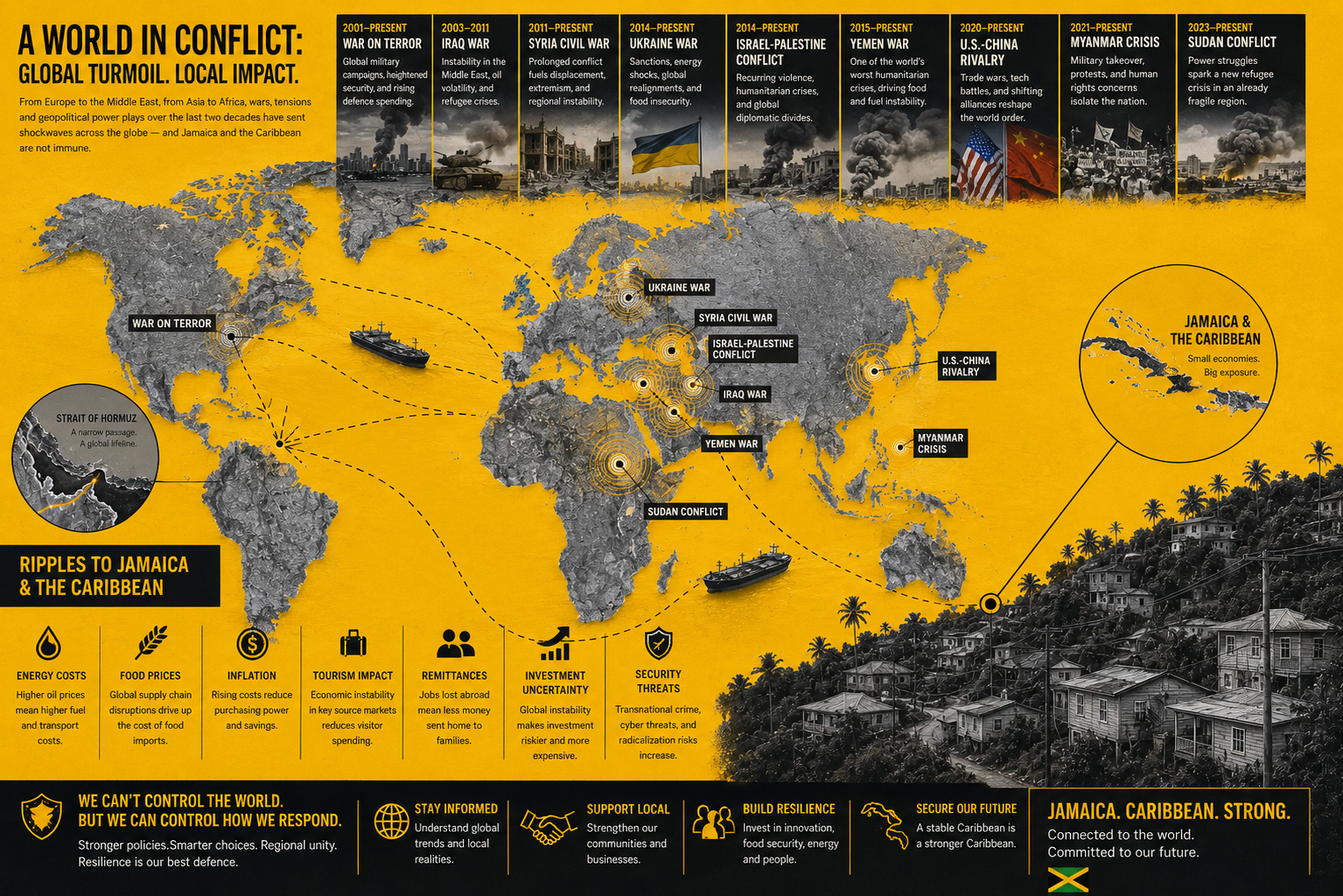
Jamaica Homes Global Conflict & Caribbean Impact Review | Published 3 April 2018 | Reporting Period: 3 January – 2 April 2018
Quarterly Briefing
- Syrian government forces and allied Russian aircraft conduct a sustained aerial and artillery assault on Eastern Ghouta from February, killing over a thousand civilians in one of the war’s worst episodes of urban bombardment.
- Russian intelligence officers use the nerve agent Novichok to poison former spy Sergei Skripal and his daughter in Salisbury, England, on March 4; the attack triggers the largest coordinated expulsion of Russian diplomats since the Cold War.
- Venezuela’s economic collapse deepens into hyperinflation exceeding 1,000 per cent annually; President Maduro launches the Petro, a government cryptocurrency ostensibly backed by oil reserves.
- North Korean athletes participate in the Winter Olympics in PyeongChang, South Korea, under a unified Korean flag in February; diplomacy resumes and a North-South summit is announced for April.
- Saudi Arabia’s Crown Prince Mohammed bin Salman begins a tour of Western capitals in March, presenting himself as a modernising reformer while the Yemen war and the anti-corruption purge continue.
- The PETROCARIBE corruption scandal gathers momentum in Haiti as a Senate report accuses the government of misusing billions in Venezuelan oil fund money intended for development projects.
Prologue: Brutality, Poison and the Search for Order
The first quarter of 2018 was a reminder that the international system’s capacity for organised brutality had not diminished. Syria’s government, backed by Russian airpower, chose to resolve the problem of an encircled rebel enclave by reducing it to rubble and killing the civilians inside. Russia chose to assassinate a man in an English market town using a weapon of mass destruction deployed on a NATO ally’s soil. Venezuela chose to address its currency’s total collapse by creating a digital currency whose credibility rested on the promise of the same government that had destroyed the previous one. Only in the Korean Peninsula did the quarter yield something resembling hope: athletes marching together under a flag of unity, followed by the announcement of diplomatic talks. For Jamaica and the Caribbean, the quarter reinforced the chronic pressures of the preceding years: oil prices moving higher, Venezuela’s crisis deepening and the PETROCARIBE arrangement’s corruption coming into sharper focus.
The Siege of Eastern Ghouta
Eastern Ghouta, a suburb east of Damascus that had been under rebel control since 2013 and besieged since 2013, came under sustained assault from 18 February 2018. Syrian government forces, supported by Russian aircraft, conducted what the UN described as the most intense bombardment of any civilian area since Aleppo fell in December 2016. Over 1,000 civilians were killed in the first weeks of the offensive. The UN Security Council passed Resolution 2401 on 24 February demanding a 30-day ceasefire; the Syrian government and Russia disregarded it. By late March, the enclave’s defenders had surrendered and its civilian population was evacuated to opposition-held territory in the north.
For the international community, the Ghouta assault demonstrated that the Security Council’s ceasefire resolutions carried no enforcement weight when Russia held a veto. For the Caribbean, where small states have a direct institutional interest in international law’s effectiveness — the same frameworks that protect their sovereignty from larger neighbours — the impunity with which the resolution was violated was a concern that transcended the immediate humanitarian catastrophe.
Salisbury and the Skripal Poisoning
On 4 March 2018, Sergei Skripal — a former Russian military intelligence officer who had spied for the UK and been exchanged in a 2010 spy swap — and his daughter Yulia were found unconscious on a bench in Salisbury, England. They had been poisoned with Novichok, a nerve agent developed by the Soviet Union. UK authorities concluded that Russian state actors were responsible. Prime Minister Theresa May gave Russia’s ambassador an ultimatum; Russia’s response was contemptuous denial. The UK expelled 23 Russian diplomats, and in a coordinated Western response, over 25 countries expelled more than 150 Russian diplomats in total — the largest mass expulsion since the Cold War. Russia retaliated in kind.
The use of a chemical weapon on British soil represented a qualitative escalation of Russian state behaviour in Western countries and reinforced the broader climate of confrontation between Russia and the West that had defined the post-Crimea period. For Caribbean diplomacy, the episode forced a choice of alignment: small states that maintain good relations with all major powers found themselves navigating an environment increasingly demanding of explicit positions on Russia’s conduct.
Venezuela: Hyperinflation and the Petro
Venezuela’s economic deterioration reached new extremes in the first quarter of 2018. The International Monetary Fund estimated annual inflation at over 13,000 per cent; the official estimate was lower but the black-market exchange rate for the Bolívar told a different story. Food and medicine shortages were severe; the emigration of Venezuelans — by some estimates 1.5 million had left by early 2018 — was accelerating into what the UN characterised as a refugee crisis of hemisphere-wide proportions. President Maduro’s government launched the Petro in February 2018: a government-issued cryptocurrency ostensibly backed by Venezuela’s oil reserves and designed to circumvent US sanctions. International financial institutions, the United States and most economists dismissed the Petro as an unconventional attempt to raise revenue without reforming the underlying economy.
For the Caribbean, Venezuela’s collapse had direct implications through PETROCARIBE. The programme’s operational capacity was deteriorating as Venezuelan production fell: in the first quarter of 2018, Venezuela was producing fewer than 1.5 million barrels per day, down from 3 million in 2014. Countries that had accumulated deferred payment obligations under PETROCARIBE faced the question of what those obligations represented and to whom they were owed as Venezuela’s political and financial situation became more complex. Haiti’s PETROCARIBE scandal — in which a Senate report alleged that over $2 billion in oil funds had been misused by successive governments — added a regional governance dimension to the energy crisis.
Korean Peninsula Diplomacy
The most unexpectedly positive development of the quarter came from the Korean Peninsula. North Korean athletes participated in the Winter Olympics in PyeongChang, South Korea, in February under a joint Korean flag. The two Koreas marched together at the opening ceremony. High-level meetings followed; in late March, South Korea announced that a summit between South Korean President Moon Jae-in and North Korean leader Kim Jong-un had been agreed for April, and that Kim had expressed willingness to meet with President Trump to discuss denuclearisation. The sudden diplomatic opening followed a year of extreme tension — multiple North Korean ballistic missile tests and a hydrogen bomb test in September had seemed to bring the peninsula to the brink of military conflict. Whether the diplomatic opening reflected a genuine change in North Korea’s strategic calculus or was a tactical manoeuvre remained deeply unclear.
Looking Ahead
The US-Iran nuclear deal’s fate is the most consequential pending question for oil markets: President Trump has set a May 12 deadline for European partners to agree to strengthen the deal or he will reimpose sanctions. The outcome will directly affect energy prices and Caribbean import costs. The Korean diplomacy will be tested by the inter-Korean summit in April and any subsequent US-North Korea meeting. Syria’s war continues with the government now controlling most of the Damascus suburbs but with the north, east and chemical weapons questions unresolved. And Venezuela’s trajectory continues downward, with its elections scheduled for May in circumstances that most of the world will not accept as legitimate. Jamaica enters the second quarter of 2018 with a firm macroeconomic foundation and a tourism sector performing well, but dependent on a global environment that remains fraught.
Jamaica Homes Global Conflict & Caribbean Impact Review is published quarterly, examining how wars, geopolitical tensions and major international crises have shaped Jamaica, the Caribbean and their economies.
Discover more from Jamaica Homes News
Subscribe to get the latest posts sent to your email.
