

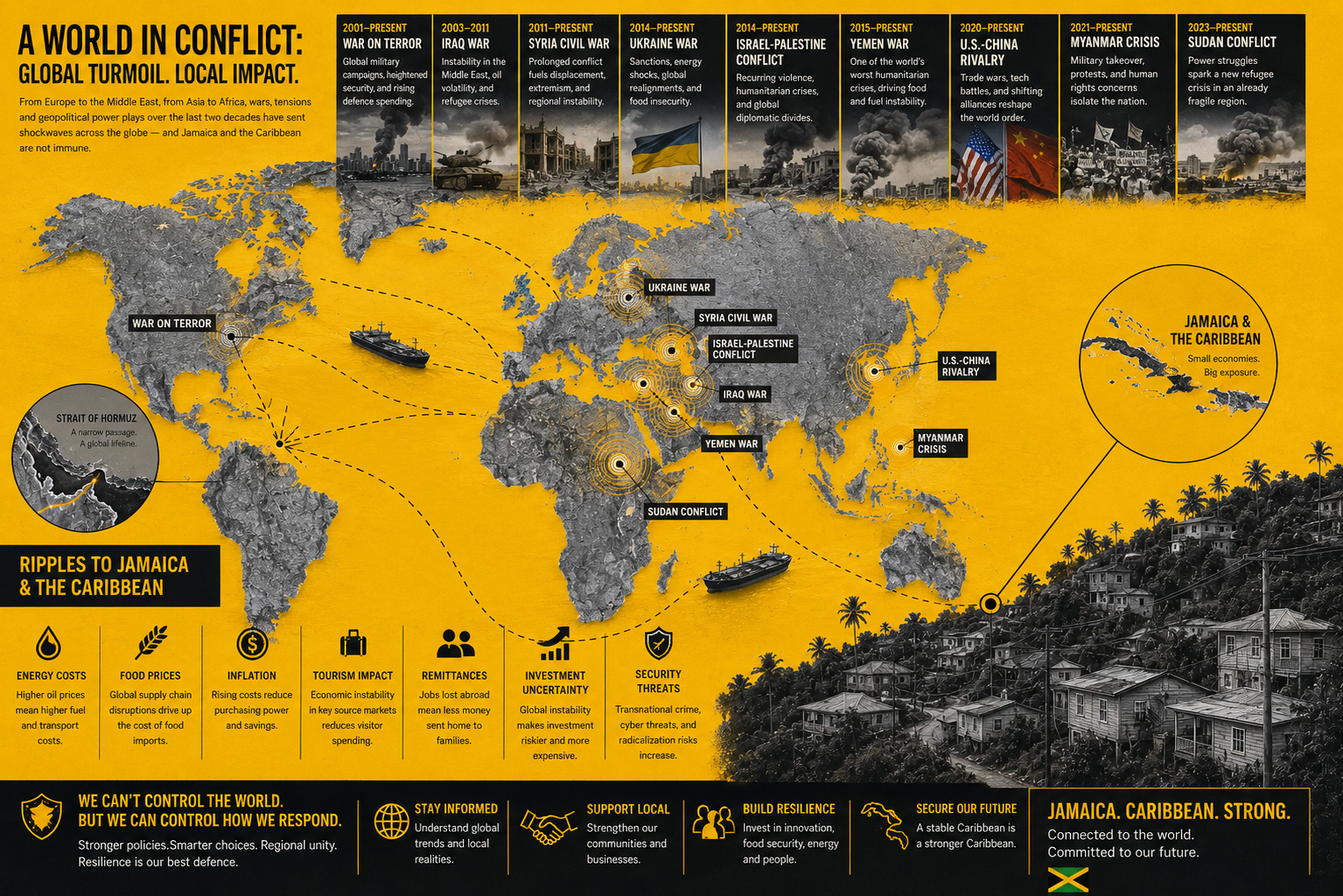
Jamaica Homes Global Conflict & Caribbean Impact Review | Published 3 October 2022 | Reporting Period: 3 July – 2 October 2022
Quarterly Briefing
- Ukraine launches a stunning counteroffensive in September, retaking most of Kharkiv Oblast in days.
- Putin orders partial mobilisation of 300,000 reservists on September 21; hundreds of thousands of Russians flee.
- Russia annexes four Ukrainian regions on September 30; a UN General Assembly vote condemning the move is imminent.
- Sri Lanka’s President Rajapaksa flees after protesters storm the presidential palace in July; the country has formally defaulted on its foreign debt.
- Iran erupts in protest following the death of Mahsa Amini in morality police custody on September 16.
- Jamaica’s fuel costs hit record levels; the Bank of Jamaica raises rates aggressively to combat double-digit inflation.
Prologue: The War Escalates, the World Wobbles
The third quarter of 2022 produced the most dramatic reversals of the Ukraine war to date and ended with Russia making its most provocative political move since the invasion began: the formal annexation of four occupied Ukrainian regions. It also saw the complete economic collapse of Sri Lanka, the assassination of Japan’s longest-serving prime minister, the beginning of a major protest movement in Iran and the sabotage of a critical European energy pipeline. For Jamaica and the Caribbean, the quarter was defined above all by its consequences at the pump: fuel prices reached record levels, and the inflationary shock from the Ukraine war — now seven months old — was grinding through every sector of the economy from construction to food prices to household utilities.
Ukraine’s Counteroffensive and Russia’s Desperate Response
Beginning in early September, Ukrainian forces launched a rapid armoured offensive in the Kharkiv region that caught Russian forces extended and vulnerable. Within two weeks, Ukraine recaptured more than 6,000 square kilometres of territory, including the city of Izyum — a key Russian logistics hub — and effectively retook most of Kharkiv Oblast. The speed was unprecedented: Russian forces abandoned positions, equipment and supplies in a retreat that drew comparisons to the collapse of Soviet-backed armies in earlier conflicts. The Kharkiv offensive was Ukraine’s most significant military success since the Battle of Kyiv in March and demonstrated that Western-supplied weapons were producing decisive battlefield results.
The reversal triggered an extreme political response from Moscow. On 21 September, Putin announced the “partial mobilisation” of 300,000 military reservists — Russia’s first wartime mobilisation since World War Two. The announcement triggered one of the largest waves of emigration in Russia’s modern history: hundreds of thousands of Russians of fighting age crossed into Finland, Georgia, Kazakhstan and other neighbours within days. The mobilisation fundamentally changed the war’s character inside Russia — from a distant “special military operation” to something that now visibly reached into Russian households.
On 30 September, Putin staged annexation ceremonies for Donetsk, Luhansk, Zaporizhzhia and Kherson oblasts, declaring them Russian territory and warning he would defend them “with all available means” — a barely veiled nuclear threat. The move was made despite Russia not fully controlling any of the four regions. The UN General Assembly is preparing a condemnation vote as this edition is published. The Caribbean Community’s consistent support for sovereignty and international law norms will be reflected in how CARICOM nations vote.
Nord Stream Sabotage
On 26 September, the Nord Stream 1 and Nord Stream 2 pipelines beneath the Baltic Sea suffered simultaneous ruptures recorded as explosions by seismic stations across Scandinavia. Both pipelines — carrying Russian natural gas to Germany — released massive methane plumes. European officials described the damage as deliberate sabotage. Responsibility remains unestablished at the time of publication. The incident effectively removed Nord Stream as a potential route for resumed Russian gas exports and cemented Europe’s energy restructuring as permanent rather than temporary. For the Caribbean, the attack on subsea infrastructure established a precedent with implications for the region’s own LNG import terminals and planned undersea electricity cables.
Sri Lanka: The Warning Caribbean Economies Must Hear
Sri Lanka’s economic crisis reached its climax on 9 July, when protesters who had been gathering for months stormed the presidential palace in Colombo. President Gotabaya Rajapaksa fled first to the Maldives and then to Singapore, resigning by email. The country had run out of foreign exchange. Fuel queues stretched for kilometres. Hospitals lacked medicines. Inflation exceeded 50 per cent. Sri Lanka had formally defaulted on its foreign debt in April — the first default in the country’s modern history.
The causes were multiple but familiar: COVID’s devastation of tourism revenues, unsustainable government borrowing, an abrupt agricultural policy reversal that damaged food production, and the commodity price spike from Ukraine that drove fuel and food import costs beyond the government’s capacity to pay. Caribbean policymakers studied the Sri Lanka collapse with uncomfortable recognition. Jamaica, Barbados and Trinidad share the island’s profile of tourism dependence, fuel import exposure and diaspora remittance reliance. Jamaica’s decade of IMF-supervised fiscal consolidation provided a degree of buffer that Sri Lanka lacked. But the lesson was clear: no island economy is immune to a severe enough confluence of global shocks.
Iran’s Protest Movement and Middle East Tensions
Mahsa Amini, a 22-year-old Kurdish-Iranian woman, died in a Tehran hospital on 16 September 2022, three days after being arrested by the morality police for allegedly wearing her hijab incorrectly. Her death triggered protests that spread from Kurdish northwestern cities to universities and streets across Iran within days. The slogan “Woman, Life, Freedom” captured a challenge that went beyond clothing enforcement to the foundations of the Islamic Republic’s governance. As of October 3, the protests are intensifying, security forces are firing live rounds, and the government has cut internet access across affected areas. The ultimate scope of the movement is not yet clear, but it is already the most significant internal challenge to the regime in decades.
For Jamaica and the Caribbean, Iran’s significance is the oil price channel. Iran produces approximately 2.5 million barrels per day. Any sustained disruption to Iranian production — or any escalatory Western response through sanctions tightening — would reduce global supply and spike Caribbean fuel import costs further. Oil markets were watching Tehran closely throughout September.
Jamaica: Record Fuel Costs and Rate Rises
Jamaica entered October 2022 in the grip of its worst inflationary episode in a generation. Fuel prices at the pump reached historic highs through the quarter, driven by global oil markets responding to the Ukraine war, OPEC production discipline and post-COVID demand. The government implemented fuel subsidies and electricity relief measures, but with limited fiscal space these could only partially offset the household impact. Food prices — particularly flour, cooking oil and animal feed — reflected Ukraine’s role as a global breadbasket now disrupted by war.
The Bank of Jamaica accelerated its monetary tightening, raising the policy rate to combat annual inflation that exceeded 10 per cent. The tightening was necessary to anchor inflation expectations but created direct headwinds for housing and real estate: mortgage rates rose, construction financing became more expensive, and buyer affordability compressed. Developers reported slower sales in some segments. Remittances from the North American diaspora provided a meaningful buffer, with flows from the United States and Canada tracking above pre-pandemic levels and helping households absorb the cost-of-living shock.
Looking Ahead
The fourth quarter of 2022 opens with Ukraine’s war entering a new and more dangerous phase: Russia mobilising additional troops, threatening nuclear use over annexed territories, and European infrastructure sabotaged. Iran’s protest movement is two weeks old with its trajectory uncertain. Energy markets face OPEC’s next production decisions imminently. For Jamaica, the question is whether global commodity prices will ease enough through the northern hemisphere winter to allow inflation to begin its descent. The signs are mixed. The risks remain heavily weighted to the downside.
Jamaica Homes Global Conflict & Caribbean Impact Review is published quarterly, examining how wars, geopolitical tensions and major international crises have shaped Jamaica, the Caribbean and their economies.
Discover more from Jamaica Homes News
Subscribe to get the latest posts sent to your email.
