

Key Highlights
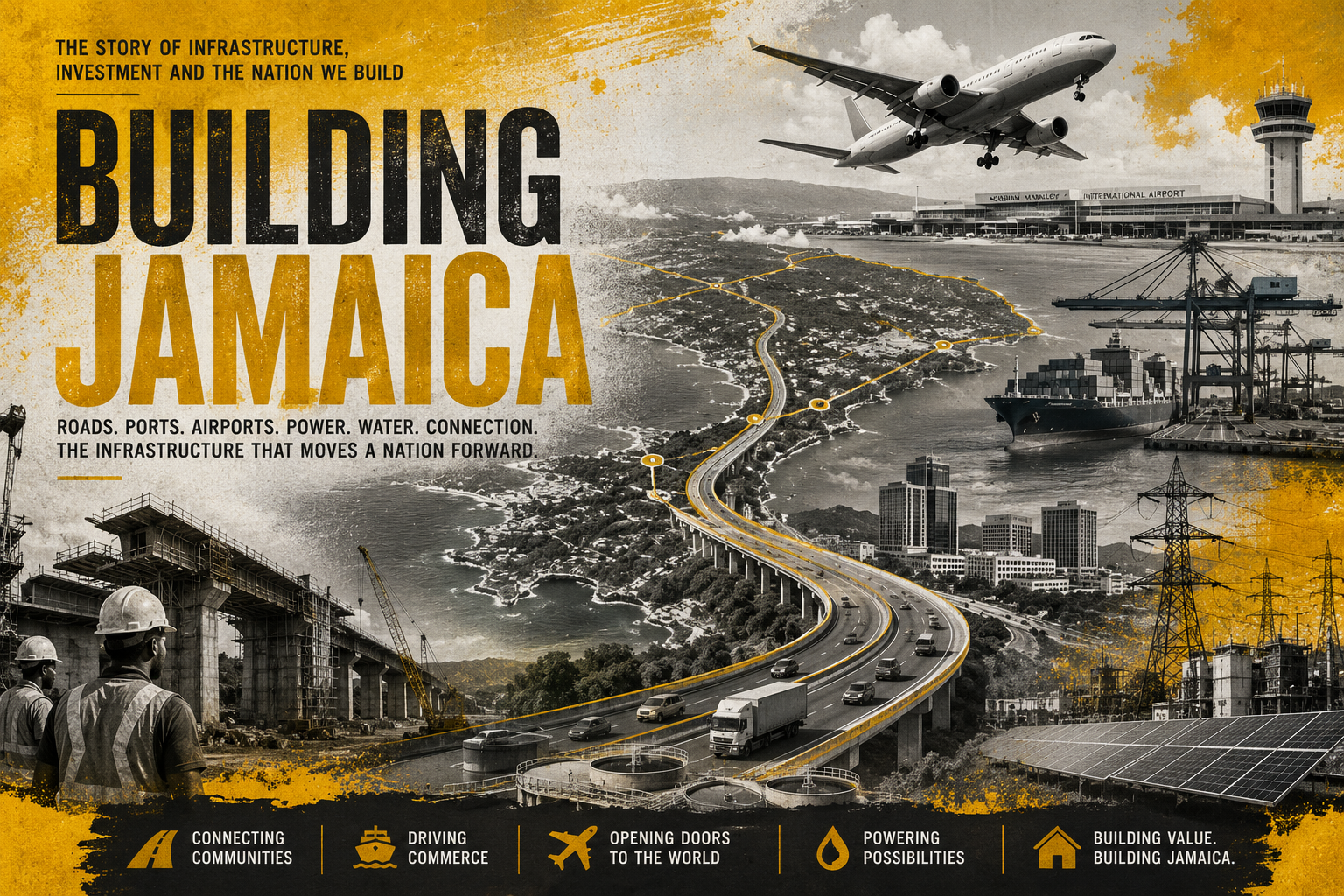
- Road spending rose 52% in real terms — but 90% came from external loans
- Fewer than one in five paved roads meets an acceptable condition standard
- Portmore’s population is growing at 4% a year, straining its sole route to Kingston
- Housing and water investment rises to 1.8% of GDP, up from 1.3% two years prior
- The National Housing Trust remains the island’s dominant mortgage provider
- Financial sector stress threatens to suppress the private investment that housing needs
Every morning, before the sun has fully cleared the Blue Mountains, the road out of Portmore begins to fill. Workers, schoolchildren, shopkeepers and civil servants file through the causeway that connects the largest planned housing settlement in the English-speaking Caribbean to the capital it was built to serve. The journey should take fifteen minutes. On most mornings in early 1995, it takes considerably longer. The Portmore causeway — a narrow strip of road crossing the salt marshes and tidal flats of Kingston Harbour’s western arm — is the single arterial connection between a city of more than 100,000 people and the jobs, markets and services that justify its existence. It carries a volume of traffic it was never designed to bear, and the gap between what it can accommodate and what it is asked to carry grows a little wider with every thousand residents who move to Portmore in search of affordable housing.
The story of Portmore is, in one reading, one of Jamaica’s most remarkable post-independence achievements: a city conjured from reclaimed swampland and populated, over roughly two decades, by working-class Jamaicans who could not afford to live closer to Kingston’s centre. In another reading, it is a cautionary account of what happens when housing policy advances faster than transport planning — when the political urgency of putting roofs over heads runs ahead of the engineering necessity of providing the roads, bridges and utilities that make those roofs liveable. Both readings are correct. And as Jamaica enters the first months of 1995, the tension between them is precisely the story the country’s infrastructure most urgently needs to tell.
The City Built on a Promise
Portmore’s origins are in the housing pressures of late-1960s Kingston, when the West Indies Home Contractors — known across the island as WIHCON — began developing a large area of reclaimed land on the western shores of Kingston Harbour into what would become Independence City, the first of the residential communities that now make up Portmore’s sprawling municipality. The land was cheap because it was marginal: low-lying, seasonally wet, exposed to the salt winds coming off the harbour and far enough from Kingston’s commercial centre to deter anyone who had a better option. Its very marginality made it available, and availability made it attractive to a government seeking large parcels of land on which to address the housing deficit that had been building in the capital since independence.
The development that transformed Portmore from a modest suburban experiment into the largest planned community in the English-speaking Caribbean came in the early 1990s, through an arrangement that illustrates how deeply Jamaica’s infrastructure investment has always depended on external finance. The Greater Portmore project — which brought 10,000 housing units to the area in a single development phase, with 14,000 ultimately planned — was financed through the San Jose Accord, a Jamaica-Venezuela bilateral agreement in which oil purchase loans were redirected into housing construction. Prime Minister Michael Manley, whose second administration carried a markedly different economic philosophy from his first, secured the arrangement as a means of addressing the housing deficit without drawing on fiscal resources that the government simply did not have. The result was the largest single housing construction programme the island had seen, executed in conditions — reclaimed swamp, a constrained site, a narrow access route — that a less politically urgent project would not have chosen.
By the time P.J. Patterson’s government entered 1995, Portmore’s population was growing at roughly four per cent annually. A settlement that had been largely empty farmland and tidal flats a quarter-century earlier now housed, by most credible estimates, more than 100,000 people. The number continues to rise. The infrastructure serving it has not risen at comparable pace.
The Road the City Needs and Does Not Have
The practical consequence of Portmore’s growth is most immediately visible at the causeway, but the transport challenge is more fundamental than any single bottleneck. A city the size of Portmore, serving the labour market of the Kingston Metropolitan Area, would, in any textbook of urban development, be connected to its anchor city by multiple road corridors, a functioning public transport system and, in many comparable international contexts, a rail link of some kind. Portmore in early 1995 has one primary road connection to Kingston and an informal transport system of route taxis and privately operated minibuses whose capacity, reliability and comfort are determined not by any planning authority but by the commercial judgement of individual operators.
The inadequacy of this arrangement is not news to the government or to the international lending institutions whose assessments shape Jamaica’s public investment priorities. The World Bank’s review of Jamaica’s public expenditure, currently being compiled from 1993-1995 data, finds that road spending increased by fifty-two per cent in real terms from 1991/92 to 1994/95 — a significant increase by any measure. The problem is not that the government has been spending less on roads. The problem is that it has been spending almost entirely with borrowed money. Capital B spending — the budget category that captures externally financed projects — rose to ninety per cent of total road expenditure by 1994/95, up from a share closer to sixty per cent at the beginning of the decade. Domestic resources — the treasury funds that can pay for routine maintenance, pothole repair and drainage clearing without the approval of a project committee in Washington or Bridgetown — have shrunk as a share of the total to near irrelevance. When the external project cycle pauses, when a donor disbursement is delayed, when a contract completion triggers a budget transfer that does not arrive on time, the maintenance that keeps a paved road from deteriorating into a potholed one simply does not happen.
The consequence is visible on almost any drive beyond the main arterials. Fewer than one in five of Jamaica’s paved roads meets an acceptable condition standard, according to the assessments available at the opening of 1995. The statistic carries a meaning that goes beyond engineering inconvenience. Roads that cannot be driven at safe speeds impose costs on every user: the farmer whose produce takes longer to reach the market; the worker whose daily commute absorbs an extra hour; the business whose delivery trucks require maintenance at twice the intended interval; the ambulance that cannot reach the hospital in the time the patient needs. These costs are real, substantial and disproportionately borne by communities furthest from the main corridors — which is to say, the communities that are also least able to absorb them.
Housing Investment: Progress and Its Limits
The increase in infrastructure spending that road numbers reflect has a counterpart in housing and water investment. Government allocations to housing, water supply, sanitation and urban infrastructure have risen from 1.3 per cent of GDP in 1993/94 to 1.8 per cent in 1994/95, with projections suggesting a further increase to 2.0 per cent in 1995/96. These are not trivial figures. They represent a genuine commitment, maintained through a period of significant fiscal pressure, to the physical fabric of communities across the island.
The National Housing Trust remains the structural foundation of this effort — the institution that, since its establishment on January 1, 1976, has served as Jamaica’s largest source of mortgage finance and the primary vehicle through which working-class Jamaicans acquire formal property rights. The NHT’s contributory model — in which mandatory payroll contributions from employers, employees and the self-employed accumulate into a fund available for mortgage lending — has proved its value precisely in the kind of environment Jamaica has been navigating: one in which government budget allocations are unreliable, commercial lending rates are prohibitively high for most household incomes, and the housing deficit compounds with each year of population growth. The Trust does not depend on the budget. It does not require a decision by the Minister of Finance to release its funds. It operates to its own rhythm, accumulating contributions and disbursing mortgages in a manner that is insulated, however imperfectly, from the cycles of fiscal austerity that have so comprehensively constrained almost every other dimension of Jamaica’s public investment.
What the NHT cannot do, however, is build roads, install water mains or run electricity lines to the communities where its housing schemes are developed. Those responsibilities rest with line ministries and statutory agencies whose capital budgets are precisely the ones most vulnerable to fiscal compression. The result, evident in Portmore and replicated in varying degrees across the NHT’s scheme portfolio, is a pattern in which housing supply runs ahead of supporting infrastructure — where the homes are built before the access road is improved, where the water connection is temporary at occupancy and permanent months or years later, where the electricity supply is adequate at scheme completion and stretched as the community grows.
The Financial Sector: An Infrastructure Risk No One Is Discussing
The infrastructure challenges Jamaica enters 1995 carrying are primarily physical — roads in poor condition, water coverage incomplete, transport systems informal. But there is a second layer of infrastructure risk that is financial rather than physical, and which, in the first months of 1995, is beginning to attract attention from analysts who watch Jamaica’s economic indicators closely.
The Jamaican financial sector in early 1995 carries the legacy of a credit expansion through the early 1990s that was not adequately supported by the institutional frameworks — supervision, capital requirements, loan classification standards — that would have given regulators confidence in the soundness of the portfolio being assembled. Interest rates in Jamaica in the mid-1990s are among the highest in the Caribbean, a reflection of the fiscal demands made by a government that has been borrowing heavily to service earlier debt and sustain public expenditure. High interest rates crowd out productive private investment. They make commercial mortgage lending unaffordable for any but the most creditworthy borrowers. They direct financial institution assets into government paper rather than into the productive loans that would generate the employment, income and tax revenue that could eventually bring interest rates down. The circle is not yet vicious — but it is tightening.
For the infrastructure sector, the practical implication of financial sector fragility is straightforward: private developers who might otherwise be building housing, commercial property or industrial facilities in the areas served by Jamaica’s improving road network cannot access capital on terms that make those projects viable. The gap is not filled by the NHT, which serves the mortgage market rather than the development finance market. It is not filled by development banks, which lack the capitalisation and deal flow to substitute for a functioning commercial lending market. It is left, instead, as a vacancy in the development pipeline that will eventually need to be addressed, at greater cost, when the financial environment improves.
Telecommunications and the Modernisation That Is Coming
Jamaica’s telecommunications infrastructure in the first quarter of 1995 is, by Caribbean standards, comparatively advanced in its architecture if not in its reach. Telecommunications of Jamaica, operating under the Cable and Wireless franchise, has been pursuing the digitalisation of its fixed-line switching network since 1991 and is making demonstrable progress toward what will eventually be a fully digital system. The practical meaning of digitalisation for the businesses and households that depend on telephone service is a substantial improvement in call quality, reliability and the capacity to support data services — a consideration that is beginning, even in 1995, to matter to the internationally oriented businesses that populate Jamaica’s free zones and tourism corridors.
The limitation of this modernisation is, as ever, geographic. Digital switching in Kingston and in the main urban centres is of limited benefit to communities in the rural parishes whose connection to the telephone network runs through ageing copper pairs and analogue equipment that digitalisation has not yet reached. A business in New Kingston communicating with a partner in Miami does so, in early 1995, through a system that is increasingly fit for purpose. A farmer in Westmoreland seeking to call a buyer in Kingston may still be navigating a connection whose reliability owes more to the condition of the line than to the technology in the exchange. The geography of telecommunications access in Jamaica maps, with uncomfortable accuracy, onto the geography of road access, water supply and every other infrastructure dimension: better in the urban centres, more variable as distance from the main corridors increases, and improving everywhere, but at a pace set by capital availability rather than by the pace at which communities grow and demand it.
The Port: Jamaica’s Quietly Growing Asset
Away from the daily frustrations of the morning commute and the engineer’s assessment of the secondary road network, one piece of Jamaica’s infrastructure enters 1995 performing precisely the function it was designed for, and doing so better than almost anyone had reason to expect when it was first conceived. The Kingston Container Terminal, created in 1975 on the natural harbour whose depth gives it an enduring geographic advantage over almost every other port in the Caribbean, is handling a growing volume of transshipment cargo as the container shipping industry’s inexorable shift toward larger vessels and fewer hub ports directs more traffic toward the deep-water facilities that can accommodate them.
The terminal’s performance in early 1995 is not merely a commercial success for the Port Authority of Jamaica. It is a demonstration, available to any investor or policymaker who cares to look for it, of the relationship between infrastructure quality and economic competitiveness. Kingston Harbour did not become one of the Caribbean’s leading transshipment facilities because of luck. It became one because a government decision, taken in 1975 under difficult economic circumstances, committed public investment to building a container terminal at a location whose natural characteristics — depth, geometry, proximity to the main east-west shipping lanes — made it capable of competing for cargo that shallower ports cannot handle. That decision is generating returns in 1995 that its architects could not have fully anticipated, in a global shipping market that has shifted decisively in its favour.
What This Means
For those tracking Jamaica’s infrastructure trajectory through the first quarter of 1995, the picture is one of genuine but uneven progress made fragile by the fiscal structures on which it depends. The government is spending more on roads and housing than it was three years ago — but is doing so almost entirely with money borrowed from international lenders rather than generated from domestic taxation. The NHT is providing the mortgage market with a stability that the commercial financial system, increasingly stressed, cannot offer — but the NHT cannot build the roads and utilities that make the homes it finances fully habitable. Portmore is growing faster than the infrastructure serving it, creating a daily demonstration of the gap between housing ambition and transport reality.
For homeowners and buyers, the Q1 1995 infrastructure picture reinforces a principle that has applied throughout Jamaica’s recent development history: property in well-connected locations commands a premium that is, at its root, a premium for infrastructure access. A house in a Portmore scheme with a reliable water supply, electricity connection and manageable commute to Kingston is worth materially more than a structurally identical house where the water is intermittent, the electricity connection temporary and the commute unpredictable. As Portmore’s population grows and its road constraints become more acute, the differential between properties with good connections and those without will widen. NHT mortgage holders in Portmore who took an affordable option in a peripheral location may find that the value of their investment tracks the quality of the infrastructure serving it more closely than they anticipated.
For developers, the combination of rising road spending and persistent road quality deficits creates a development calculus that favours locations already on the main corridors over those requiring new access investment. The risk of developing on the urban periphery — in communities dependent on a single access road, served by informal transport, awaiting utility connections that the budget may not fund on schedule — is real and increasing as the financial sector’s capacity to absorb underperforming assets diminishes.
For investors and businesses, the Kingston Container Terminal’s growing transshipment volumes are the clearest available signal that Jamaica’s infrastructure story is not uniformly discouraging. The terminal demonstrates that strategic public investment in the right location, at the right time, can create competitive advantages that persist for decades. The question for investment decisions in 1995 is which other infrastructure investments — in transport corridors, in industrial zones, in tourism facilities — might generate comparable returns over the medium term.
For policymakers, the dominant message from the first quarter of 1995 is the oldest one in the infrastructure planning literature: housing policy and transport policy must be designed together, or the consequences of designing them separately are paid by the communities that live in the gap between them. Portmore’s causeway is not merely a road. It is the physical expression of a planning decision — to build a city at a distance from its economic anchor without simultaneously building the transport infrastructure to connect them reliably — whose costs are being absorbed, every morning, by the 100,000 people who need to cross it.
Looking ahead from the first quarter of 1995, informed observers would identify two developments with the greatest potential to alter Jamaica’s infrastructure trajectory over the following six to eighteen months. The first is the outcome of the growing financial sector stress — whether the pressures building in Jamaica’s commercial banking and insurance sector prove manageable through regulatory intervention or escalate into a more disruptive correction that crowds out both public and private investment for an extended period. The second is whether the government can translate its increased road spending — real, significant, but almost entirely externally financed — into a durable maintenance programme funded from domestic revenue, of the kind that the World Bank’s public expenditure analysis has identified as the essential missing piece of Jamaica’s transport sector strategy. The answer to both questions will shape not only the road network Jamaica inhabits in 1996, but the property market, the communities and the economic geography of an island still in the process of building itself.
Follow Jamaica Homes on Youtube @jamaicahomes and Instagram @jamaica_homes and on Facebook @jamaicahomesnews Send us a message or email us at onlinefeedback@jamaica-homes.com or editor@jamaica-homes.com
Support independent Jamaican journalism.
- 1Our journalists cover housing, politics and community — stories that directly affect Jamaican lives.
- 2We have no billionaire owner and no advertisers calling the shots. Every story is decided by our editors.
- 3It costs less than a cup of coffee a week, and takes less time to subscribe than it took to read this article.
Support Jamaica Homes News today.
- Save 17% compared to monthly
- All articles unlocked
- Weekly newsletter
- Priority support
By subscribing you agree to our Privacy Policy and Terms.

Visit our YouTube Community ↗