

On March 10th, 2021 — exactly one year to the day after Jamaica confirmed its first COVID-19 case — Prime Minister Andrew Holness became among the first Jamaicans to receive a coronavirus vaccine, rolling up his sleeve at the University Hospital of the West Indies before cameras and a national television audience in a deliberate act of public leadership. The 14,400 doses of the AstraZeneca vaccine that had arrived through the COVAX international distribution mechanism represented a beginning more than an arrival: the scale relative to a population of nearly three million was modest, and the months required to achieve meaningful immunity coverage would be long. But the symbolism of vaccination beginning on the anniversary of Jamaica’s first case carried a meaning beyond the pharmacological.
Key Highlights
- Jamaica receives first COVAX vaccine shipment and begins national immunisation campaign on March 10th, 2021
- Tourism arrivals under Resilient Corridors continue gradual upward climb; January–March traffic ahead of comparable 2020 period
- IMF enters new programme engagement with Jamaica to support post-COVID fiscal recovery path
- New Fortress Energy Montego Bay LNG receiving facility advances to construction phase; western Jamaica gas supply targeted for 2022
- Road infrastructure programme resumes full-year capital plan after pandemic-constrained 2020
- GDP growth forecast for 2021 revised upward as tourism recovery trajectory becomes clearer; consensus around 5–8 per cent expansion
The first quarter of 2021 has unfolded against a backdrop of vaccine-driven optimism that is real in its direction even if uncertain in its pace. The United States, Jamaica’s largest single source market for tourism, has been administering vaccine doses at a rate that by March was exceeding two million per day, generating the population-level immunity that will eventually translate into the consumer confidence that Jamaica’s tourism sector requires. The United Kingdom, the second-largest source market, is following a parallel trajectory. The specific policy instruments that will mark the transition from restricted to normalised international travel — what test-and-vaccination combinations will satisfy airline and destination entry requirements, what assurance frameworks will satisfy source market governments that outbound travel is safe to allow — are being developed in real time across multiple jurisdictions, creating a complex and evolving environment that the Jamaica Tourist Board and resort operators must navigate in their forward planning.
Jamaica’s own vaccination programme has proceeded from the March 10th launch with the measured pace that a limited initial supply makes inevitable. The COVAX mechanism, which was designed to ensure equitable global vaccine access, has been delivering to Jamaica a share of the AstraZeneca vaccine production that reflects the island’s population and income status as a middle-income developing country. Successive deliveries have allowed the programme to expand from the initial priority groups — frontline healthcare workers, elderly residents, and hospitality sector workers covered under the tourism-oriented early prioritisation that recognises the sector’s importance to economic recovery — toward broader population coverage as supply allows.
Tourism: Gradual Rebuild Under the Corridors
The winter season of 2020–21, which closed in March, delivered visitor numbers that were a fraction of the pre-pandemic baseline but meaningfully above the near-zero levels of the comparable period in 2020. January and February 2021 produced the best monthly arrivals figures since the pandemic began, driven primarily by US travellers who were increasingly comfortable with the Resilient Corridors model and for whom Jamaica was emerging as the most accessible and reliably managed Caribbean destination in the pandemic environment. The corridors framework has been refined and improved through the months of its operation, with the testing protocols updated to align with the evolving guidance of international health authorities and the excursion and movement frameworks expanded to allow a wider range of tourism experiences outside the immediate resort precincts.
The European market has been slower to recover, constrained by the UK’s strict outbound travel restrictions that remained in force through most of the first quarter and the generally more cautious approach to international travel that European source markets have maintained relative to the United States. The UK market, which has historically accounted for a significant share of Jamaica’s stopover arrivals — particularly at the premium resort segment where longer stays and higher per-night expenditure characterise the British travelling profile — was largely absent from the first quarter’s recovery numbers. The anticipation is that the UK’s rapid vaccination progress, which was among the most advanced of any major economy by March 2021, will translate into relaxed outbound travel policy and a recovery of UK arrivals in the second half of the year.
The cruise sector remains effectively suspended. The major cruise lines, which had voluntarily ceased Caribbean operations in March 2020 and have since been unable to resume under the public health frameworks required by US and international regulatory bodies, have not yet operated calls at Falmouth, Ocho Rios, or Montego Bay during the pandemic period. The cruise industry has been engaged in an intensive process of designing and validating the health protocols that will allow resumption, working with the US Centres for Disease Control and with Caribbean destination governments to establish frameworks for safe operation. The expectation within the industry, and within the Jamaican cruise port operations, is that resumption will occur later in 2021 as vaccination rates in the cruise industry’s source markets reach levels that make the regulatory framework viable.
Energy: Montego Bay Gas Terminal Under Construction
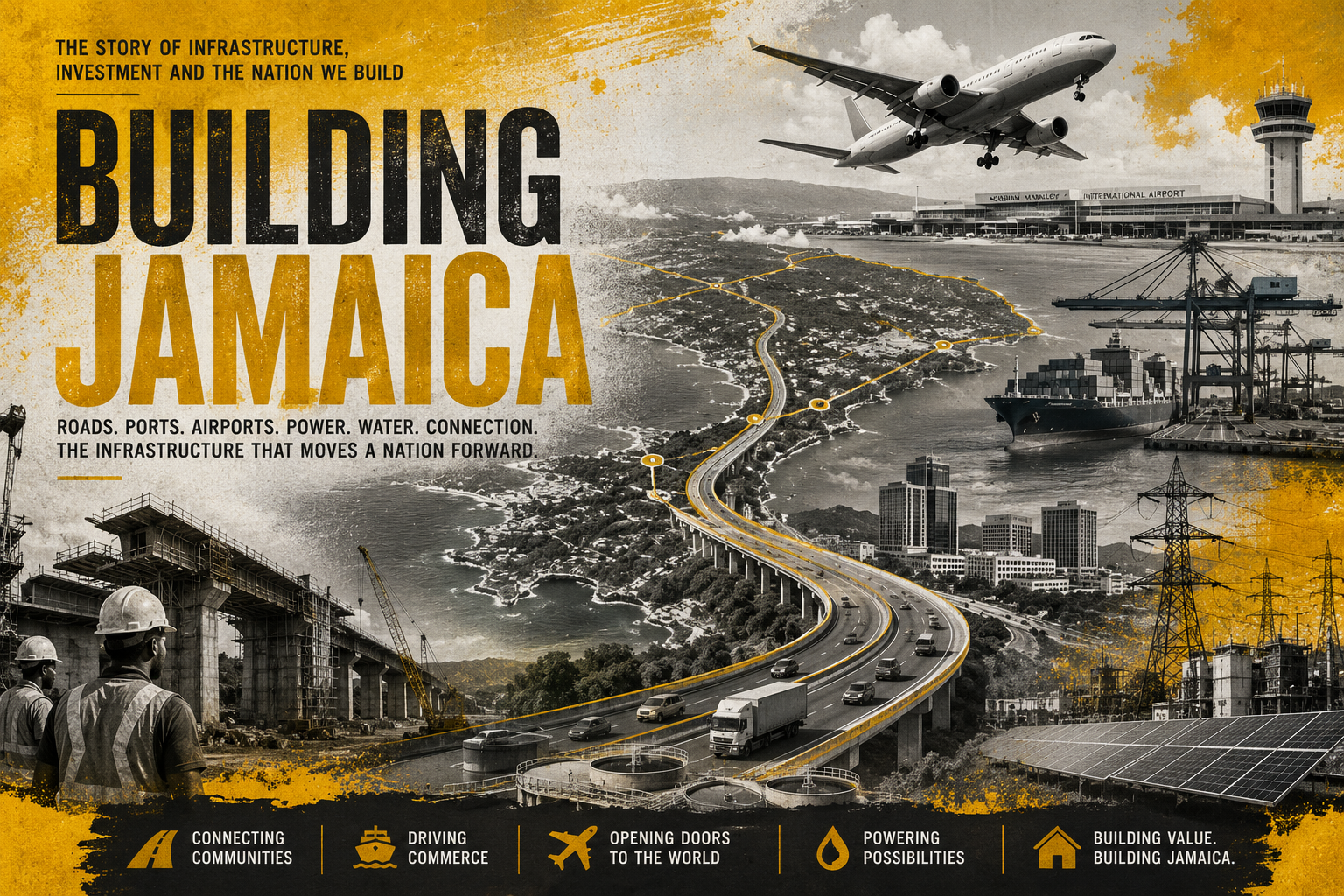
New Fortress Energy has mobilised construction activities for the Montego Bay LNG receiving facility that will supply natural gas to the Bogue power station complex in St James. The project, which received its key regulatory approvals in the fourth quarter of 2020, has moved into engineering and procurement activities that are advancing on a timeline targeting commissioning in 2022. The construction of the receiving terminal — a smaller-scale facility than the FSRU-based installation at Old Harbour Bay, reflecting the different logistics model that the shorter Montego Bay supply chain makes appropriate — involves civil works in the harbour area and the installation of compression and metering equipment to connect the receiving terminal to the Bogue plant.
The economics of the western Jamaica gas supply are particularly compelling in the context of the tourism sector’s recovery. The resort-heavy western parishes of St James, Hanover, and Westmoreland are among the largest electricity consumers on the island, and the reduction in per-unit electricity costs that gas-fired Bogue generation will deliver represents a meaningful improvement in the operating cost structure of hotels that have been working with reduced revenues through the pandemic period. The investment case for the Montego Bay LNG facility has therefore been strengthened by the pandemic’s demonstration that cost reduction in energy — an uncontrollable fixed cost for resort operators — provides a resilience benefit as well as a competitive one.
The Old Harbour Bay facility has continued to operate reliably and without material incident through the first quarter. The FSRU and its associated infrastructure are well into their operational maturity, with the engineering and operations teams having developed the detailed understanding of the facility’s performance characteristics that comes only with sustained operating experience. Scheduled maintenance activities have been completed within planned outage windows without significant impact on gas supply to the generating station.
Roads: Full-Year Capital Programme Resumes
The National Works Agency has entered the 2021–22 budget year with a capital programme that represents a meaningful step up from the pandemic-constrained programme of 2020–21. The restoration of infrastructure investment to closer to pre-pandemic levels reflects both the improving fiscal position as tax revenues recover alongside the economy and the government’s strategic commitment to maintaining road quality as a foundational enabler of economic activity and community wellbeing. The priority list for the coming year includes the completion of bridge rehabilitation works begun in 2020, the commencement of new resurfacing contracts in the parishes where pavement condition surveys identify the greatest need, and the continuation of the eastern parish programme that was substantially complete before the pandemic’s fiscal constraints led to the deferral of some planned works.
The construction contractor community has been demonstrating improved capacity and capability through recent programme cycles, a reflection of the sustained investment in the sector that has allowed smaller Jamaican firms to grow their equipment and workforce capabilities. The NWA’s procurement framework has been refined to allow better packaging of works — grouping contracts at scales that suit the capacity of growing mid-size Jamaican contractors rather than either the mega-packages that only international firms can handle or the micro-contracts that produce inefficient management overhead. The approach reflects a deliberate policy of using public infrastructure investment to develop a more capable and competitive domestic construction industry.
Port: Container Volumes Recovering Alongside Global Trade
Kingston Freeport Terminal Limited has been experiencing the surge in container shipping demand that has characterised global trade patterns in the first quarter of 2021. The paradox of the pandemic’s impact on container shipping has been that the collapse of trade volumes in 2020 was followed, more quickly than most industry analysts predicted, by a surge in goods demand as consumers in major markets redirected discretionary spending from experiences (travel, restaurants, entertainment — all COVID-restricted) toward products (home improvement, electronics, furnishings). This goods demand surge, combined with disruption to port operations at major container hubs and shortages of containers and vessel capacity, has produced a global supply chain environment of extraordinary tightness that is generating record freight rates on all major trade lanes.
For KFTL, this environment has produced strong demand for transhipment capacity as shipping lines seek every available slot in their effort to move goods through constrained networks. The terminal’s operational efficiency, maintained through the pandemic through sustained investment in equipment maintenance and workforce training, has positioned it to capture a disproportionate share of the increased demand flow through the Caribbean basin.
Fiscal: Recovery Path Clarifying
Jamaica’s fiscal position has been improving more quickly than the most pessimistic forecasts of early 2020 suggested, a reflection of the resilience of tax revenues in the segments of the economy that remained active through the pandemic — particularly remittances, digital services, and the essential retail and food distribution sectors — and the disciplined management of emergency expenditure that avoided the addition of structural spending that would persist after the crisis passed.
The budget for 2021–22, presented by Finance Minister Clarke in March, begins the path back toward the fiscal responsibility framework’s primary surplus target. The budget projects a narrowing deficit that reflects both the expected growth recovery as tourism resumes and the moderation of emergency expenditure as the immediate crisis requirements ease. The IMF’s engagement with Jamaica has supported this trajectory, with technical assistance on the design of the fiscal consolidation path and the discussions around a new programme arrangement that would provide an institutional framework for the recovery period. The growth forecast for 2021 has been revised upward as the first quarter’s data confirms that the economy is recovering more quickly than the conservative assumptions that underpinned the early pandemic planning. Jamaica enters the second year of its COVID experience in a fundamentally different position from a year ago: vaccinations are beginning, tourism is slowly returning, and the fiscal framework is being deliberately restored. The trajectory, finally, points upward.
Follow Jamaica Homes on Youtube @jamaicahomes and Instagram @jamaica_homes and on Facebook @jamaicahomes Send us a message or email us at onlinefeedback@jamaica-homes.com or editor@jamaica-homes.com
Support independent Jamaican journalism.
- 1Our journalists cover housing, politics and community — stories that directly affect Jamaican lives.
- 2We have no billionaire owner and no advertisers calling the shots. Every story is decided by our editors.
- 3It costs less than a cup of coffee a week, and takes less time to subscribe than it took to read this article.
Support Jamaica Homes News today.
- Save 17% compared to monthly
- All articles unlocked
- Weekly newsletter
- Priority support
By subscribing you agree to our Privacy Policy and Terms.
