

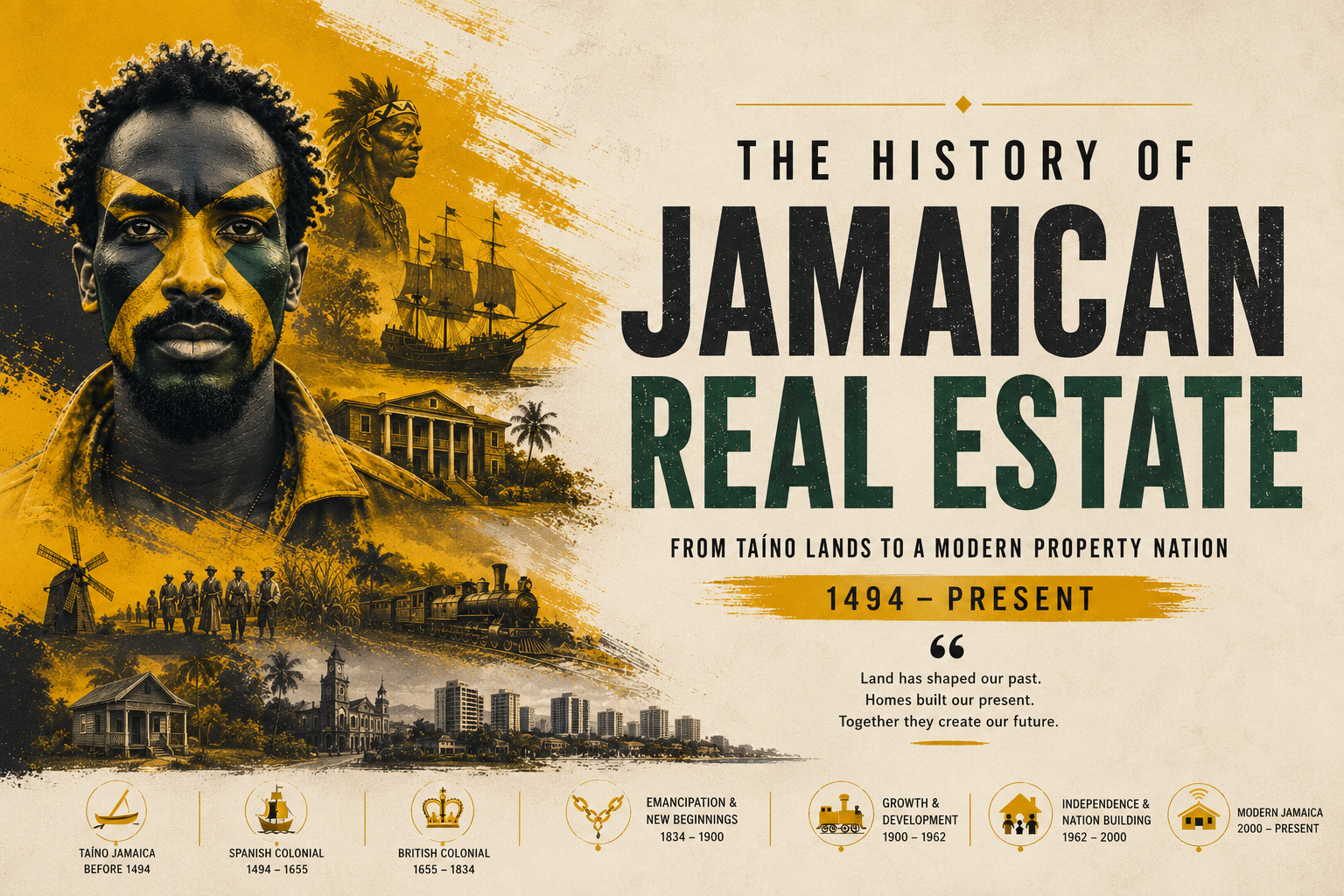
- Jamaica’s 1888 Act introduced the Torrens system of indefeasible registered title.
- A central state register replaced the fragile colonial deed-recording system.
- Registered title is guaranteed by the state — creating certainty for buyers.
- The Titles Office, now the NLA, remains guardian of Jamaican property rights.
- Millions of acres of ‘family land’ still sit outside the formal title system.
- The Act’s legacy shapes every property transaction in Jamaica today.
On a sweltering afternoon in the summer of 1888, a clerk in Kingston dipped his pen and entered the first details into a ledger that would, over the generations to come, become the bedrock of Jamaican property law. The Registration of Titles Act, enacted that year by Jamaica’s colonial legislature, was not merely a bureaucratic reform. It was a revolution in how the island’s most precious asset — its land — would be owned, bought, sold, and inherited. More than a century later, its architecture still underpins every conveyance, every mortgage, every boundary dispute on the island.
A Colony in Search of Certainty
To understand why 1888 mattered so profoundly, one must first reckon with the chaos that preceded it. For most of the eighteenth and early nineteenth centuries, land ownership in Jamaica was evidenced by a tangle of private deeds — handwritten instruments drafted by attorneys, witnessed by neighbours, enrolled in the records of the island’s courts, and then stored, with varying degrees of care, in private solicitors’ offices or tin trunks in plantation great houses. The system was inherited wholesale from English common law, where ownership was proved not by any state guarantee but by a chain of title: a sequence of deeds stretching back in time, each conveying what the grantor had received from the grantor before him.
In theory, a diligent purchaser could trace this chain and satisfy himself of a seller’s ownership. In practice, the tropical climate conspired against paper records. Ink faded in the humidity. Deeds were lost to fire, to flood, to the indifference of generations. In a colony where land had changed hands violently — through Crown grants to planters, through the forced labour of the enslaved who worked it, through the upheavals of emancipation in 1838 — the pedigree of any given parcel was frequently murky. Attorneys grew wealthy charging fees to search through mouldering bundles of parchment seeking evidence of a clean title that was often impossible to confirm with certainty.
The human cost was considerable. Smallholders who had purchased their plots after emancipation, often at great sacrifice, found it difficult and expensive to prove what they owned. Disputes between heirs were adjudicated on the basis of documents that might be incomplete, forged, or simply missing. Mortgagees advanced money on the security of land they could not verify the borrower truly owned. The colonial economy needed a more reliable foundation.
The Torrens Revolution Reaches the Caribbean
The solution, when it arrived, came from the other side of the world. In 1858, Sir Robert Richard Torrens — an Irish-born politician serving in South Australia — had piloted through the colonial legislature of that young settler colony a radical new system of land registration. Torrens had observed the difficulties that English deed-based conveyancing caused in a frontier society where land changed hands rapidly and professional legal services were scarce. His insight was elegantly simple: instead of tracing chains of past title, the state should issue a single authoritative certificate of title reflecting the current state of ownership. The certificate, once issued, was indefeasible — immune to challenge on the basis of prior dealings not recorded on the register. The register was the title; the title was the register.
The Torrens system spread with the confidence of colonial administrators who admired its efficiency. By the 1870s and 1880s, versions of the legislation had been adopted across Britain’s settler colonies — in New Zealand, in the Canadian provinces, in parts of Africa. Jamaica’s legislators, watching the experiment from across the Atlantic, concluded that the island’s tangled property records demanded the same remedy.
The Registration of Titles Act was passed in 1888, and it followed the Torrens model closely. The Act established a Titles Office — an institution that would sit, for most of its history, on King Street in Kingston — charged with maintaining a public register of all land in the island brought within the new system. When a parcel was first registered, a trained examiner of titles would scrutinise the existing deeds and surveys, satisfy himself of the claimant’s ownership, and then issue a certificate of title in the name of the registered proprietor. That certificate, and its corresponding folio in the register, became the definitive statement of who owned the land and what encumbrances — mortgages, easements, restrictive covenants — burdened it.
The Mechanics of Indefeasibility
The Act’s most consequential innovation was the principle of indefeasibility. Once title was registered, it could not be impeached by any prior unregistered interest or by any defect in the original chain of deeds that had been examined and approved on first registration. A purchaser who bought from the registered proprietor and was herself registered took her title free of all prior claims, fraud or statutory exceptions aside. The state, in effect, underwrote the title. If an error by the Titles Office caused loss to an innocent party, the Assurance Fund — a statutory fund maintained under the Act — could be called upon to pay compensation.
This was a profound shift in legal philosophy. Under the old deed system, a purchaser bought at his own risk; caveat emptor extended even to the title itself. Under the Torrens system, the state absorbed the risk of title defects, offering in exchange the certainty that commercial markets for land required. Mortgagees could lend against registered titles with confidence. Buyers could transact without incurring the crippling cost of exhaustive title searches. The Act was, in this sense, as much an economic reform as a legal one.
The practical procedure was straightforward if somewhat deliberate. An applicant for first registration submitted their deeds and a survey plan to the Titles Office. The Examiner of Titles reviewed the documents, published notice of the application, and, if satisfied, directed the Registrar of Titles to open a new folio in the Register Book and issue a duplicate certificate of title to the applicant. Subsequent dealings — sales, mortgages, transmissions on death — were endorsed on the folio and the duplicate certificate. The register was public; any person could inspect a folio and learn, at a glance, who owned the land and what charges lay against it.
The Titles Office and Its Institutional Legacy
The Titles Office that the 1888 Act created has undergone several transformations in the nearly fourteen decades since. For most of the colonial period and well into independence, it operated as a branch of the island’s judicial infrastructure, its staff of registrars and examiners occupying a position of considerable practical authority. The quality and care of the Jamaican register became a point of professional pride; legal practitioners trained in the Torrens tradition understood that the register’s integrity was the foundation of the entire conveyancing system.
In the modern era, the functions of the Titles Office have been folded into the National Land Agency (NLA), a statutory body established in 2001 to consolidate the island’s land administration functions. The NLA today administers the titles register, processes applications for first registration and subsequent dealings, and houses the Survey Department responsible for the cadastral maps upon which boundary determinations depend. Researchers wishing to trace the history of a particular parcel may access historical folios through the NLA’s records; the agency has in recent years collaborated with the Jamaica Archives and Records Department (JARD) to preserve and digitise the oldest registers, some of which date to the Act’s earliest years.
Scholars at the University of the West Indies (UWI) have noted that the Jamaican register, despite the institutional upheavals of independence and subsequent reorganisation, has maintained a degree of accuracy and continuity remarkable among post-colonial land registries. The British National Archives in Kew hold correspondence between Jamaican colonial administrators and the Colonial Office documenting the deliberations that preceded the 1888 Act, offering insight into the political negotiations behind what appeared on the surface to be a purely technical reform.
The Shadow of the Register: Family Land and Unregistered Title
Yet the 1888 Act, for all its ambition, did not swallow the whole island. Voluntary first registration meant that land could remain outside the Torrens system indefinitely, and vast tracts — particularly in the rural parishes of St. Elizabeth, Trelawny, St. Ann, and Portland — were never brought onto the register. On these parcels, ownership continued to be governed by the old deed-based system, or, in a development that would have puzzled the colonial legislators entirely, by no formal legal instrument at all.
The phenomenon of ‘family land’ — undivided parcels held informally by extended kinship groups across generations — emerged in the decades following emancipation and persists to this day as one of the most distinctive features of Jamaican land tenure. When a smallholder died intestate in the late nineteenth century, his parcel did not necessarily pass to a single heir under the formal rules of intestate succession. Instead, it might be divided in practice among multiple children and grandchildren, none of whom obtained a formal deed or sought registration, each working a portion of the land on the basis of family agreement and customary recognition. Over generations, the original parcel became fragmented among scores of descendants, all of whom might claim some right to the land but none of whom held a title that would be recognised by a bank or a court without expensive and contentious litigation.
Anthropologists and legal scholars — including the pioneering work of Edith Clarke, whose 1957 study My Mother Who Fathered Me examined family structures in rural Jamaica, and later researchers associated with UWI’s Faculty of Law — have documented family land as a rational response to conditions of poverty and legal exclusion. Formal title was expensive to obtain and maintain. Lawyers’ fees were beyond the means of many smallholders. The Titles Office, despite its importance, was an institution rooted in Kingston, remote in practical terms from the farming communities of the interior. Family land provided a form of security outside the formal system: it could not be sold away from the family, it could not be mortgaged to satisfy a single member’s debts, and it endured as a collective inheritance even when individual members migrated to the cities or overseas.
The legal grey area this created was — and remains — profound. Family land is neither fish nor fowl in Jamaican law. It is not communal property in any recognised legal sense. It is not a trust, though it sometimes resembles one. It is not a tenancy in common, though courts have occasionally treated it as such when forced to adjudicate disputes. The Jamaica Information Service (JIS) and various government agencies have, over the decades, made periodic efforts to bring family land within the title system through first registration drives and subsidised legal assistance schemes. Progress has been halting. Estimates suggest that as of the early twenty-first century, a substantial minority of rural land in Jamaica — some estimates place the figure as high as a third in certain parishes — remains outside formal title.
The Act’s Enduring Architecture
The Registration of Titles Act 1888, as amended, remains in force today. It has been supplemented and modified by subsequent legislation — the Registration (Strata Titles) Act governing condominium ownership, amendments addressing electronic registration and the NLA’s administrative reforms — but its foundational architecture is recognisably that of the original Torrens instrument. The folio system, the duplicate certificate, the principle of indefeasibility, the Assurance Fund: all persist in substantially the form conceived by the Act’s colonial draftsmen.
The Act’s influence can be felt in every real estate transaction on the island. When a buyer in Kingston signs a sale agreement and her attorney submits a transfer for registration, the procedure is governed by principles laid down in 1888. When a mortgagee in Montego Bay seeks to enforce its security over a registered parcel, it does so within the framework the Act created. When a title examiner at the NLA reviews an application for first registration of a long-held rural parcel, she is performing a function that her predecessors have performed, in that same institution, since the reign of Queen Victoria.
A Foundation Built to Last
History has a habit of lodging itself in the present in unexpected ways. The Registration of Titles Act 1888 was enacted by a colonial legislature in service of imperial economic interests — the efficient transfer of property in a plantation economy transitioning toward smallholder agriculture and commercial development. Its architects could not have anticipated the Jamaica of the twenty-first century: the diaspora remittances that finance new construction in St. Catherine, the resort developments that have transformed the north coast, the urban land pressures in Greater Kingston where a single registered lot can change hands for tens of millions of Jamaican dollars.
Yet the Act’s core bargain — that the state would guarantee the title of the registered proprietor, and that the register would be the single authoritative source of truth about land ownership — has proven durable precisely because it serves interests that transcend the circumstances of its creation. Certainty of title is as valuable to a first-time homebuyer in Portmore today as it was to a merchant in Kingston in 1888. The register’s integrity is as vital to a mortgage lender in New Kingston as it was to the colonial banking houses that lobbied for the reform in the first place.
The family land that sits outside the register is, in this sense, not merely a legal anomaly. It is a reminder that formal law does not always capture the full complexity of how people actually live on and relate to land. The challenge for Jamaican land policy in the years ahead is to honour the security and social function of customary tenure while finding pathways that bring more of the island’s land within the clarity and protection of the Torrens system — extending, at last, to every Jamaican family the guarantee that a clerk in Kingston first inscribed in a ledger in 1888.
Sources and further reading: Registration of Titles Act 1888 (Jamaica); National Land Agency (NLA) institutional history; Jamaica Archives and Records Department (JARD); Edith Clarke, My Mother Who Fathered Me (1957); British National Archives, Colonial Office correspondence CO 137; University of the West Indies (UWI) Faculty of Law working papers on informal land tenure; Jamaica Information Service (JIS) land registration resources.
Follow Jamaica Homes on Youtube @jamaicahomes and Instagram @jamaica_homes and on Facebook @jamaicahomes Send us a message or email us at onlinefeedback@jamaica-homes.com or editor@jamaica-homes.com
Support independent Jamaican journalism.
- 1Our journalists cover housing, politics and community — stories that directly affect Jamaican lives.
- 2We have no billionaire owner and no advertisers calling the shots. Every story is decided by our editors.
- 3It costs less than a cup of coffee a week, and takes less time to subscribe than it took to read this article.
Support Jamaica Homes News today.
- Save 17% compared to monthly
- All articles unlocked
- Weekly newsletter
- Priority support
By subscribing you agree to our Privacy Policy and Terms.
