

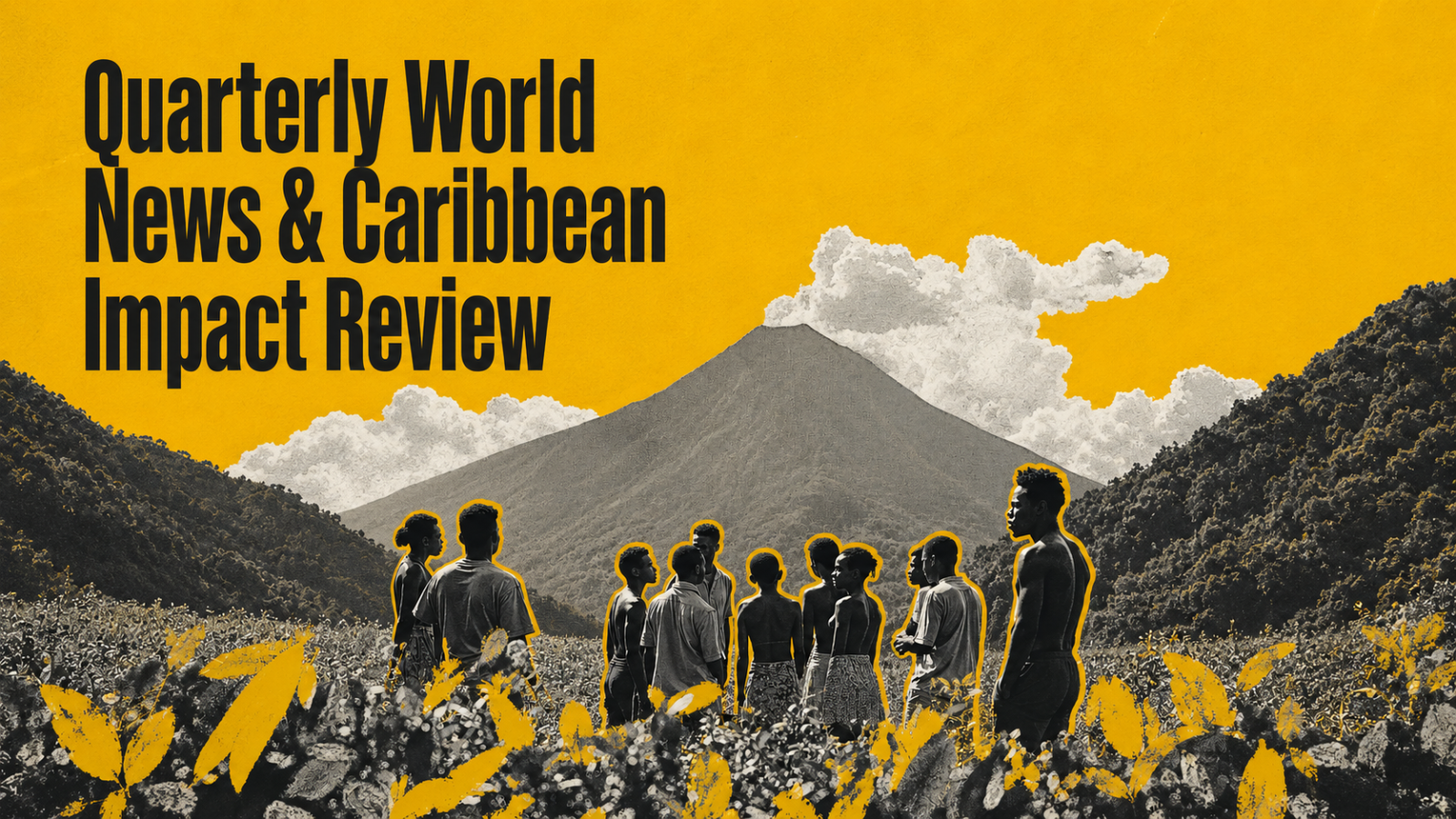
Jamaica Homes Global Conflict & Caribbean Impact Review | Published 3 April 2010 | Reporting Period: 3 January – 2 April 2010
Quarterly Briefing
- A magnitude-7.0 earthquake strikes Haiti on January 12 at 4:53pm local time; the epicentre is 25 kilometres west of Port-au-Prince; estimates of the dead range from 200,000 to 300,000, with 300,000 injured and 1.5 million people made homeless; the Presidential Palace, parliament, the main cathedral and an estimated 250,000 homes are destroyed; it is the worst disaster in the Caribbean in recorded history.
- NATO and Afghan forces launch Operation Moshtarak in Helmand Province’s Marjah district in February in the largest offensive since the 2001 invasion; the operation is designed to clear the Taliban from one of its principal Afghan strongholds and demonstrate the effectiveness of the surge strategy; early results are contested, with the town taken but governance vacuum slow to fill.
- Iraq holds its second national parliamentary election on March 7; the results, as this edition is published, show Ayad Allawi’s Iraqiya bloc narrowly ahead of incumbent Prime Minister Nuri al-Maliki’s State of Law coalition; a bitter dispute over the result is developing, with Maliki calling for a recount and threatening to challenge the outcome.
- Honduras rejoins the Organisation of American States in March after being suspended following the June 2009 coup against President Zelaya; the new president, Porfirio Lobo Sosa, inaugurated on January 27, is seeking international rehabilitation, though Zelaya’s supporters regard the election as illegitimate.
- Google announces on January 12 that it will no longer censor its Chinese search engine and may withdraw from China entirely, citing cyberattacks originating from China targeting human rights activists’ Gmail accounts; the confrontation between the world’s largest internet company and its largest national market signals a new dimension in US-China strategic competition.
- The United States and Russia announce completion of negotiations on a new nuclear arms reduction treaty, the successor to START I; a signing ceremony is expected imminently; the treaty would reduce deployed strategic warheads to 1,550 each and introduce new inspection mechanisms.
Prologue: The Earthquake That Changed the Caribbean
No event in recent Caribbean history approaches the Haiti earthquake of January 12, 2010 in its scale, immediacy or consequence. The disaster did not create Haiti’s vulnerabilities — the country’s deforestation, its density of poorly constructed buildings, its weakened institutions and its extreme poverty were all pre-existing conditions — but it exposed them with absolute clarity. A country of ten million people lost perhaps two per cent of its population in thirty-five seconds. The Caribbean Community watched in horror as images emerged of a capital city turned to rubble; Jamaica deployed medical teams and rescue personnel within hours. The international response was unprecedented in its speed and scale; within a week, 48 urban search-and-rescue teams from 36 countries were operating in Haiti; within a month, the US military had deployed 22,000 personnel and established effective control of the Port-au-Prince airport. But the scale of the disaster was such that even this extraordinary response was inadequate.
Haiti: Loss, Response and the Long Recovery
The physical destruction inflicted on Port-au-Prince was nearly total in some neighbourhoods. The Cité Soleil slum, already among the Western Hemisphere’s most difficult urban environments, was devastated. Government Quarter, the business district and middle-class residential areas all experienced catastrophic collapse; the gap between official building codes and actual construction standards was lethal. An estimated 28,000 commercial buildings and 105,000 homes were destroyed outright; another 208,000 homes were damaged. The Haitian civil service effectively ceased to exist: the Ministry of Justice, Ministry of Finance and dozens of other ministries were destroyed; the director-general of the Ministry of Finance was killed; parliament was rendered inoperable.
The international response, while massive, revealed deep systemic problems. The paralysis of the Haitian state created a vacuum that UN peacekeeping forces, NGOs, the US military and dozens of national bilateral missions were ill-equipped to fill coherently. The Port-au-Prince airport, with a single runway and limited cargo handling capacity, became a bottleneck; aid was piling up that could not be moved. Food and water distribution was often chaotic; security concerns about looting — significant but sometimes overstated in early media reporting — complicated relief logistics. For the Haitian diaspora, whose annual remittances were a larger share of Haiti’s GDP than all foreign aid combined, the disaster meant both personal devastation and an outpouring of emergency support. Jamaica’s own response — government, NGO and individual — was perhaps the most proximate in the region and the most sustained.
Afghanistan’s Uncertain Surge
Operation Moshtarak, launched on February 13, was the largest NATO-Afghan military operation since the 2001 invasion. The target was Marjah in Helmand Province, a district that had served as a Taliban stronghold and a major opium-producing area. The military phase was relatively swift; the town was taken within days. The harder question was whether the civilian governance — the “government in a box” that General McChrystal promised would quickly follow the military clearance — could be delivered. Afghan government officials and development workers arriving in Marjah found a population deeply suspicious of any authority and a governance vacuum that the Afghan local administration could not immediately fill. Three months on, the Taliban remained active in the district and the operation’s ultimate outcome was unresolved.
Honduras and Caribbean Democratic Norms
Honduras’s return to the OAS in March closed, at least formally, the chapter opened by last June’s coup against President Zelaya. The election of Porfirio Lobo in November 2009 and his inauguration in January 2010 gave international partners a framework for normalising relations, even though Venezuela, Nicaragua and several left-aligned Latin American governments continued to regard the elected government as illegitimate. For CARICOM, the Honduras episode had raised sharp questions about the principles — democratic governance, constitutional order, non-interference — that the Community held itself to. The willingness of some regional actors to accept the post-coup electoral process as restoring legitimacy, while others insisted on Zelaya’s restoration, illustrated the persistent fault lines in Caribbean and Latin American democratic solidarity.
Looking Ahead
Haiti’s reconstruction will be the defining Caribbean geopolitical story of 2010 and beyond; the international commitment of $10 billion pledged for reconstruction must now translate into actual buildings, governance capacity and economic recovery on a country whose absorptive capacity has been shattered. Iraq’s contested election result will test its democratic institutions and its neighbours’ willingness to accept an outcome that does not favour their interests. The Afghan surge is too young to evaluate; the coming months will provide the first genuine test of whether the Marjah model can be replicated across the south and east of the country. And the US-Russia nuclear deal — expected to be signed within days — offers one of the few moments of genuine strategic cooperation between the major powers in an otherwise fractious global security environment.
Jamaica Homes Global Conflict & Caribbean Impact Review is published quarterly, examining how wars, geopolitical tensions and major international crises have shaped Jamaica, the Caribbean and their economies.
Follow Jamaica Homes on Youtube @jamaicahomes and Instagram @jamaica_homes and on Facebook @jamaicahomesnews Send us a message or email us at onlinefeedback@jamaica-homes.com or editor@jamaica-homes.com
Support independent Jamaican journalism.
- 1Our journalists cover housing, politics and community — stories that directly affect Jamaican lives.
- 2We have no billionaire owner and no advertisers calling the shots. Every story is decided by our editors.
- 3It costs less than a cup of coffee a week, and takes less time to subscribe than it took to read this article.
Support Jamaica Homes News today.
- Save 17% compared to monthly
- All articles unlocked
- Weekly newsletter
- Priority support
By subscribing you agree to our Privacy Policy and Terms.

Visit our YouTube Community ↗