

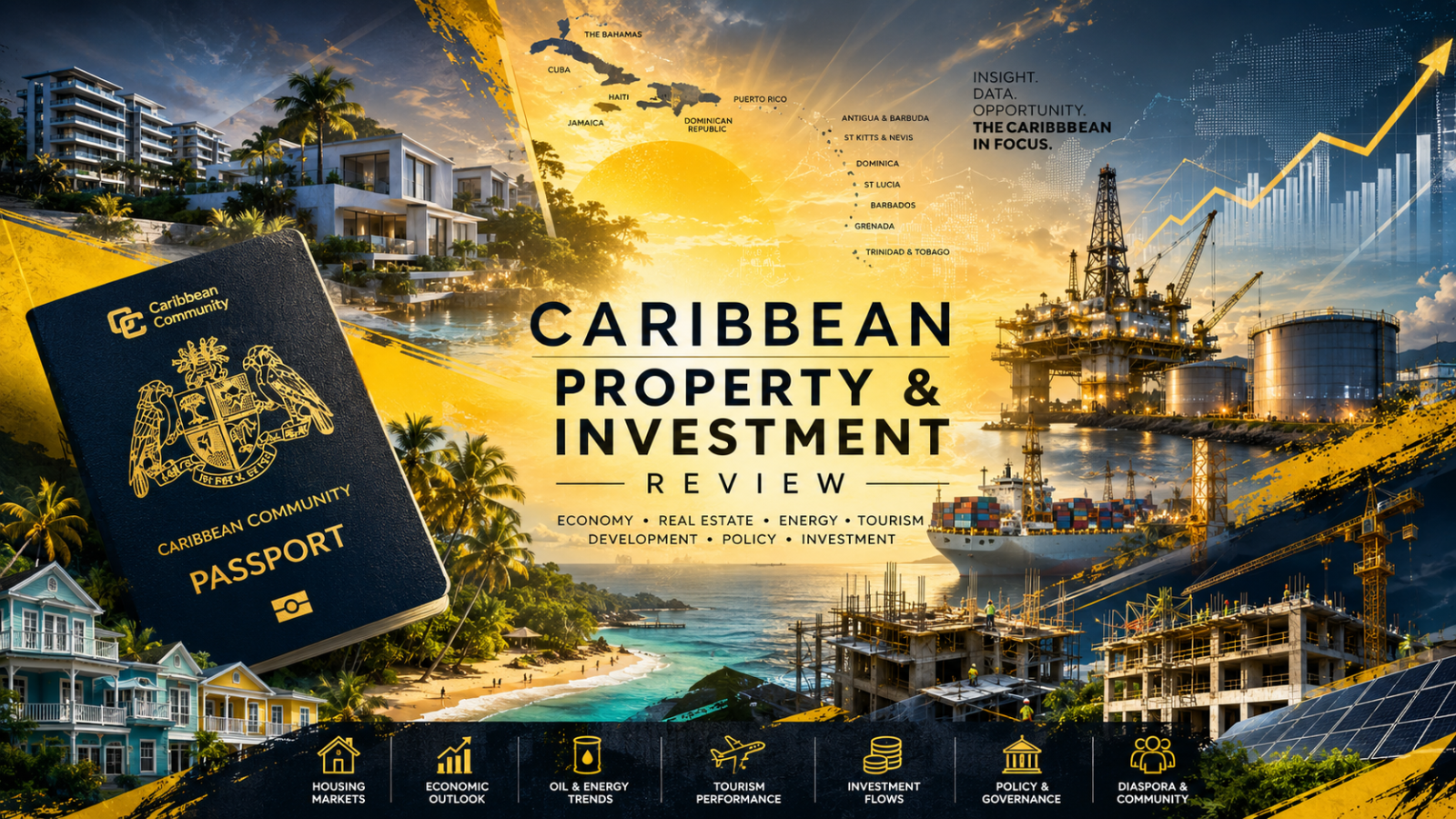
Publication Date: 3 October 2013 | Coverage Period: 3 September – 2 October 2013
Morning Briefing
- October signals the opening of the Caribbean’s important winter tourism season — air arrivals from North America and Europe begin building, hotel pre-openings are underway, and the hospitality property sector positions itself for its most commercially significant months.
- Caribbean citizenship by investment programmes are reporting growing application pipelines heading into the fourth quarter — St Kitts & Nevis, Antigua & Barbuda, Dominica, and Grenada are all marketing their real estate investment routes to an expanding international audience.
- Trinidad & Tobago’s luxury residential market — particularly high-end developments in Westmoorings, Glencoe, and the upscale south Trinidad corridor — is demonstrating strong price resilience as energy-sector professionals maintain demand for premium accommodation.
- Barbados is confronting a more challenging economic environment than most of its Caribbean peers, with tourism recovery slower than hoped and the government managing a significant fiscal deficit — though the island’s internationally-regarded reputation and lifestyle appeal continue to underpin its premium property market.
- Jamaica’s National Housing Trust is advancing its affordable housing programme, with several construction projects active across Kingston, St Catherine, and the western parishes, providing both direct housing supply and stimulus to the building sector.
- The 2013 Atlantic hurricane season is heading towards a quiet conclusion — Tropical Storm Ingrid aside, no Caribbean island hurricane strikes have occurred, making 2013 one of the least disruptive recent seasons for Caribbean property and tourism.
Caribbean CBI: Four Programmes, One Growing Market
The Caribbean citizenship by investment landscape has, in the space of just two years, transformed from a niche product offered by a single jurisdiction into a genuinely competitive market featuring four active programmes. The growth trajectory of the sector has significant implications for Caribbean property markets — CBI-qualifying real estate investment represents a layer of demand that is insulated from local economic conditions and driven instead by global wealth distribution patterns, passport valuation, and the fiscal and lifestyle priorities of high-net-worth individuals in emerging market jurisdictions.
St Kitts & Nevis, as the pioneer, maintains several important advantages: brand recognition built over nearly three decades, an established legal and administrative infrastructure, and a roster of approved real estate developments that spans a range of property types and price points. The programme’s real estate route — requiring a minimum investment of US$400,000 in an approved development, held for at least five years — has generated very significant property investment in a small island economy. Approved developments on both St Kitts and Nevis include resort hotels, branded residence programmes, and private villa communities, attracting buyers from Russia, the Middle East, China, and increasingly from West Africa.
Antigua & Barbuda’s programme, now in its second year, is maturing steadily. The government has been active in expanding its approved real estate list — a critical task given that the quality and diversity of available investment options is a primary competitive factor in the CBI marketplace. Several resort and residential projects have received programme approval in 2013, and marketing agents internationally are reporting that Antigua’s combination of natural beauty, existing international airlift, and programme credibility is gaining traction with potential applicants, particularly from the UK, where the island has historical ties and strong brand recognition.
Dominica’s economic citizenship programme, operating under a different model than its real estate-focused competitors — with the primary route being a contribution to the country’s Economic Diversification Fund — continues to attract applicants who prioritise programme cost efficiency over real estate investment. The island’s passport, providing access to over 100 countries, represents excellent value at its price point. Grenada’s newly relaunched programme is the most interesting newcomer: its E-2 treaty relationship with the United States creates a unique downstream utility for Grenadian citizenship that no other Caribbean CBI programme can currently offer. Developers and agents are working to build out Grenada’s approved development portfolio to give the programme a competitive real estate investment option alongside the direct investment route.
Jamaica: NHT and the Affordable Housing Challenge
The National Housing Trust remains Jamaica’s most important institutional actor in the residential property market, and its activities through the September coverage period reflect both the enduring demand for affordable homeownership on the island and the constraints imposed by the IMF reform environment. The NHT’s mortgage lending — available to qualifying contributors at subsidised rates below commercial bank levels — continues to be the primary route to homeownership for Jamaica’s middle-income families. In a period when commercial mortgage rates and property prices are challenging for ordinary earners, the NHT’s competitive terms represent a critical market support mechanism.
The Trust’s construction programme is active across multiple parishes. Development sites in the Corporate Area (Kingston and St Andrew), St Catherine, and Westmoreland are seeing NHT-backed housing construction advancing, providing both direct supply of affordable units and employment and materials demand that benefits the broader construction sector. The NHT’s ability to continue this programme is linked to the health of Jamaica’s formal payroll — contributor numbers and contribution levels determine the Trust’s financial capacity — and the IMF-driven public sector wage freeze, while not directly reducing NHT contributions (which are percentage-based), does constrain the growth of the contribution base.
For first-time buyers in Jamaica, the NHT represents the most accessible path to property ownership — but demand consistently outstrips the Trust’s capacity to supply. The waiting lists for NHT-developed units in desirable locations can be extended, and the secondary market in NHT mortgages and NHT-financed properties is active, reflecting genuine underlying demand. The reform environment makes it unlikely that NHT funding capacity will expand significantly in the near term, meaning the fundamental supply-demand imbalance in Jamaica’s affordable housing market will persist through the IMF programme period.
Barbados: Navigating Economic Headwinds
Barbados is among the Caribbean territories facing the most difficult economic conditions in the current period. The island’s heavy dependence on tourism as an economic driver — tourism and tourism-related activities account for a very large share of GDP and employment — has made it particularly sensitive to the lingering weakness in UK and European consumer spending that followed the 2008-2011 financial crisis and Eurozone sovereign debt emergency. British visitors, who historically represent the largest source of stayover arrivals from Europe, have been arriving in smaller numbers than the pre-crisis norm, a reflection of UK economic conditions and competitive pressure from alternative Mediterranean and long-haul destinations.
The Bajan government is managing a fiscal situation that requires careful attention. The deficit has been elevated, the public debt trajectory is concerning, and the government has been implementing a programme of fiscal adjustment — not under IMF conditionality like Jamaica, but driven by domestic necessity and the imperative of maintaining the Barbados dollar’s long-standing peg to the US dollar at 2:1. That peg is a cornerstone of Barbados’s economic model and a critical anchor of confidence for the island’s significant international property and financial services sectors. Maintaining it requires fiscal discipline, which means that government spending — including on construction and infrastructure — is constrained.
The silver lining for Barbados’s property market is that the island’s premium international reputation remains intact. The west coast — Sandy Lane, Holetown, Speightstown — continues to attract high-net-worth buyers who value Barbados’s combination of political stability, legal certainty (English common law system, independent judiciary), air connectivity (direct British Airways and Virgin Atlantic flights from London), and lifestyle quality. Several significant villa transactions have completed on the west coast during the year, and while the pace of activity is below the pre-2008 peak, the direction of travel is cautiously positive. The east coast and interior, less internationally prominent but offering excellent value, are seeing interest from buyers priced out of the west coast.
T&T Luxury Market: Energy Wealth at Work
Trinidad & Tobago’s luxury residential market is performing strongly as the fourth quarter approaches. The upper end of the market — properties priced above TT$5 million, encompassing executive houses, premium apartments, and select waterfront properties — continues to benefit from the sustained prosperity generated by the energy sector. Senior employees of international oil and gas companies, successful energy-sector entrepreneurs, and the professionals who service this industry ecosystem represent a demand base for luxury accommodation that shows little sign of shrinking while oil remains near US$100 per barrel.
Tobago’s property market, distinct in character from Trinidad’s, is also attracting increasing attention. The island’s natural beauty, unhurried pace, and improving air connections from Port of Spain and from international gateways are generating interest from both Trinidadian buyers seeking a second-home retreat and from international investors attracted to the Caribbean lifestyle at a price point more accessible than the most exclusive English-speaking Caribbean markets. Several villa and boutique hotel projects on Tobago are advancing through development, and the island’s infrastructure — particularly its road network and utility services — is benefiting from government investment.
Caribbean Leaders This Month
St Kitts & Nevis — CBI Pioneer: The Federation’s long-established programme continues to generate the most consistent and substantial CBI-motivated property investment in the Caribbean, with approved developments reporting strong sales pipelines heading into Q4.
Trinidad & Tobago — Luxury Segment: The twin-island republic’s premium residential market continues to demonstrate price resilience and transaction activity that stands out in a Caribbean context, supported by sustained energy-sector wealth generation.
Dominican Republic — Hotel Development: The DR’s pipeline of new hotel openings and resort developments — across Punta Cana, La Romana, and the north coast — continues to grow, attracting international brand commitments and generating substantial property investment.
Grenada — CBI Differentiation: Grenada’s relaunched programme is making genuine progress in establishing its market position, with the E-2 treaty advantage providing a compelling differentiator that developers and agents are leveraging effectively in North American marketing.
Jamaica — NHT Continuity: Despite the challenges of the IMF reform environment, the National Housing Trust is maintaining its affordable housing construction and mortgage programmes, providing an important demand floor in the residential market that partially offsets the cooling effect of public sector wage restraint.
Antigua & Barbuda — Programme Expansion: Antigua’s growing roster of approved CBI developments is broadening the programme’s appeal and making the real estate investment route increasingly competitive with other jurisdictions.
Barbados — West Coast Values: Notwithstanding the broader economic challenges, Barbados’s most prestigious residential addresses are holding value and transacting, demonstrating the enduring appeal of the island’s premier coastal lifestyle product to high-net-worth international buyers.
Overall Performer — St Kitts & Nevis: The Federation’s combination of the most mature CBI programme in the region, a stable and transparent regulatory environment, and a genuinely attractive resort property product makes it October’s standout for property investment generation relative to market size.
Looking Ahead
The Caribbean’s winter tourism season — running through to April — is the most commercially critical period for many island economies and their associated property markets. Early indicators for the season are broadly positive: North American consumer confidence is improving as the US economy continues its gradual recovery, and forward hotel bookings in major Caribbean destinations are ahead of prior-year levels. The conversion of tourism interest into property inquiry and eventual purchase is a typical and important dynamic of the winter season, and real estate agents across the Caribbean are staffing up for a busier period.
CBI programme competition will intensify as all four active Caribbean programmes invest in international marketing and expand their approved development rosters. The programmes that will succeed in attracting the most investment are those that can demonstrate the most credible governance, the fastest processing times, and the most compelling real estate product offerings. Jurisdictions that allow programme standards to slip — through inadequate due diligence or compromised approval processes — risk reputational damage that could undermine their property investment flows more broadly.
Jamaica’s property market will be shaped through the rest of 2013 by the IMF programme’s trajectory and the government’s ability to maintain both fiscal discipline and social cohesion. The upcoming quarterly review will be an important indicator of programme health. For long-term investors in Jamaican property, the reform programme — if successfully executed — represents the foundation for a significantly improved macroeconomic environment over the medium term that would be supportive of property market recovery and growth.
The Caribbean Property & Investment Review is published monthly and provides regional analysis for property investors, developers, and industry professionals. This edition surveys the period 3 September to 2 October 2013. All market observations reflect conditions during the coverage period.
Follow Jamaica Homes on Youtube @jamaicahomes and Instagram @jamaica_homes and on Facebook @jamaicahomesnews Send us a message or email us at onlinefeedback@jamaica-homes.com or editor@jamaica-homes.com
Support independent Jamaican journalism.
- 1Our journalists cover housing, politics and community — stories that directly affect Jamaican lives.
- 2We have no billionaire owner and no advertisers calling the shots. Every story is decided by our editors.
- 3It costs less than a cup of coffee a week, and takes less time to subscribe than it took to read this article.
Support Jamaica Homes News today.
- Save 17% compared to monthly
- All articles unlocked
- Weekly newsletter
- Priority support
By subscribing you agree to our Privacy Policy and Terms.

Visit our YouTube Community ↗