

- Land disputes rank as Jamaica’s highest-volume civil court matter.
- Squatters can legally own land through long-term adverse possession.
- Family land without wills creates multi-generational ownership chaos.
- ‘Paper land’ fraud costs Jamaican property owners millions annually.
- The Land Disputes Tribunal was created to slash court backlogs.
- Jamaica is digitising its title registry to eliminate fraudulent transfers.
On a warm morning in Kingston in the late 1990s, a retired schoolteacher named Erna Campbell arrived at the Supreme Court of Jamaica clutching a folder of documents that traced her family’s claim to a modest parcel of land in St. Elizabeth back to 1934. Across the courtroom sat her cousin, armed with an equally thick file and an equally firm conviction that the land was his. The case would drag on for eleven years. It was, by Jamaican standards, utterly unremarkable.
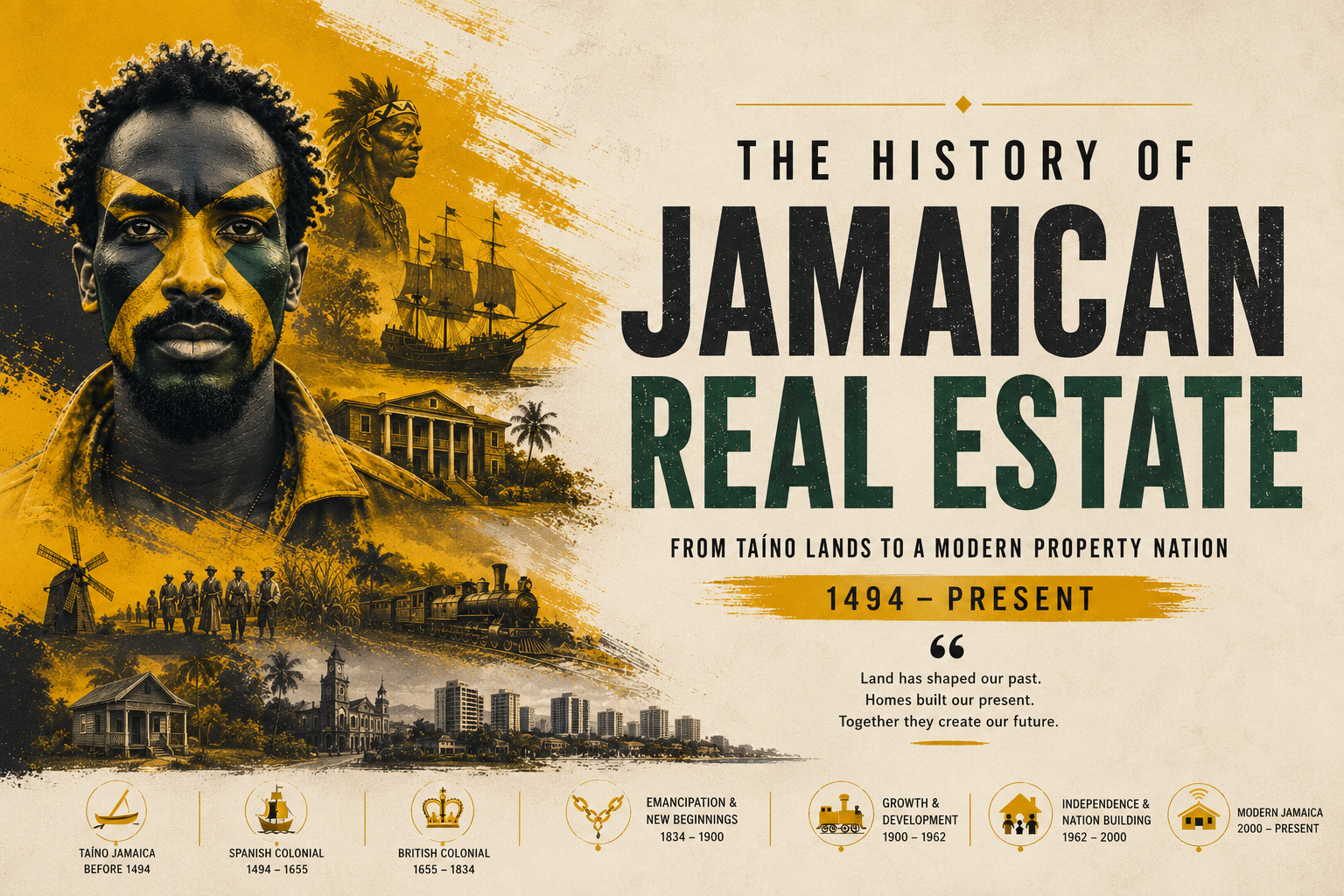
Land disputes have long been the defining feature of Jamaica’s civil justice landscape — a fact rooted not merely in individual quarrels, but in centuries of colonial dispossession, legislative ambiguity, and the peculiar cultural institution of “family land.” To understand the modern Jamaican real estate market, one must first reckon with the history of how Jamaicans have fought over, clung to, and been defrauded of their most precious asset: the earth beneath their feet.
A Colony Built on Contested Ground
The roots of Jamaica’s land crisis stretch to 1655, when English forces wrested the island from Spain, and deepened catastrophically after Emancipation in 1838. The Emancipation Act, administered under the auspices of the Colonial Office and documented in the British National Archives at Kew, freed approximately 311,000 enslaved people — but freed them largely without land. The great plantation estates, many exceeding thousands of acres, remained in the hands of the planter class. Freedmen who sought to farm independently were forced into marginal hillside plots, often purchased informally and without formal title documentation.
The Morant Bay Rebellion of 1865, which historian Professor Verene Shepherd of the University of the West Indies (UWI) has described as fundamentally a protest about land access, crystallised the tension. Paul Bogle and his followers were not simply rising against political injustice — they were responding to a system in which the law protected large landholders and left smallholders without recourse. Governor Edward Eyre’s brutal suppression of the rebellion did nothing to address the underlying land inequality; it merely silenced its most vocal critics.
By the early twentieth century, Jamaica had developed a fragmented landscape of formal freehold titles, Crown lands, and vast tracts of informally occupied ground. The Land Registration Law of 1888 introduced the Torrens title system to Jamaica — a registration framework designed to provide certainty of ownership — but its implementation was incomplete and administratively stretched. Tens of thousands of smallholders continued to occupy land without registered titles well into the post-independence era.
Family Land: Inheritance Without Wills
Perhaps no institution has generated more litigation in Jamaican courts than the concept of “family land.” The practice, documented extensively by anthropologist Edith Clarke in her landmark 1957 study My Mother Who Fathered Me, emerged in the aftermath of Emancipation as a survival strategy among rural communities. When a patriarch or matriarch acquired a plot, the land was often understood — though rarely legally formalised — to belong not to any single heir but to the entire family in perpetuity.
The arrangement was communal by design. No single family member could sell the land without consensus. Multiple generations built homes on the same parcel. The land became a form of social insurance, a guarantee that no branch of the family would be entirely without shelter or soil. “Family land is our bank,” a St. Mary farmer told the Jamaica Information Service (JIS) in a 2004 survey on rural land tenure. “You may not have the paper, but you have the place.”
The fatal flaw in this arrangement was the absence of wills. Under the Intestates’ Estates and Property Charges Act, when a landholder died without a formal will, the estate was divided among all surviving heirs according to a statutory formula. Over two or three generations, a single two-acre parcel might technically be owned by forty or fifty co-heirs, many of whom had emigrated to England, the United States, or Canada and had little knowledge of — or interest in — the property. When a family member sought to sell, develop, or mortgage the land, the legal requirement to obtain consent from all co-owners became practically impossible. The land was, in the language of Jamaica’s legal community, “locked.”
The Jamaica Agricultural and Rural Development Authority (JARD) estimated in the early 2000s that family land arrangements affected hundreds of thousands of acres across the island, with particular concentration in the rural parishes of St. Elizabeth, Trelawny, and St. Mary. The National Land Agency (NLA), established in 2001, inherited the Sisyphean task of attempting to regularise these tenures.
The Courts Under Siege: Land as the Dominant Civil Matter
By the 1990s, the Supreme Court of Jamaica and the Parish Courts were groaning under the weight of property litigation. Official statistics compiled by the Court Administration Division, and referenced in successive reports by the Justice Ministry, consistently showed that land disputes constituted the single largest category of civil matters filed in the Supreme Court — at certain periods accounting for more than thirty percent of all civil filings.
The causes were structural. Jamaica’s land registration system, administered through what was then the Land Titles Division of the Ministry of Finance, was paper-based and chronically understaffed. Title searches required physical access to deteriorating ledger books. Boundaries were often described in nineteenth-century documents referencing landmarks — a cotton tree, a stone wall, a river bend — that had long since vanished. Survey maps were frequently inconsistent with registered title documents. Into these gaps rushed litigation.
Cases took years, sometimes decades. The Caribbean Court of Justice’s predecessor, the Judicial Committee of the Privy Council in London, saw a steady stream of Jamaican land appeals well into the 2000s. Legal fees consumed estates. Families fractured. The human cost, though never fully quantified, was incalculable. As Chief Justice Zaila McCalla observed in a 2010 address to the Jamaican Bar Association, the dysfunction of the land registration system was “not merely an administrative inconvenience — it is a barrier to development and a generator of human suffering.”
Adverse Possession: When Squatters Become Owners
Into the vacuum created by absent or disputed formal ownership, the common law doctrine of adverse possession — colloquially, squatter’s rights — played an outsized role in Jamaican land history. Under the Limitation of Actions Act, a person who openly, continuously, and exclusively occupied a parcel of land for twelve years without the true owner’s permission could, in certain circumstances, extinguish the original owner’s title and acquire legal ownership.
The doctrine arrived in Jamaica via English common law and was applied by Jamaican courts with reasonable consistency. Its effects were sweeping. In the post-independence decades, as urban migration swelled communities like West Kingston, Trenchtown, Arnett Gardens, and August Town, thousands of families built homes on land they did not own. Some occupied government land; others settled on privately held agricultural estates that had fallen into disuse. Over time, as twelve-year periods elapsed and adverse possession claims matured, courts were obliged to grapple with the tension between registered title holders and long-established occupants.
The 2006 Jamaican Supreme Court case Brown v. Attorney General illustrated the complexity. A West Kingston family that had occupied a government parcel for nearly two decades sought a declaration of adverse possession, only to find that the Crown’s statutory immunity from limitation periods presented a significant legal obstacle. The case exposed a fundamental inequity: squatters on private land might successfully claim title, while those on Crown land faced near-insurmountable hurdles. The Land Administration and Management Programme (LAMP), a joint initiative between the Government of Jamaica and international development partners launched in the late 1990s, attempted to regularise informal settlements partly in response to these tensions — processing thousands of applications for formalisation of occupancy across eleven pilot communities.
The ‘Paper Land’ Scandal: Fraud in the Title Registry
If adverse possession represented one mode of illegitimate land acquisition, the phenomenon Jamaicans came to call “paper land” represented another — and far more pernicious — one. Paper land refers to the fraudulent registration of title to land, typically through the forgery of transfer documents, the exploitation of clerical errors in the registry, or the corruption of officials within the land administration system.
The problem attracted sustained public attention in the early 2000s, when a series of investigations by the Jamaica Constabulary Force’s fraud squad, reported in detail by the Jamaica Gleaner, revealed networks of individuals who had successfully registered title to land they had no legal claim to — in some cases, land already registered in another person’s name. The mechanics of the fraud exploited the paper-based registry’s weaknesses: because title searches were manual and title registers were not cross-referenced electronically, a determined fraudster could lodge a false transfer instrument without triggering immediate detection.
The National Land Agency, established in part to address this vulnerability, introduced enhanced verification procedures and worked with the Registrar of Titles to implement safeguards. The Office of the Registrar of Titles — operating under the Registration of Titles Act — bore principal responsibility for the integrity of the title register, and successive Registrars acknowledged that the manual system was inadequate. Legal scholars at UWI’s Faculty of Law argued that Jamaica’s indefeasibility provisions, designed to protect innocent purchasers who relied on the register, inadvertently created a perverse incentive: once a fraudulent title was registered, a bona fide purchaser who bought from the fraudster could, in certain circumstances, obtain unimpeachable title, leaving the defrauded original owner with only a claim in damages against an often-impecunious fraudster.
The Land Disputes Tribunal: A Specialist Forum
Recognising that the general court system was ill-equipped — in both procedural design and institutional capacity — to handle the volume and technical complexity of land disputes, the Government of Jamaica established the Land Disputes Tribunal (LDT) under the Land Disputes Tribunal Act. The Tribunal, which began operations in the early 2000s, was conceived as a specialist forum with streamlined procedures, the ability to receive expert evidence from surveyors and valuers, and a mandate to resolve disputes more expeditiously than the Supreme Court.
The LDT’s jurisdictional reach covered boundary disputes, claims arising from informal occupation, and certain categories of landlord-tenant disputes relating to agricultural land. Its panel of adjudicators included legally trained members and technical experts. Early assessments suggested that average case resolution times were meaningfully shorter than equivalent Supreme Court proceedings, though critics noted that the Tribunal’s jurisdiction was narrower than advocates had hoped and that its geographic reach — centred in Kingston — limited accessibility for rural litigants from distant parishes.
Legal practitioners interviewed by the Jamaica Legal Aid Council in the mid-2000s observed that the Tribunal was a genuine improvement but that it addressed only a fraction of the dispute backlog. Many categories of land litigation remained firmly within the exclusive jurisdiction of the Supreme Court, and the fundamental problem — the unreliability of the title registry — remained unaddressed by any tribunal reform.
Digitisation and the Road to Reform
The most significant structural intervention in Jamaica’s land dispute crisis has been the progressive digitisation of the National Land Agency’s records and the move toward an electronic title registry. The initiative, supported in part by the Inter-American Development Bank and aligned with the broader E-Government Jamaica programme, aims to convert the island’s paper-based title register into a searchable, cross-referenced digital database that would dramatically reduce the scope for fraudulent registration and clerical error.
The National Land Agency, working alongside the Registrar of Titles, began systematic digitisation of title records in the mid-2000s, a project that the Jamaica Information Service (JIS) has tracked through successive governmental announcements. The process is vast: hundreds of thousands of title folios, many dating to the late nineteenth century, must be scanned, indexed, and verified. Survey maps held by the National Land Survey Department must be reconciled with title descriptions. The technical challenge is matched by the administrative one — building the institutional capacity to maintain and update a digital system in perpetuity.
The Jamaica National Heritage Trust (JNHT), separately, has worked to preserve historical land records of cultural and historical significance, ensuring that the documentary evidence of Jamaica’s complex land history is not lost in the transition to digital administration. The British National Archives in Kew hold extensive Colonial Office records — including plantation maps, Encumbered Estates Court records, and post-Emancipation land grant documents — that researchers from UWI and the National Library of Jamaica (NLJ) have increasingly accessed to reconstruct the paper trail of disputed parcels.
A Legacy Written in the Land
The history of land disputes in Jamaica is, in the deepest sense, a history of Jamaica itself — a record of Emancipation’s incomplete promises, colonial administration’s structural failures, the ingenuity of communities who created their own systems of tenure in the absence of reliable formal ones, and the persistent gap between the law as written and the law as lived.
The schoolteacher Erna Campbell, if her case were filed today rather than in the 1990s, would find a legal landscape that has changed in measurable ways. The Land Disputes Tribunal offers an alternative forum. The National Land Agency has improved verification procedures. Digitisation is gradually making the title registry more reliable. Legal aid initiatives have expanded access to counsel for low-income litigants.
And yet the inheritance of history weighs heavily. Family land disputes continue to crowd the courts. Adverse possession claims still wind their way through a system not designed for their resolution. Paper land fraud, though harder to execute in a more digitised environment, has not disappeared. The fundamental tension between formal legal title and the lived reality of how Jamaicans have historically understood land ownership remains unresolved.
Jamaica’s real estate market in the twenty-first century is built, sometimes literally, on the contested ground of the past. Understanding that ground — its legal architecture, its historical sediment, its human complexity — is not merely an academic exercise. It is the essential precondition for building a property market that is transparent, accessible, and just. The documents in the National Library of Jamaica, in the Registrar’s vault, and in the archives at Kew tell a story that every Jamaican property owner, investor, and policymaker would do well to read.
Follow Jamaica Homes on Youtube @jamaicahomes and Instagram @jamaica_homes and on Facebook @jamaicahomesnews Send us a message or email us at onlinefeedback@jamaica-homes.com or editor@jamaica-homes.com
Support independent Jamaican journalism.
- 1Our journalists cover housing, politics and community — stories that directly affect Jamaican lives.
- 2We have no billionaire owner and no advertisers calling the shots. Every story is decided by our editors.
- 3It costs less than a cup of coffee a week, and takes less time to subscribe than it took to read this article.
Support Jamaica Homes News today.
- Save 17% compared to monthly
- All articles unlocked
- Weekly newsletter
- Priority support
By subscribing you agree to our Privacy Policy and Terms.

Visit our YouTube Community ↗