

- Gas riots kill nine; government reverses fuel tax hike
- FINSAC fallout: 24,000 loan accounts sold to receivers
- Real GDP contracts for a third consecutive year
- Cable & Wireless monopoly begins its long unravelling
- Jamaica Carnival 1999 draws a record 40,000 revellers
- Jamaicans for Justice born from the streets of Half-Way-Tree
The Burning Year: Jamaica in 1999
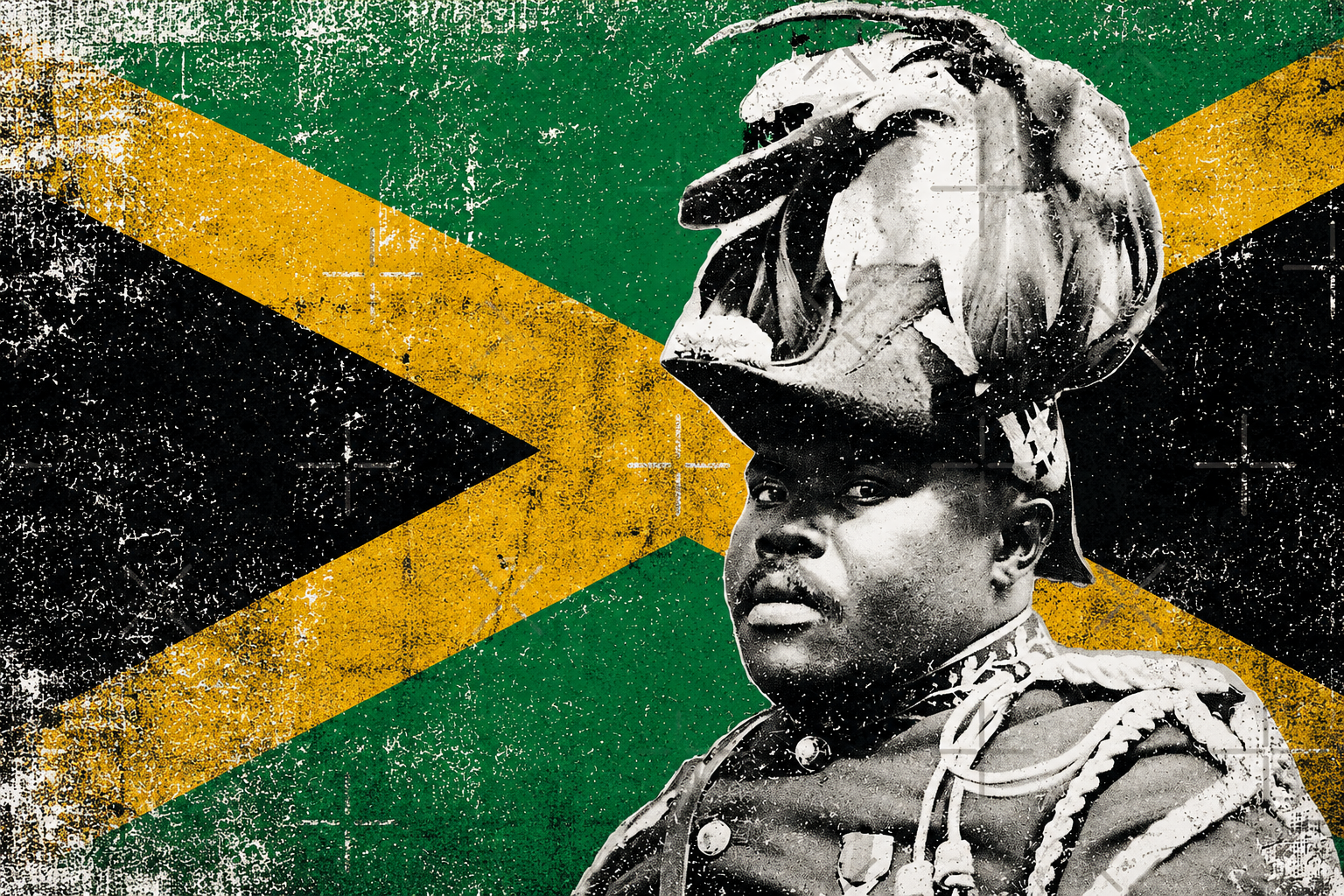
In 1999, a small island nation confronted the consequences of decisions made — and deferred — across a decade. Debt consumed more than half the national budget. A financial crisis had stripped thousands of families of their homes. And then, in April, the streets erupted. Marcus Garvey had spent a lifetime insisting that economic self-determination was the only foundation on which a Black nation could stand. One hundred and twelve years after his birth, Jamaica measured the distance still to travel.
Three Days That Shook the Island
The announcement came on April 16, 1999, with the precision of a budget line and the bluntness of a hammer. The government of Prime Minister P.J. Patterson proposed a 31 per cent increase in petrol prices — a levy intended to raise J$100 million and help close a yawning fiscal gap. By the time the announcement reached communities already stretched thin by years of negative growth, it did not register as economic policy. It registered as insult.
Within hours, Kingston’s streets were alight. Roadblocks of burning tyres multiplied across the metropolitan area and spiralled outward into St. Andrew, St. Catherine, and beyond. Schools closed. Businesses shuttered. Airlines and cruise lines — the lifeblood of a tourism-dependent economy — began cancelling bookings as images of the unrest circled the globe. Over three days of rioting, nine people were killed, more than 160 were arrested, and millions of dollars in property was destroyed. Jamaica had not seen civil unrest of this scale in a generation.
Patterson moved swiftly to contain the political damage. A special cabinet committee was convened over the weekend, and by Monday the Prime Minister announced a 50 per cent reduction in the proposed fuel levy — cutting the increase to roughly 15 per cent instead of 31 per cent. To offset the J$37 million shortfall this created, a new 15 per cent tax on investment interest was introduced alongside a reduction of savings account interest taxes from 25 to 15 per cent. It was a compromise that satisfied no one entirely, yet it steadied the streets.
What the gas riots clarified, more sharply than any economic report could, was the compound nature of Jamaica’s crisis in 1999. The fury was not only about petrol prices. It was about the accumulated weight of stagnant wages, collapsed businesses, foreclosed properties, and a government that appeared to be asking the poorest citizens to bear the greatest burden of a debt crisis they had not engineered. “The events of last week,” Patterson acknowledged, “served to remind us that any solution cannot succeed without the understanding of the people.”
Out of that moment of rage, something unexpected took shape. In the weeks that followed, a small group of concerned citizens began meeting to discuss what the riots had revealed — not only about economic inequality, but about policing, the justice system, corruption, and the structural exclusions that made ordinary Jamaicans so vulnerable. On October 15, 1999, approximately twenty people gathered at a private home in Jacks Hill and formally incorporated what would become Jamaicans for Justice. The burning streets of April had, improbably, lit the foundations of one of Jamaica’s most enduring civil society organisations.
When a government raises the price of getting to work, it is not raising the price of petrol. It is raising the price of belonging to the economy at all.
The Weight of Borrowed Money
The numbers that framed Jamaica’s 1999 were stark, but their true weight lay in what they had accumulated over a decade of structural difficulty. Real GDP contracted by 0.5 per cent — the third consecutive year of negative growth. GDP per capita fell to USD 2,465, down from USD 2,681 the previous year. Inflation, while dramatically lower than in earlier years, still ran at 5.9 per cent. The unemployment rate held at 15.5 per cent, with women and young people disproportionately excluded from formal employment.
But the figure that explained the gas riots better than any other was this: 62 per cent of the government’s total budget was consumed by debt service. Of every dollar that flowed into public coffers, sixty-two cents was obligated before a school opened, a hospital received supplies, or a road was repaired. Social and community services — education, health, housing — received 17.9 per cent of the budget. Economic development received 5.7 per cent. The architecture of fiscal Jamaica in 1999 was a machine designed almost exclusively to service the consequences of past borrowing.
The internal debt burden had ballooned from J$121 billion in 1998 to J$154.4 billion by August 1999. The external debt stock stood at USD 3.03 billion. The government had planned to borrow a further J$68.2 billion during the fiscal year — 26.3 per cent from external sources and 73.7 per cent domestically. Commercial bank lending rates averaged 38 per cent in the first nine months of the year, making private investment a near-impossibility for small and medium-sized enterprises. The Bank of Jamaica reduced commercial bank cash reserve requirements from 25 per cent to 16 per cent during the year, in an effort to ease credit conditions, but with interest rates at those levels, the loosening of reserve requirements offered cold comfort to entrepreneurs.
Trade had become a source of strain rather than strength. Total exports reached USD 1.246 billion against imports of USD 2.728 billion, producing a trade deficit of USD 1.482 billion. The apparel sector, once a significant employer in free zones across the island, had lost 42 per cent of its workforce since 1994. In 1999 alone, four factories closed. The economy’s service sector, employing roughly 60 per cent of the workforce, carried nearly all the weight of GDP generation — some 77 per cent — yet remained structurally dependent on the performance of industries, particularly tourism, that were vulnerable to external shocks.
Houses Lost, Dreams Deferred
For thousands of Jamaican families, the crisis of 1999 was not an abstraction measured in basis points and fiscal ratios. It had an address, a front door, and a monthly mortgage payment that had become impossible to meet. The Financial Sector Adjustment Company — FINSAC — which had been created in 1997 to manage the collapse of Jamaica’s near-insolvent banking sector, continued in 1999 to dispose of the assets it had acquired, including the mortgaged homes and commercial properties of borrowers who had defaulted at the peak of the crisis.
Approximately 24,000 loan accounts were sold by FINSAC to the Jamaica Redevelopment Foundation, an entity established to manage the remaining portfolio. These were not dry financial instruments. They were people’s homes, businesses, and generational ambitions — assets that had been acquired through savings, sacrifice, and what had, at the time of borrowing, seemed like reasonable planning. When interest rates climbed to 120 per cent at the height of the crisis, repayment became arithmetically impossible for borrowers who had taken loans at far lower rates. Properties were seized and sold, often at fractions of their original value, with the residual debt pursuing borrowers long after the property was gone.
The human testimonies that emerged from this period read as a litany of dispossession. A couple who had built their home in Grosvenor Terrace found it seized and sold below market value; they were left both homeless and in debt. A man in Patrick City lost his house and moved his family into a single room. A construction contractor whose J$80 million loan had swollen to over J$1 billion through compounding interest at crisis-era rates found himself legally liable for a sum no business of his scale could ever repay. These were not outliers. They were representative of what had happened to an entire stratum of Jamaica’s aspiring middle class — people who had done precisely what economic orthodoxy and home ownership culture encouraged them to do, and who had been destroyed for it.
Marcus Garvey had understood, with a clarity that now appeared prophetic, that property ownership was not merely a personal aspiration. It was the mechanism through which communities accumulated generational wealth, built political leverage, and secured their children’s futures. FINSAC had not simply destroyed personal balance sheets. It had interrupted the transmission of that wealth across generations, leaving gaps where assets should have stood.
Homeownership Under Siege
Against this backdrop, the headline figure of 57.9 per cent home ownership in Jamaica in 1999 appeared, on its surface, relatively strong. More than half of Jamaican households owned the roof above their heads — a statistic that would compare favourably with many nations. Yet the figure masked profound structural vulnerabilities. A significant proportion of what counted as ownership was informal: homes built on untitled land, inherited through customary family arrangements rather than registered transfers, or located in settlements that existed outside the formal planning and land registry system.
Jamaica’s 1997 National Land Policy had identified land titling as a critical foundation for economic development, noting that unregistered and informally held land could not function as productive economic collateral. Without a registered title, a homeowner could not borrow against their property to start a business, improve their house, or send a child to university. The asset existed — but it existed in a legal half-light that excluded it from the formal economy. This was precisely the condition that the economist Hernando de Soto had been identifying across developing countries throughout the 1980s and 1990s: billions of dollars in “dead capital,” locked inside communities that could not mobilise it.
The National Housing Trust continued to provide mortgage financing for Jamaicans in formal employment during 1999, operating as the primary institutional mechanism for home acquisition by working-class and lower-middle-class families. Yet with the housing deficit estimated to require 15,000 new units per year simply to keep pace with population growth, and with commercial interest rates running at 38 per cent, the gap between housing need and housing supply remained severe. Squatter communities, long a feature of Jamaican urban life, continued to grow — not as a failure of character but as a rational response to an unaffordable formal housing market and a land registration system that had never been modernised to match the scale of demand.
A people who cannot hold title to the land beneath their feet are a people perpetually one crisis away from dispossession — regardless of how many years they have worked that ground.
The Dial-Up Nation
On September 30, 1999, the government signed an agreement that would, over the coming years, transform Jamaica’s economic and social infrastructure more profoundly than almost any other single policy decision of the decade. The “New Connections” agreement ended Cable & Wireless Jamaica’s exclusive monopoly over telecommunications services — a monopoly that had originally been scheduled to run until 2013. In exchange for relinquishing those rights early, the company received a compensation package. The government committed to auctioning two cellular phone licences in 2000 and to creating an open-market environment for telecommunications providers.
At the moment of signing, the practical implications remained theoretical. Cable & Wireless still controlled Jamaica’s fixed-line telephone infrastructure, its international call routing, and the pricing of services that kept Jamaica expensive to reach and expensive to call from. International call revenues had long subsidised the company’s domestic rates, meaning that liberalisation would require a fundamental restructuring of how telecommunications services were priced and delivered. The full impact of the 1999 agreement would only become visible over the years that followed, as competitors entered the market and mobile telephony expanded access to communities that had never had a landline.
But the signing itself was significant. It represented a recognition — belated but real — that monopoly provision of essential communications infrastructure was an economic drag that Jamaica could no longer afford. For a country with 637,000 nationals living in the United States alone, the cost and difficulty of communicating across the diaspora was not a minor inconvenience. It was a barrier to investment, to family cohesion, and to the flow of remittances that had become, by 1999, one of the most important pillars of the Jamaican economy.
Bananas, Bauxite, and the Shrinking Harvest
Agriculture, which employed approximately 21 per cent of Jamaica’s workforce in 1999 and contributed 7 per cent of GDP, was navigating a confluence of pressures that had no easy resolution. Sugar, which had been the defining economic activity of colonial Jamaica and had retained significant employment in rural parishes through the post-independence decades, faced structural competition from producers with far lower costs. High production expenses, ageing equipment, and the lingering effects of adverse weather patterns had squeezed margins across the sugar belt.
The banana sector faced a different but equally serious challenge. Jamaica exported approximately 76,978 tonnes of bananas to the European Union in 1997, benefiting from preferential trade arrangements established under the Lomé Convention that had given Caribbean producers privileged access to European markets. But by 1999, those arrangements were under sustained pressure from a World Trade Organisation dispute initiated by the United States — acting largely on behalf of US-owned multinationals operating large-scale plantations in Latin America — which argued that the EU’s preferential quota system for ACP banana producers was incompatible with WTO rules. For the Windward Islands, where bananas accounted for more than half of export earnings, the stakes were existential. For Jamaica, where banana cultivation was one component of a more diversified agricultural base, the threat was significant but not terminal — yet.
For rural communities in banana and sugar-growing parishes — St. Thomas, Westmoreland, St. Elizabeth, Clarendon — the economic deterioration in agriculture translated into unemployment, migration to Kingston, and the hollowing-out of community institutions. These were places where Garvey’s vision of prosperous, self-sustaining agricultural communities had once seemed most plausible. By 1999, they were experiencing the opposite: the erosion of the productive base upon which that vision had rested.
A Diaspora Lifeline
Remittances from Jamaicans overseas had grown from approximately USD 183 million in 1991 to over USD 600 million annually by 1999 — a rise that reflected both the growth of the Jamaican diaspora and the increasing ease with which money could be transferred internationally. Approximately 637,000 Jamaican-born individuals lived in the United States; substantial communities existed also in the United Kingdom, Canada, and across the Caribbean. Together, they were performing an act of economic solidarity that no formal aid programme could replicate in scale or efficiency: sending money directly to family members who could use it immediately for rent, school fees, medical expenses, and small business needs.
The formal remittance infrastructure of 1999, however, was far from efficient. Transfer fees were high, exchange rates often unfavourable, and the telecommunications monopoly meant that keeping in contact with family across the Atlantic was expensive. The Bank of Jamaica classified remittances as a component of the current account but had limited visibility into the full flow of informal transfers — cash sent through returning travellers, goods shipped back, or informal hawala-style arrangements within diasporic communities. The official figure of USD 600 million-plus was itself probably an undercount.
Jamaica had a “Return of Talent” programme by this period, designed to encourage skilled members of the diaspora to bring expertise back to the island. Return migration had peaked in the early 1990s — 2,493 returnees in 1993 and 2,417 in 1994 — and the flows had moderated since. But the interest in return, and in investment in Jamaican property from abroad, remained a consistent current within diaspora communities. For those who had left during the crisis years and were watching from New York or London or Toronto, the question of whether Jamaica was a safe destination for savings, investment, or eventual retirement remained very much open in 1999.
A Cancelled Stage, A Record Road March
The cultural calendar of 1999 carried the contradictions of the year within it. Reggae Sunsplash, the festival that had placed Jamaica on the global music map since 1978 and had served as an annual celebration of the island’s most powerful cultural export, was cancelled. Financial pressures and promotional difficulties had accumulated over several years, but the specific trigger in 1999 was a dispute over the festival’s use of Bob Marley’s name and image. Rita Marley made clear that she would not endorse events that carried her late husband’s name without the family’s oversight and approval. The silence where Sunsplash had been was felt not only in the music industry but in the hotel rooms, transportation revenues, and food stalls that had depended on the annual influx of visitors it generated.
And yet, in the same year, Jamaica Carnival experienced what its principal promoter, Byron Lee, described as its most successful edition in history. The Easter road march on April 11 — just five days before the gas riots — drew 40,000 revellers through the streets of New Kingston, a turnout that exceeded every previous year. Lee was already pressing the government to provide formal marketing support, arguing that Carnival had the potential to become a year-round driver of tourist arrivals if it were packaged and promoted as a distinct Jamaican cultural product rather than a derivative of Trinidad’s model. The contrast between a cancelled Sunsplash and a record-breaking Carnival captured something of the cultural moment: the old certainties were under pressure, and new energy was finding its own channels.
A nation’s culture does not pause for an economic crisis. It reshapes itself around the crisis — sometimes mourning, sometimes celebrating, always making meaning from the conditions it is given.
Garvey’s Measure: Against the Yardstick
Marcus Garvey was born in St. Ann’s Bay in 1887. By 1999, one hundred and twelve years had passed since his birth and sixty years since his death in London, in exile, without having seen the political liberation of Africa or the economic liberation of the Black diaspora that he had dedicated his life to pursuing. Jamaica had been independent for thirty-seven years. The question this series poses is not whether Garvey’s specific prescriptions were correct in every particular, but whether the condition of Jamaica in any given year moved closer to or further from the vision of dignified, self-determining, economically grounded nationhood that he articulated.
By that measure, 1999 was a year of serious retreat. The dispossession of thousands of homeowners through the FINSAC process was not merely a financial event. It was the destruction of the very form of asset accumulation that Garvey had identified as the bedrock of community power. The fiscal architecture that channelled 62 per cent of the national budget to debt service was an architecture of dependency — not on colonial masters, but on international creditors whose conditions shaped domestic policy in ways that constrained the government’s ability to invest in housing, education, agriculture, and infrastructure. When the streets erupted in April, the fury expressed was recognisably Garveyite in its frustration: a people who felt they were not the beneficiaries but the bearers of a system designed elsewhere and applied without sufficient regard for their welfare.
And yet the year also carried evidence of a different inheritance. The remittance flows — over USD 600 million channelled directly from diaspora members to their families — represented an informal economy of solidarity that owed everything to Jamaican community bonds. The formation of Jamaicans for Justice out of the gas riots showed a civil society capable of converting grievance into institutional energy. The telecommunications liberalisation agreement, however modest its immediate effects, opened a door that had been sealed for decades. These were not transformations. But they were movements — small, contested, uncertain — in directions that a more equitable and self-determining Jamaica might, over time, need to travel.
Tourism in 1999 drew approximately 1.25 million stopover visitors and 760,000 cruise passengers to the island — a performance that demonstrated the persistent appeal of Jamaica’s landscape, hospitality, and culture even amid domestic turbulence. But with tourism estimated at 15 per cent of GDP and foreign exchange earnings dominated by a sector almost entirely owned and controlled by international hotel and cruise corporations, the wealth generated did not distribute itself evenly across Jamaican communities. A Garveyite economics would have asked not merely how many tourists arrived but how much of the revenue from their visits was retained within Jamaican-owned enterprises, communities, and land.
The Legacy Lives On
Standing at the end of 1999 and looking forward, what could a thoughtful observer have concluded about Jamaica’s trajectory — without recourse to the hindsight we now possess, but drawing only on what was known and visible in that December?
The financial crisis had crested. Inflation was falling. The telecommunications monopoly had cracked. A civil society organisation had emerged from the violence of April. The diaspora was sending money home in volumes that no foreign aid budget could match. These were not small things.
But the structural challenges that had produced the gas riots, the FINSAC foreclosures, and three consecutive years of economic contraction had not been resolved. They had been managed, deferred, partially addressed. The debt burden that consumed 62 per cent of the government budget would not disappear in a year or two. The housing deficit that left hundreds of thousands of Jamaicans in informal settlements or in rental accommodation they could barely afford would require sustained investment, land reform, and title regularisation on a scale that 1999’s public finances could not support. The agricultural communities of rural Jamaica, hollowed out by declining sugar and banana revenues, faced a structural transition whose ultimate direction was still unclear.
What 1999 suggested, above all, was that Jamaica was a nation whose people possessed extraordinary reserves of resilience, creativity, and solidarity — resources that were perpetually under-leveraged by a political and economic system that had not yet found a way to translate them into the self-determining prosperity that Garvey had insisted, a century before, was their birthright. The burning year had not resolved that question. It had simply made it more urgent.
Series note: This is Edition 2 of Marcus Garvey & The Making of Modern Jamaica — an ongoing editorial series examining Jamaica’s journey through the lens of Garvey’s enduring vision. Edition 1 (1887–1998) explored the historical foundations of independent Jamaica. Edition 3 (2000) follows. All events, statistics, and developments referenced in this article were publicly known as of 31 December 1999. No subsequent knowledge has been introduced.
Follow Jamaica Homes on Youtube @jamaicahomes and Instagram @jamaica_homes and on Facebook @jamaicahomesnews Send us a message or email us at onlinefeedback@jamaica-homes.com or editor@jamaica-homes.com
Support independent Jamaican journalism.
- 1Our journalists cover housing, politics and community — stories that directly affect Jamaican lives.
- 2We have no billionaire owner and no advertisers calling the shots. Every story is decided by our editors.
- 3It costs less than a cup of coffee a week, and takes less time to subscribe than it took to read this article.
Support Jamaica Homes News today.
- Save 17% compared to monthly
- All articles unlocked
- Weekly newsletter
- Priority support
By subscribing you agree to our Privacy Policy and Terms.

Visit our YouTube Community ↗