

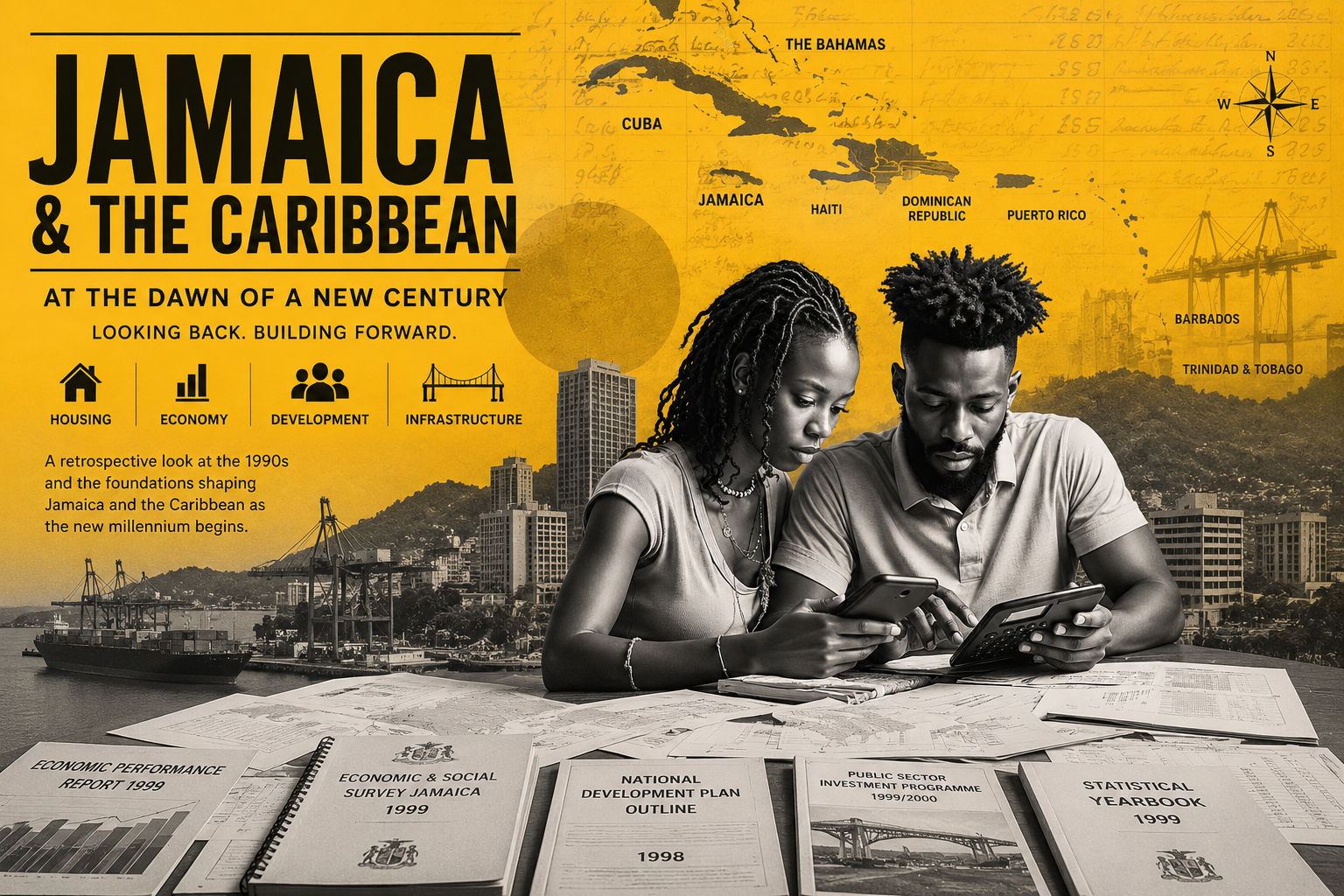
On 3 September 2020, Andrew Holness led the Jamaica Labour Party to an election victory of historic proportions, winning 49 of 63 parliamentary seats against a People’s National Party that was reduced to 14 — the most lopsided result in Jamaican electoral history, a mandate that was as much a verdict on four years of economic management as on anything the PNP had offered as an alternative. The election was called during a pandemic, held under health protocols, and delivered the most decisive approval of fiscal discipline that any Caribbean electorate has produced. We record here, from October 2020, what Jamaica’s economy looked like in the final quarter of 2019 — the last quarter before COVID erased the numbers and an election that COVID could not stop vindicated them.
- Full-year 2019 GDP growth confirmed at approximately 1.0%, with debt near 90% of GDP.
- Tourism 2019 delivered the ninth consecutive annual record with 2.68 million stopover arrivals.
- Winter season 2019-20 opened strongly before COVID arrivals ended it by March 2020.
- Nigel Clarke, Finance Minister from May 2019, maintained fiscal discipline through transition.
- JLP won landslide election September 3, 2020, with 49-14 seats on a COVID-safe mandate.
- COVID contracted the 2020 economy sharply; debt ratio rising, recovery efforts under way.
The fourth quarter of 2019 was Jamaica at its confident best. The ninth consecutive tourism record had been confirmed in the third quarter, and what followed — the October-to-December period that opens the Caribbean’s premium winter season — brought forward-booking numbers for the 2019–20 winter that were the strongest the island’s hotel operators had seen. The Jamaica Tourist Board reported that early bookings for January and February 2020 were running twenty per cent above the prior year’s equivalent period, a pace that would have made 2019–20 a tenth consecutive tourism record, had the pandemic not closed the airports four months into the season. For those who work in Jamaican hospitality — the room attendants, the line cooks, the taxi drivers who ferry visitors from Sangster International to the resort strips — the winter of 2019–20 was shaping up to be the best of their working lives. Then it was not.
The full-year 2019 GDP figure, confirmed by STATIN in its preliminary release, settled at approximately 1.0 per cent — a modest moderation from 2018’s 1.9 per cent but a figure that, in the context of the reform decade’s trajectory, still represented solid performance for a small, open economy in a period of moderating global growth. Jamaica’s tourism sector delivered total stopover arrivals of 2.68 million for the calendar year, exceeding 2018’s 2.47 million and setting a new record that now stands as the pre-COVID benchmark. Bank of Jamaica data for the year showed the debt-to-GDP ratio ending at approximately 90 per cent — sixty percentage points below the 2013 peak, a decline that few reform programmes in emerging market history have matched in pace or duration.
Nigel Clarke, who replaced Audley Shaw as Finance Minister in May 2019, used the Q4 period to begin laying the groundwork for what he intended to be the next phase of Jamaica’s fiscal framework — the transition from the post-crisis consolidation of the EFF and SBA years toward a growth-oriented budget framework that would take the institutional discipline of the reform era and deploy it in service of the development investments that the country had been unable to afford at the height of its debt crisis. Clarke’s presentations to the business community in late 2019 spoke of an economy that was entering a new chapter: debt below 90 per cent and declining, unemployment at historic lows, institutions functioning. The script he wrote for 2020 was then rewritten entirely by a virus.
What COVID did to Jamaica’s economy in 2020 requires a different vocabulary from the one this publication has used through the reform years. The language of adjustment — primary surplus, primary surplus target, review compliance — was replaced by the language of emergency: Rapid Financing Instrument, food distribution, curfew, border closure. The Ministry of Finance confirmed in mid-2020 that the economy would contract by between 10 and 12 per cent in fiscal year 2020–21 — a shock larger in a single year than the entire cumulative contraction of the EFF period. The debt ratio, which had taken six years of primary surpluses to bring from 145 per cent to 90 per cent, will rise by fifteen to twenty percentage points as GDP shrinks and borrowing increases. The deficit that COVID requires is not a policy choice; it is the arithmetic of survival.
The election of 3 September 2020 was, in its way, one of the more remarkable events in Jamaica’s political history. Holness dissolved parliament, called the election during a pandemic, and won 49 of 63 seats — a majority so large that it would have been implausible if predicted in advance. The result was interpreted by psephologists and political economists as a compound verdict: approval of the economic management of the EFF and post-EFF years, approval of the government’s handling of the early COVID response, and a rejection of an opposition that had no credible alternative to offer on either economic or public health grounds. The JLP’s campaign had argued, in essence, that the Jamaica Labour Party had fixed the economy once and could fix it again. Forty-nine electoral districts agreed.
Writing in October 2020, the tourism sector is partially operating. The Jamaica Tourist Board reports that the “resilient corridor” protocol — a system that allows vaccinated or tested tourists to stay within designated resort areas — is generating some occupancy, though at levels far below 2019. The BPO sector has adapted more successfully to the crisis than almost anyone predicted: the workforce that built the sector’s employment base from 10,000 to 40,000 in fifteen years proved capable of shifting to work-from-home arrangements at speed, and BPO revenues have held up better than any other tourism-adjacent sector. BPIAJ reports that most major operators maintained their Jamaican workforce through the crisis, recognising that the alternatives — rebuilding a trained workforce from scratch — would cost more than the subsidies required to keep people employed through a pandemic of uncertain duration.
What This Means
Q4 2019’s numbers — 1.0 per cent growth, 2.68 million tourists, 90 per cent debt — are not simply statistics of a good year. They are the high-water mark against which the COVID recession will be measured, and the foundation on which the post-COVID recovery will be built. The institutional assets that Jamaica constructed during the reform decade — credible fiscal rules, an independent and inflation-targeting central bank, an EPOC oversight mechanism, a sovereign credit profile that allows market access at reasonable rates — survived the shock intact. They did not prevent the economic damage, because no institutional framework can prevent a pandemic from collapsing tourism. But they mean that the Jamaica that must now rebuild is starting from a qualitatively stronger position than it occupied at the beginning of the reform decade.
The Road Ahead
The Holness government enters its second term with a 49-seat mandate and a shattered economy. Finance Minister Nigel Clarke has committed to restoring the fiscal framework — the primary surplus, the debt reduction trajectory, the IMF monitoring relationship — as soon as conditions permit, while managing the immediate imperative of pandemic support for households and businesses that cannot wait for the macroeconomic recovery to arrive. The path back to the 2019 numbers is not short: tourism will not return fully until global vaccination is widespread, and unemployment will not return to historic lows until the hotels reopen at 2019 occupancy levels. But for an island that proved, between 2013 and 2019, that it could do something most small developing economies cannot — make a fiscal adjustment work and make growth follow it — the task of recovery is at least familiar in kind, if not in origin.
Follow Jamaica Homes on Youtube @jamaicahomes and Instagram @jamaica_homes and on Facebook @jamaicahomes Send us a message or email us at onlinefeedback@jamaica-homes.com or editor@jamaica-homes.com
Support independent Jamaican journalism.
- 1Our journalists cover housing, politics and community — stories that directly affect Jamaican lives.
- 2We have no billionaire owner and no advertisers calling the shots. Every story is decided by our editors.
- 3It costs less than a cup of coffee a week, and takes less time to subscribe than it took to read this article.
Support Jamaica Homes News today.
- Save 17% compared to monthly
- All articles unlocked
- Weekly newsletter
- Priority support
By subscribing you agree to our Privacy Policy and Terms.
