


- Jamaica’s GDP contracted 10.2% in 2020 — worst in four decades.
- Tourism revenue collapsed 65% to US$1.26 billion in 2020.
- Diaspora remittances set a record: US$3.3 billion in 2021.
- JLP won a historic landslide: 49 parliamentary seats to 14.
- Steel prices surged 46% in just five months during 2021.
- Construction sector grew 6.2% even as the economy contracted sharply.
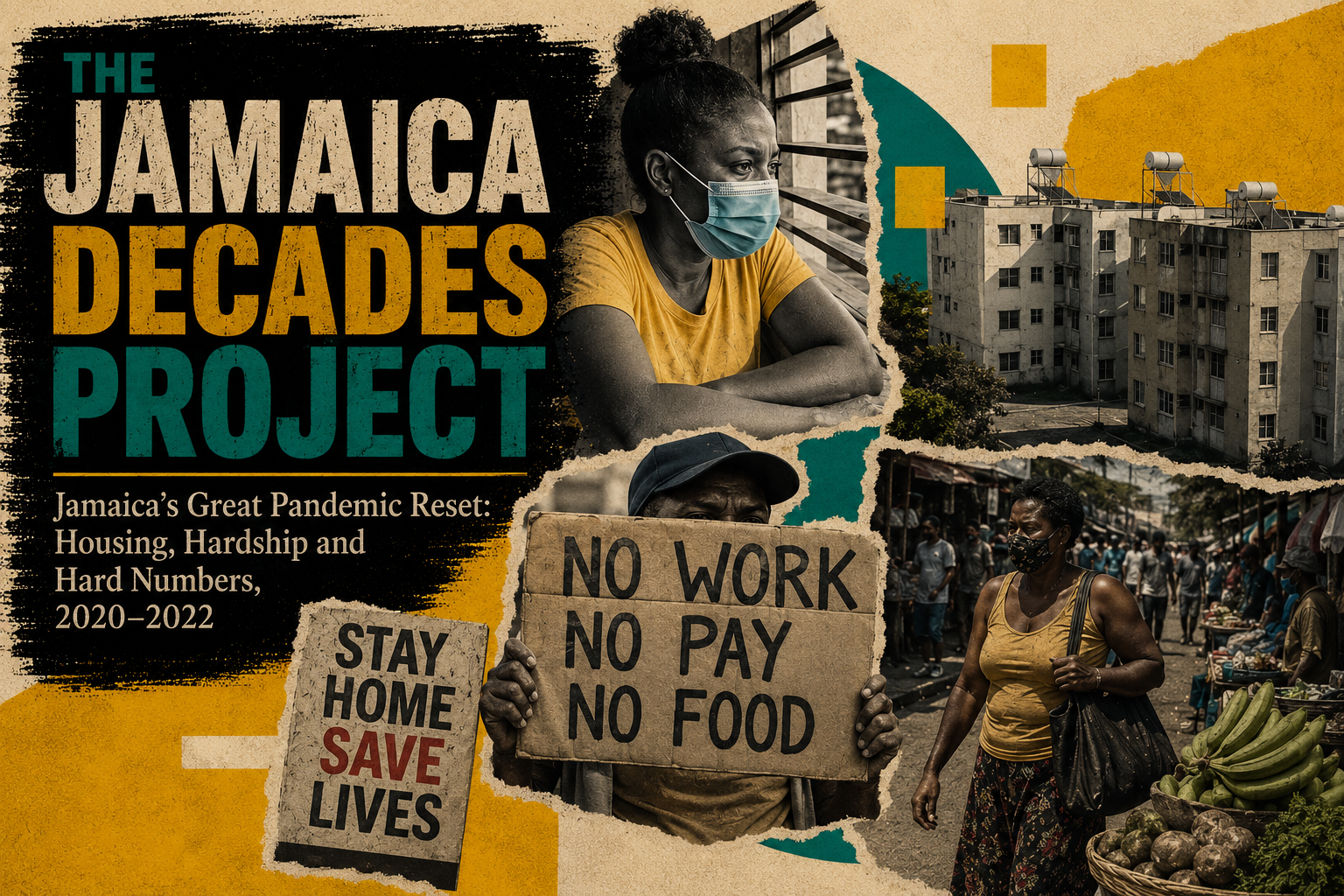
When COVID-19 arrived in Jamaica on March 10, 2020, it triggered the island’s worst economic contraction in almost four decades — a -10.2 per cent collapse in GDP that stripped away twenty consecutive quarters of uninterrupted growth in a matter of months. Tourism, which had underpinned nearly a third of the island’s economy, lost 65 per cent of its revenue in a single year. Yet the same crisis that emptied the hotels and shuttered the bars also revealed something enduring about Jamaica’s economic architecture: a diaspora whose remittances defied every global forecast, a property market whose underlying demand proved stubbornly resistant to shock, and a workforce that pivoted to remote work — in many cases for the first time in its life — with a speed that surprised even its most optimistic advocates.
When the Island Went Silent: The First Days of COVID-19
The confirmation came on a Tuesday. On March 10, 2020, Jamaica’s Ministry of Health announced the island’s first confirmed case of COVID-19 — a returning traveller who had carried the virus back from abroad. At that moment, the quarterly GDP data showed a contraction of just -1.7 per cent year-on-year for January through March: the pandemic had arrived too late in the first quarter to do its worst. What followed in April, May and June would be unlike anything in the living memory of most Jamaicans.
Within days of the March 10 announcement, the government moved with unusual decisiveness. Schools shuttered. International borders closed to passenger movement. Work-from-home orders, curfews and mandatory mask regulations arrived in rapid succession. By April 1, 2020, an island-wide twelve-hour curfew was formally in force. The curfew’s rules were specific and granular in the way that emergency regulations always are: retail businesses could operate only between 8am and 4pm; markets from 6am to 4pm on Mondays through Saturdays; gas stations from 6am to 6pm; public transportation from 5am to 7pm. Gatherings of more than ten persons were prohibited. Beaches, bars, nightclubs and rivers — those open-air social institutions that define Jamaican leisure — were closed. Persons aged seventy and over were issued a stay-at-home order. The island that had welcomed 2.68 million stopover overnight visitors in 2019 was, abruptly, closed to the world.
The human texture of that closure is worth dwelling on, because the aggregate statistics that follow can obscure it. Jamaica is not a large economy in global terms, but it is a densely social one. Tourism employs people not just in the headline hotel and restaurant categories but across an intricate web of informal economic relationships — the taxi driver, the craft vendor, the jerk chicken operator who feeds hotel workers on the night shift, the sound system operator who books the hotel’s weekly beach party. When the tourism sector contracted by 53.5 per cent for the full year 2020 — and by a staggering 85 to 87.5 per cent in the second quarter alone — that contraction cascaded through every one of those relationships simultaneously. The Statistical Institute of Jamaica recorded that employed persons fell from 1,254,100 in July 2019 to 1,118,300 in July 2020: a loss of 135,800 jobs in twelve months. These were not anonymous statistical units. They were, in overwhelming proportion, people whose livelihoods had been built on serving visitors who were no longer coming.
The government’s social protection response was rapid by Caribbean standards. The PATH programme — the Programme of Advancement Through Health and Education, Jamaica’s primary conditional cash transfer mechanism — received emergency supplementary support with UNICEF assistance. More significantly, the government created an entirely new instrument: the CARE Programme (COVID-19 Allocation to Restore the Economy), which initially targeted 350,000 Jamaicans with new grants and ultimately reached approximately 500,000 recipients by September 2021. CARE provided an automatic grant of JMD 18,000 to unemployed recipients and included a Self-Employed and Temporarily Unemployed component for workers who had lost positions on or after March 10, 2020. The World Bank ultimately allocated US$150 million in 2021 toward Jamaica’s recovery and social protection expansion. These were substantial interventions for an economy of Jamaica’s size, and they blunted — though they could not eliminate — the poverty impact of the contraction. Independent analysis estimated the poverty rate rose from approximately 19 per cent to approximately 23 per cent in 2020, reversing years of gradual progress.
The Anatomy of Collapse: GDP, Employment and Exchange Rate Pressure
The quarterly breakdown of GDP performance in 2020 illustrates, with unusual clarity, how an economy is dismantled by a pandemic. The first quarter contraction of -1.7 per cent was almost incidental — a mild dip caused by the first few weeks of restrictions before the full weight of the crisis arrived. The second quarter was catastrophic: -18.4 per cent year-on-year, driven by the near-total cessation of international tourism and the attendant multiplier effects on every service sector that fed from it. Hotels and restaurants contracted by between 85.6 and 87.5 per cent in a single quarter. Transportation, storage and communications fell 13.5 per cent for the year. Mining and quarrying dropped 21.7 per cent. Other services shed 23.4 per cent. The services industry as a whole contracted 11.3 per cent, while even the goods-producing sector — partially insulated by its relative independence from tourism — contracted 4.7 per cent.
The full-year result, confirmed by the Planning Institute of Jamaica at -10.2 per cent, was the weakest annual economic performance in almost four decades. PIOJ Director General Dr. Wayne Henry described it in those terms explicitly, and the description was accurate: one had to reach back to the severe dislocations of the 1980s to find comparable damage. The fiscal year 2020/21 contraction was projected between -10.5 and -12.5 per cent, compounding the calendar-year shock. Twenty consecutive quarters without a contraction — a run of sustained growth that had been Jamaica’s proudest recent economic achievement — ended in a matter of months.
The Labour Market in Freefall
Jamaica’s unemployment rate, which had fallen to a pre-pandemic low of 7.3 per cent in January 2020, reached 12.6 per cent by July of that year. That headline figure conceals a more granular picture of concentrated pain. Youth unemployment for persons aged 14 to 24 reached 30.4 per cent — meaning nearly one in three young Jamaicans who sought work could not find it. Female youth unemployment stood at 24.7 per cent. Adult female workers faced marginally steeper proportional job losses than males (11.2 per cent versus 10.5 per cent), with female unemployment reaching 14.0 per cent against 11.5 per cent for men — a gap that reflected the concentration of women in the hardest-hit service and hospitality roles.
The sectoral job loss data published by the Statistical Institute of Jamaica maps the crisis with precision. Accommodation and food services shed 32,900 positions — a 29.5 per cent decline in the sector’s workforce. Arts, entertainment and recreation lost 20,100 jobs, or 16.1 per cent. Construction lost 18,900 positions despite the sector’s relative activity (largely reflecting the second-quarter shock before the sector’s exemption from restrictions took effect). Transportation and storage lost 14,800 workers. Manufacturing shed 10,100. Tourism as a category lost 39,100 positions in total, falling from 161,500 to 122,400 employed persons — a 24.2 per cent reduction in the workforce of Jamaica’s defining industry. The social scale of this disruption was captured in a single STATIN data point: 57.4 per cent of Jamaican households experienced income reduction during the pandemic, affecting 262,900 wage-earning households, 166,200 non-farm business households, and 106,300 farming and fishing households.
Exchange Rate Pressure and the Cost of Imported Essentials
Foreign-exchange pressure arrived alongside the job losses. The Jamaican dollar had been on a long, gradual depreciation trajectory for decades, but the tourism collapse accelerated the process sharply in 2020. When tourism generates roughly 53 per cent of Jamaica’s total export receipts and accounts for approximately 20 per cent of GDP, the sudden cessation of foreign-visitor spending creates an acute shortage of the hard currency the economy needs to service imports and debt. Finance Minister Nigel Clarke noted explicitly that tourism foreign-exchange earnings had dried up. The exchange rate moved from approximately JMD 136.05 per US dollar in March 2020 to JMD 148.28 per US dollar by July 2020 — a depreciation of roughly nine per cent in just four months. The Bank of Jamaica, prioritising support for borrowers and economic activity over price stability, held its policy interest rate at a historic low of 0.5 per cent through the early pandemic period. That rate was unprecedented in the institution’s history and had the intended effect of reducing borrowing costs, but it also meant that savings earned essentially nothing in real terms against even moderate inflation. As the recovery gathered pace in 2021 and 2022, global commodity price shocks — particularly in energy and food — accelerated inflation, eventually prompting the Bank of Jamaica to begin a tightening cycle that would define the subsequent period.
Tourism: The Engine That Stalled, Then Roared Back
To understand the scale of what happened to Jamaica’s tourism sector in 2020, it is necessary first to understand the scale of what it was. Tourism contributed approximately 34 per cent of total economic output before the pandemic struck, directly employed 175,000 Jamaicans, and generated indirect employment for a further 354,000. Tourism receipts represented 53 per cent of total exports and approximately 20 per cent of GDP. The Brookings Institution ranked Jamaica as the sixteenth most tourism-dependent economy on Earth. When that sector collapsed, there was no domestic sector large enough, diversified enough, or fast-moving enough to absorb the shock.
The pre-pandemic trajectory had been encouraging. The year 2019 produced 2.68 million stopover overnight visitors and total revenue of US$3.64 billion, equivalent to 21.37 per cent of gross national product. January and February 2020 had continued that momentum: stopover arrivals in January 2020 reached 227,200, a 4.9 per cent increase over January 2019. The industry was on course for a landmark year — forecasters had projected US$4.25 billion in revenue and progress toward a five-million-visitor target. Then the borders closed.
The full-year 2020 numbers were stark. Stopover overnight arrivals fell to 880,000, down 67 per cent from the 2019 figure. Same-day and cruise visitors dropped to 450,000, down 71 per cent. Revenue collapsed to US$1.26 billion — 65 per cent below the previous year’s level, and a fall from 21.37 per cent of GNP to just 8.4 per cent. Vision 2030 Jamaica’s analysis estimated that the sector would haemorrhage approximately JMD 76 billion by year-end. Hotels displaced approximately 150,000 workers. A sector that had taken a generation to build to its 2019 peak was reduced to a fraction of its former self in twelve months.
The Resilient Corridors Experiment
Jamaica’s partial reopening to international tourism on June 15, 2020 — just three months after the first confirmed case — was either a bold act of economic necessity or a reckless gamble, depending on one’s perspective. The government chose the former framing and designed a system to justify it: the Resilient Corridors model, which isolated arriving tourists within designated resort zones centred on Montego Bay and other major destinations. Visitors entering these corridors were subject to pre-departure testing, mandatory health declarations, and movement restrictions that kept them within the resort ecosystem rather than freely circulating through local communities. The model was designed explicitly to separate the economic imperative of tourism receipts from the public health imperative of community protection.
By the metrics available, it worked. The infection rate among visitors within the Resilient Corridors remained below 1.0 per cent over the first year of operation — a figure that gave the approach credibility and became a reference point for other Caribbean nations designing their own reopening strategies. The corridors did not restore tourism volume quickly — the second half of 2020 still produced deeply depressed arrivals — but they established a functional pathway back, signalled to international operators that Jamaica was open for business, and began generating at least some foreign-exchange income during a period when the current account desperately needed it.
The Road Back: 2021 and 2022
Recovery in 2021 was partial but substantial, and its character revealed something important about the nature of post-pandemic tourism. Overnight arrivals reached 1.46 million — 55 per cent of the 2019 baseline — while revenue recovered to US$2.10 billion, or 58 per cent of pre-pandemic levels. The asymmetry between these two figures — arrivals recovering at 55 per cent but revenue at 58 per cent — pointed to a compositional shift in the visitor mix. With cruise tourism still largely suppressed (cruise passengers generate lower per-day spending than stopover visitors), the remaining visitor base skewed heavily toward overnight guests who stayed longer and spent more. Average per-visitor spending rose sharply to US$1,365 in 2021, compared with US$718 in 2018 — a near-doubling that reflected both the higher-spending profile of the visitors choosing to travel and the reduced price competition in a constrained market.
By 2022, the recovery was approaching completion. Overnight arrivals reached 2.48 million — 93 per cent of 2019 levels. Revenue reached US$3.62 billion, essentially matching the pre-pandemic record at 99.5 per cent of 2019’s figure. Cruise and same-day visitors recovered to 852,300, still below 2019’s 1.55 million but moving in the right direction. The government projected 2.6 million total visitors by the year’s end. The hotels and restaurants industry, which had contracted by 87.5 per cent in a single quarter of 2020, was among the fastest-recovering sectors in the entire economy. The Resilient Corridors model, whatever its limitations as a public health instrument, had kept the institutional infrastructure of Jamaica’s tourism sector — the hotels, the supply chains, the trained workforce — alive and ready for the rebound.
The Diaspora as Economic Architecture: Remittances in the Age of Crisis
When the World Bank issued its projections for global remittance flows in the early months of the pandemic, they were pessimistic. Standard economic logic suggested that a global recession would reduce the incomes of migrant workers and therefore reduce the transfers they sent home. Jamaica, among the most remittance-dependent countries on Earth, appeared particularly exposed. Those projections proved wrong in an instructive way.
Jamaica’s diaspora — concentrated in the United States, United Kingdom and Canada, estimated at over one million persons — did not reduce its support for family members at home when the pandemic struck. It increased it. The diaspora communities most numerically significant to Jamaica were disproportionately employed in sectors that remained active through the US pandemic: construction, healthcare, transportation and essential retail. As the US federal government deployed unprecedented stimulus cheques and enhanced unemployment benefits, and as travel restrictions prevented discretionary spending on holidays and entertainment, remittance senders found themselves with both the income and the motive — family hardship at home — to increase transfers. The result was one of the most striking statistical counter-narratives of the pandemic period.
Remittance inflows to Jamaica in 2020 reached between US$2.3 and US$2.9 billion depending on measurement methodology — already at or near record levels at a moment when the domestic economy had contracted by a tenth. In 2021, inflows exceeded US$3.3 billion, with money transfer transactions surpassing twelve million in that year alone. As a share of GDP, remittances stood at approximately 15.9 per cent in the pandemic period — and given the GDP contraction, the absolute denominator had shrunk, meaning remittances’ structural weight in the economy was even greater than that ratio suggests. Senator Leslie Campbell, Minister of State in the Ministry of Foreign Affairs and Foreign Trade, described the surge at the 2022 Global Diaspora Summit in Dublin as a “strong testament of commitment” from the diaspora community — a phrase that was diplomatic, accurate, and also somewhat insufficient to convey the scale of what had happened.
Remittances in 2018 accounted for approximately 16 per cent of Jamaica’s GDP — equal to three times FDI inflows, twice external debt service requirements, and 41 per cent of total export value. During the pandemic, they grew further still.
Planning Institute of Jamaica / Bank of Jamaica Data
The pre-pandemic context sharpens the significance of this figure. Even before the crisis, remittances had accounted for approximately 16 per cent of Jamaica’s GDP — a figure equivalent to three times direct foreign investment inflows, twice external debt service requirements, and 41 per cent of total export value. The pandemic revealed this not merely as an economic statistic but as a structural fact about Jamaica’s political economy: the island’s most important financial relationship was not with any multilateral institution, bilateral lender or foreign investor, but with the million-plus Jamaicans who had left and continued to send money home.
The government drew the appropriate conclusion. The Ministry of Foreign Affairs and Foreign Trade began formally repositioning diaspora members not merely as remittance senders but as investors, partners and development agents. JN Group and other financial institutions accelerated programmes designed to channel diaspora capital into real estate and business investment rather than simply consumption support. The distinction mattered for long-term development: consumption transfers sustain households; investment transfers build assets. The pandemic period saw meaningful movement toward the latter, with diaspora real estate investment becoming a visible and structurally significant feature of the Jamaican property market for the first time at scale.
A Property Market Against the Odds: Resilience, Demand and the Diaspora Buyer
In most economies, the combination of a 10 per cent GDP contraction, a doubling of the unemployment rate and a severe currency depreciation produces a property market correction of corresponding severity. Jamaica’s residential real estate sector in 2020 and 2021 did not follow that script. While the pandemic produced genuine hardship for many Jamaicans seeking to buy or build homes, the aggregate market demonstrated a resilience that surprised analysts and shaped developer behaviour for years afterward. Several interlocking mechanisms explained this divergence from expectation.
The NHT Response: Mortgage Moratoriums and Rate Reductions
The government’s housing sector response was announced with unusual speed. On March 19, 2020 — nine days after Jamaica’s first confirmed case — Prime Minister Andrew Holness announced a package of NHT (National Housing Trust) measures designed to prevent the economic shock from triggering a cascade of mortgage defaults. The measures were concrete and immediate: a three-month mortgage payment moratorium for NHT mortgagors who had been laid off due to COVID-19, effective immediately; a six-month window from April 1, 2020 for contributors to restructure delinquent loans; and interest rate reductions of one percentage point on new loans (benefiting approximately 8,000 new mortgagors annually) and 0.5 percentage points on existing loans (benefiting roughly 100,000 current mortgagors). The Intergenerational Mortgage Programme, which allows children and parents to combine income for mortgage qualification, was extended on April 1, 2020 to include open-market purchases and construction loans — a structural expansion of access that would outlast the immediate crisis. Seniors aged 65 and above were designated as Voluntary NHT Contributors with loan tenures extended to age 70, widening the eligible borrower pool at a moment when the housing authority needed active demand to sustain its lending volumes.
These measures operated against the backdrop of the Bank of Jamaica’s historic low policy rate of 0.5 per cent — the lowest in the institution’s history. For borrowers who retained income — civil servants, healthcare workers, those in less-disrupted sectors — the combination of reduced NHT rates and the Bank of Jamaica’s accommodative stance produced mortgage affordability conditions that were, in historical terms, exceptional. The pandemic created losers and winners in the mortgage market simultaneously: those who lost income could not borrow, but those who retained it found borrowing cheaper than it had ever been.
The Diaspora Buyer Emerges as a Primary Market Force
The more structurally significant development was the emergence of the diaspora buyer as a primary rather than peripheral force in Jamaica’s residential property market. The mechanism was straightforward and powerful. As remote work spread across the United Kingdom, United States and Canada during 2020 and 2021, Jamaican diaspora members found themselves with two things they had not previously possessed simultaneously: geographic flexibility and accumulated savings. Travel restrictions had cancelled the holidays, weddings, home visits and other discretionary spending that typically absorbed diaspora income. Enhanced unemployment support in the United States and continued employment in essential sectors meant many diaspora households were financially better positioned than they had been in years, even as their emotional connection to Jamaica — sharpened by the anxiety of seeing family members at home struggle — was heightened.
A significant cohort redirected this capital toward Jamaican real estate. The purchases took multiple forms: family support (buying or improving a home for parents or relatives); investment properties to generate rental income in a market where tourist demand was expected to recover; and in a number of cases, preliminary investments toward eventual return migration that the pandemic had made seem suddenly more plausible. This demand was largely foreign-currency-denominated — transacted in US dollars, pounds sterling or Canadian dollars — which insulated it from the JMD depreciation pressures that were reducing the purchasing power of domestic buyers. A diaspora member earning in sterling and buying in JMD was benefiting from exchange rate dynamics that favoured acquisition precisely at the moment when domestic Jamaican buyers were most constrained. The construction sector’s relative exemption from COVID-19 gathering restrictions — which kept supply pipelines moving through most of the pandemic — meant that developers had product to sell into this demand surge. The result was a bifurcated market: severe difficulty for informal self-builders and lower-income aspirant homeowners; relative buoyancy for the formal sector serving diaspora and retained-income domestic buyers.
Beyond direct investment, the pandemic also altered the domestic geography of housing demand in ways that persisted beyond the crisis. Jamaicans who retained income and began working from home — 11.8 per cent of employed persons, according to STATIN data from July 2020, with 8.5 per cent working from home daily — began reassessing their spatial needs. The shift created demand for additional rooms that could serve as home offices, for larger outdoor spaces, and for locations beyond the dense residential areas of the Kingston Corporate Area. Suburban communities in St. Catherine, the cooler elevations of St. Andrew, and parish towns that offered space and amenity without urban density saw renewed interest from buyers who, for the first time, did not need to live within daily commuting distance of an office.
The Cost of Building: Materials Inflation and the Self-Builder’s Squeeze
The property market’s relative resilience in 2020 and early 2021 was tested in a different way as the year progressed: not by collapsing demand but by surging construction costs. The same global forces that were driving housing booms in North America and Europe — supply-chain disruption, pandemic-era home renovation demand, sawmill production shocks, and an extraordinary spike in international freight rates — arrived in Jamaica with full force, transmitted through the island’s near-total dependence on imported building materials.
The data points are specific enough to be instructive. In January 2021, structural steel was priced at approximately JMD 95,000 per tonne at Jamaican hardware suppliers. By May 2021, the same material had reached JMD 139,000 per tonne — a 46 per cent increase in just five months — with additional increases of JMD 19,000 per tonne reported in the weeks immediately preceding that figure. Lumber told a similar story. Construction-grade plywood that sold for JMD 3,400 per sheet in January 2021 had reached JMD 5,700 per sheet by May of the same year — the lowest available price in a market where supply had become genuinely constrained. That represented a 68 per cent increase in the cost of a single sheet of plywood in approximately four months. With approximately 95 per cent of Jamaica’s lumber imported from the United States, the island was fully exposed to the North American lumber price spike that was making headlines in its own right across that market.
Cement availability was disrupted as well, though through a different mechanism. Hardware operators reported rationing supplies across multiple locations as demand remained strong even as imported supply was subject to shipping delays. Caribbean Cement Company Limited denied supply shortfalls in public statements, while hardware stores in practice limited customer purchase quantities. At least one major hardware operator in Santa Cruz, St. Elizabeth, reported a 30 per cent decline in sales as higher prices suppressed demand from smaller builders even as underlying construction activity — measured at the aggregate level — remained robust. The divergence between aggregate construction data and the experience of individual builders was stark: the sector was growing, but a significant proportion of the people who would typically have been building were priced out of proceeding.
The freight cost component deserves separate attention. Global container shipping rates surged through 2020 and 2021 as supply chains strained, ports congested, and container equipment migrated to routes serving the highest-value cargo. For an import-dependent island economy like Jamaica, rising freight costs function as a tariff on all imported goods simultaneously — including the steel, lumber, cement, plumbing fixtures, electrical materials and finishing goods required to build a house. The surge in shipping costs compounded the commodity price increases in a way that was particularly damaging for smaller builders undertaking phased construction projects, who could not lock in prices through bulk purchasing and were therefore exposed to each new price spike as their project progressed.
What emerged was a genuinely bifurcated construction market. Large developers with access to capital, established supplier relationships, and the ability to purchase materials at scale could absorb cost increases — passing them to buyers through higher prices that the buoyant formal market could, for the most part, support. Individual self-builders, who represent a significant proportion of Jamaica’s housing stock (formal housing delivery from institutions like the NHT has never met the full extent of demand, leaving a substantial self-build sector to fill the gap), faced a different reality: projects stalled, budgets overran, completion timelines extended, and in some cases, partially-built structures were left unfinished as the gap between estimated and actual costs became unbridgeable. This dynamic — materials inflation falling most heavily on the households least able to absorb it — deepened the affordability challenge at the bottom of the market precisely when the social protection system was already under maximum strain.
Political Jamaica: An Election in the Shadow of the Virus
On September 3, 2020, with the pandemic still active and social gathering restrictions still in force, Jamaica held a general election. The decision to go to the polls was Prime Minister Andrew Holness’s and the Jamaica Labour Party’s, and it was widely characterised as a calculated political gamble — the governing party seeking a mandate at the moment when its pandemic response was most visible and before the full economic consequences of 2020 became apparent in household income and employment data. The gamble, if that is what it was, produced one of the most decisive results in Jamaican electoral history.
The JLP secured 49 seats in the House of Representatives against just 14 for the People’s National Party — a margin that was both historic in scale and instructive about the electoral dynamics of pandemic politics. Voter turnout was historically low, with large numbers of Jamaicans apparently unwilling to queue at polling stations and risk COVID-19 exposure. The suppression of turnout disproportionately favoured the governing party: opposition support, concentrated in urban areas and among younger voters who are typically hardest to mobilise under any circumstances, fell further, while the JLP’s older, more motivated base turned out to ratify a pandemic management record that had, whatever its limitations, avoided the catastrophic mortality outcomes seen in some peer economies. The result gave Prime Minister Holness a commanding mandate and confirmed the JLP as the dominant force in Jamaican politics — its third consecutive general election victory. The implications for housing policy were significant: the NHT stimulus measures, the Intergenerational Mortgage Programme expansions, and the infrastructure agenda could continue without the uncertainty of a change of government.
The political period of 2020–2022 was not defined solely by the pandemic. Jamaica continued to experience serious crime through these years, and the government maintained its strategy of States of Public Emergency across multiple police divisions simultaneously — a compound governance challenge that asked law enforcement to enforce COVID-19 curfews, manage gang-related violence, and maintain community trust at the same time. The SOEs were declared in seven police divisions during this period. The intersection of pandemic restriction and crime suppression created conditions in some communities that were, by any measure, acutely difficult: movement constrained by both curfew and the threat of violence; economic activity restricted by both business closures and security operations; and the community trust upon which both public health messaging and crime intelligence depend placed under simultaneous strain.
Digital Leapfrogging: Remote Work, Fibre and the New Economy
One of the pandemic’s more durable contributions to Jamaica’s economic structure was what it did to the relationship between Jamaicans and digital technology. The transition was not uniformly smooth — access to devices, reliable connectivity and appropriate workspace was unevenly distributed, as in every society — but the aggregate data suggests a genuinely significant shift. According to STATIN’s July 2020 labour force survey, 11.8 per cent of employed persons worked from home at least one day per week, with 8.5 per cent doing so on a daily basis. Most striking was the composition of this group: 52 per cent of those working from home in July 2020 were doing so for the first time, because COVID-19 had made it necessary. The pandemic had, in effect, run a forced experiment in remote work across the Jamaican economy and produced a workforce with at least some experience of digital-first working arrangements — experience that was not available to them eight months earlier.
The physical infrastructure for a more digital economy was developing alongside the behavioural shift. Local cable television providers and toll road operators contributed 650 kilometres of fibre-optic cables to Jamaica’s national digital backbone during this period, with bandwidth testing achieving 10 gigabits per second capacity between Kingston and Santa Cruz. National identification system legislation was passed to support digital transformation and create the legal and technical infrastructure for e-government service delivery. The World Bank’s Digital Economy for Latin America and the Caribbean diagnostic identified Jamaica as a country with significant latent potential in the digital services sector, and Vision 2030 Jamaica had long identified ICT as “playing a central role in the transformation of Jamaica over the next two decades” — a phrase that was acquiring concrete meaning rather than remaining aspirational language.
Remote work platforms began actively recruiting Jamaican professionals in 2021 for roles that would not have been available to island-based workers in a pre-pandemic world: The Bridge was recruiting Agile coaches, mobile developers, backend engineers and UX/UI designers from Jamaica in June 2021, positioning the island’s educated, English-speaking workforce as a natural resource for the global digital services economy. The government formalised this logic through a National Strategy for Jamaica’s Global Digital Services Sector, recognising that the pandemic had created both the behavioural foundation — a workforce with remote-work experience — and the geopolitical context — a global appetite for distributed digital labour — for a meaningful shift in Jamaica’s economic mix. That this shift would take years to fully materialise did not diminish the significance of its origins in the crisis years of 2020 to 2022.
Key Economic Indicators: Jamaica 2020–2022
| Indicator | 2020 (Crisis Year) | 2021 (Partial Recovery) | 2022 (Near-Full Recovery) |
|---|---|---|---|
| Annual GDP Growth Rate | -10.2% | +8%+ (IMF projected; recovery quarter) | Positive; GDP US$13.1B |
| Unemployment Rate | 12.6% (July 2020) | Declining from peak | Continued recovery toward pre-pandemic levels |
| Youth Unemployment (14–24) | 30.4% | Elevated | Recovering |
| JMD/USD Exchange Rate | ~148 JMD (July 2020) | Continued gradual depreciation | Further depreciation trend |
| Bank of Jamaica Policy Rate | 0.5% (historic low) | 0.5% then rising (tightening began) | Tightening cycle underway |
| Tourism Overnight Arrivals | 880,000 (down 67%) | 1.46 million (55% of 2019) | 2.48 million (93% of 2019) |
| Tourism Revenue (USD) | US$1.26 billion | US$2.10 billion | US$3.62 billion |
| Remittance Inflows (USD) | US$2.3–2.9 billion | US$3.3 billion (record) | Continuing elevated levels |
| Steel Price (JMD/tonne) | Baseline pre-surge | JMD 95,000 → JMD 139,000 (Jan–May 2021) | Elevated; normalising |
| Households with Income Reduction | 57.4% | Declining | Further improvement |
Era Timeline: Jamaica 2020–2022
- March 10, 2020: Jamaica confirms its first COVID-19 case — a returning traveller. The government begins immediate restrictions on public movement and gathering.
- March 19, 2020: Prime Minister Holness announces NHT mortgage moratorium, interest rate reductions and Intergenerational Mortgage Programme expansion as emergency housing sector stimulus.
- April 1, 2020: Island-wide twelve-hour curfew formally implemented. Strict business hours, ten-person gathering limit, mandatory masks and beach closures come into force.
- Q2 2020 (April–June): GDP contracts -18.4% year-on-year — the worst single quarter on record. Hotels and restaurants industry collapses by 85.6–87.5% in the same period.
- June 7, 2020: Public beaches reopen under social-distancing protocols, marking the first easing of the most acute restrictions.
- June 15, 2020: Jamaica reopens borders to international visitors under the Resilient Corridors model, isolating arriving tourists within designated resort zones.
- September 3, 2020: General election produces a historic JLP landslide: 49 seats to the PNP’s 14 — one of the most decisive results in Jamaican electoral history. Voter turnout is historically low due to pandemic concerns.
- December 2020: Confirmed COVID-19 cases reach 12,915. Full-year GDP contraction confirmed at -10.2% — the worst annual performance in almost four decades.
- January 2021: Structural steel priced at approximately JMD 95,000 per tonne at Jamaican hardware suppliers — the beginning of a dramatic materials price surge.
- March 31, 2021: COVID-19 cases reach 39,543 — the largest quarter-on-quarter increase recorded. Jamaica’s third wave strains the public health response.
- May 2021: Steel reaches JMD 139,000 per tonne (up 46% from January); construction plywood reaches JMD 5,700 per sheet (up 68% from January). The materials crisis peaks.
- 2021 (full year): Remittances exceed US$3.3 billion — a new record, with 12 million transfer transactions. IMF projects GDP growth of more than 8% for Jamaica’s recovery year.
- 2021 (full year): Tourism overnight arrivals recover to 1.46 million — 55% of 2019 levels. Revenue reaches US$2.10 billion as per-visitor spending surges to US$1,365.
- 2022: World Bank commits US$150 million for Jamaica’s recovery and social protection expansion. Tourism reaches 2.48 million overnight visitors and US$3.62 billion in revenue — near-full restoration of pre-pandemic levels.
- 2022: National Strategy for Jamaica’s Global Digital Services Sector published, formalising the government’s ambition to leverage the pandemic-era digital transition for long-term economic diversification.
Investment Legacy: What Held Value and What Did Not
Best-Performing Asset Classes and Investments
Residential real estate in the formal sector proved the most durable store of value through the pandemic years. Properties targeting diaspora buyers — particularly in resort-adjacent areas, suburban Kingston, and coastal communities in St. Ann and Hanover — maintained or increased in value. The combination of foreign-currency buying power, record-low mortgage rates and construction sector activity sustained formal property prices through a contraction that would have caused deep corrections in a more insular property market. Investors who had acquired property before March 2020 and held through the downturn captured the full benefit of the 2021–2022 recovery.
Remittance infrastructure and financial services represented the era’s most structurally advantaged positions. Money transfer operators, digital payment platforms and the banks and credit unions channelling record diaspora inflows were well-positioned throughout. Jamaica’s formal financial sector — subject to IMF programme oversight and fiscal discipline — entered the pandemic with relatively healthy balance sheets that allowed continued lending and operations through the downturn.
Construction and building supply businesses with scale were paradoxically among the better performers despite the materials crisis. Large operators with capital to bulk-purchase materials before prices peaked, or with supplier relationships that allowed preferential access to constrained stock, were able to continue projects, charge market-reflective prices, and capture the demand from diaspora buyers and the public sector alike. The sector’s exemption from COVID-19 gathering restrictions — a regulatory decision that would have been politically impossible in many countries — proved commercially decisive.
Digital services businesses saw accelerating demand through the pandemic as both domestic and international clients pivoted to remote service delivery. The small but growing community of Jamaican software developers, UX designers and remote IT professionals captured opportunities that had simply not existed in the pre-pandemic economic geography.
Worst-Performing Asset Classes and Investments
Tourism sector businesses, particularly small and medium operators, bore the worst of the pandemic’s economic force. Small guesthouses, independent restaurants, craft vendors, entertainment businesses and the informal tourism economy — all the economic activity that surrounds but is not contained within the large resort zones — had no equivalent of the Resilient Corridors to protect them. Their customer base evaporated entirely and their capital reserves were largely insufficient to survive a multi-year crisis. Many did not.
Informal self-build housing projects were savaged by the materials inflation of 2021. Families who had budgeted carefully for construction projects found themselves with approximately half the purchasing power they had anticipated when steel prices rose 46 per cent and lumber prices 68 per cent in a matter of months. Projects were abandoned, extended indefinitely, or completed to a lower standard as budget constraints forced substitution of inferior materials.
Commercial real estate and retail suffered through the lockdown period and into the recovery, with office occupancy disrupted by remote work adoption and retail footfall reduced by curfews, income constraints and shifting consumer behaviour. The recovery in this segment was slower and less complete than in residential property or tourism hospitality.
Parish Spotlight: Where Jamaica Moved and Built During the Pandemic Years
St. James (Montego Bay): The Resilient Corridors Capital
St. James and its principal city Montego Bay sat at the geographic heart of Jamaica’s pandemic-era tourism strategy. The Resilient Corridors model was centred on Montego Bay’s hotel strip, making the parish simultaneously the site of Jamaica’s greatest tourism exposure and its primary reopening experiment. The infection rate of less than 1 per cent among visitors in the corridors’ first year was a St. James data point as much as a national one, and it shaped the parish’s economic trajectory through the recovery period. Montego Bay’s large hotels — the institutional infrastructure of Jamaica’s tourism economy — remained relatively active through the second half of 2020 and accelerated through 2021 and 2022, giving the parish a recovery profile that was faster than much of the rest of the island. Real estate in resort-adjacent communities benefited from the early influx of diaspora investment, and development continued through the period at a pace that would not have been possible without the Resilient Corridors providing a functioning tourist population to anchor the local economy.
Kingston and St. Andrew: The Remote Work Hub
The Kingston Metropolitan Area — encompassing Kingston and the urban parishes of St. Andrew — emerged as Jamaica’s centre of the pandemic-era digital transition. The concentration of professional-class employment, government institutions, financial services and the island’s most developed telecommunications infrastructure meant that Kingston was both the primary site of Jamaica’s nascent remote work economy and the place most directly affected by the government’s policy response, headquartered here, to the pandemic. The demand for larger residential spaces, home offices and suburban locations pushed buyers outward from inner-city and corporate-area addresses toward communities in the cooler elevations of the Blue Mountains foothills and toward the expanding communities along the Highway 2000 corridor linking Kingston to Portmore and St. Catherine. The digital infrastructure investment — fibre-optic capacity linking Kingston to Santa Cruz via the national backbone — was centred on the capital, reinforcing its role as the logical hub for any digital services sector that Jamaica was seeking to develop.
St. Catherine and Portmore: Suburban Expansion Under Pandemic Pressure
St. Catherine, and Portmore in particular, absorbed a significant portion of the housing demand that the pandemic redirected away from Kingston’s denser urban core. Portmore — Jamaica’s largest dormitory community, housing a population that has grown substantially in recent decades as Kingston’s affordability has declined — was positioned as a destination for buyers seeking more space at lower cost, with the newly viable option of working from home removing the traditional commuting penalty associated with living there. NHT-assisted developments in the parish attracted buyers who qualified for the institution’s expanded loan terms and rate reductions, and construction activity in the parish continued at a pace that distinguished it from more severely disrupted communities. The materials inflation of 2021 hit self-builders in St. Catherine as hard as anywhere, but the formal development pipeline maintained momentum.
St. Elizabeth: Hardware, Cement and the Small-Town Materials Crisis
St. Elizabeth, Jamaica’s southernmost substantial parish and a predominantly agricultural region, provides a useful lens on the materials inflation crisis because its hardware trade documented the phenomenon with unusual specificity. It was in Santa Cruz, St. Elizabeth, that a major hardware operator reported a 30 per cent decline in sales as construction material prices soared beyond the reach of the parish’s largely self-build residential market. The parish’s distance from Kingston and the ports through which imported materials arrive meant it was at the end of a supply chain that was already strained, adding logistical friction to the cost pressures experienced everywhere. The fibre-optic infrastructure running between Kingston and Santa Cruz — 650 kilometres of cable contributed by cable operators and toll road providers — did reach the parish, however, situating it within the digital backbone investment that the pandemic had catalysed.
Lessons from the Era: What the Pandemic Years Teach Investors, Builders and Policymakers
The first lesson is about demand floors. The pandemic years demonstrated that Jamaica’s residential property market has a structural demand floor that proved resistant to even the most severe economic contraction on record. That floor is composed of several reinforcing elements: a domestic population with deep homeownership aspiration and a cultural connection to property as the primary store of family wealth; a diaspora of over one million persons with the financial capacity and emotional motivation to invest in the homeland; and a public-sector housing apparatus in the NHT with the mandate, the capital base and the institutional reflexes to respond rapidly to crisis with demand-support measures. Investors who assumed that a 10 per cent GDP contraction would automatically produce equivalent property price falls misread this architecture.
The second lesson concerns the asymmetric impact of construction cost inflation. The materials price surge of 2020–2021 — steel up 46 per cent, lumber up 68 per cent in months — did not affect all market participants equally. It was acutely damaging for self-builders and small-scale residential construction, where cost overruns could not be absorbed or passed through, and relatively manageable for large developers with capital and scale. Policies designed to support housing affordability must therefore disaggregate between formal sector and self-build markets: what is sufficient to keep large developers building is entirely insufficient to protect the self-builder from a 68 per cent lumber price increase. Material price insurance schemes, government bulk purchasing programmes and local sourcing initiatives all emerge as relevant policy tools from this experience.
The third lesson is about the diaspora as a counter-cyclical economic force. The conventional economic model treats diaspora remittances as a flow that is correlated with the economic conditions in the sending country — when the US or UK economy is strong, remittances are strong; when it suffers, they fall. The pandemic disconfirmed this in Jamaica’s case. Remittances rose sharply precisely when Jamaica’s economy suffered its worst contraction, because the diaspora’s motivation to send money home is not merely economic but familial and emotional — and those motivations intensify during crises. Policymakers and investors who treat remittances as a mechanically pro-cyclical flow will systematically underestimate Jamaica’s resilience during downturns.
The fourth lesson concerns economic diversification and the danger of sector concentration. The tourism sector’s 65 per cent revenue collapse in 2020 was an existential threat to an economy for which tourism accounted for 34 per cent of output. The lesson is not that tourism is the wrong industry — the speed of its recovery to near-pre-pandemic levels by 2022 confirms its fundamental strength — but that an economy this dependent on a single sector, and a sector this vulnerable to a single category of external shock, carries structural fragility that warrants sustained policy attention to diversification. The digital services sector initiative that emerged from the pandemic years is the most credible response to this lesson yet attempted.
The fifth lesson is about the relationship between fiscal discipline and crisis capacity. Jamaica entered the pandemic having spent a decade reducing its public debt from over 140 per cent of GDP to approximately 94 to 96 per cent — painful, fiscally restrictive work that constrained public investment and social spending through the 2010s. The payoff for that discipline arrived in 2020, when the government had the financial credibility to access World Bank support, maintain IMF programme status, and deploy social protection at scale without triggering a debt crisis. The CARE Programme, the NHT moratoriums and the economic stimulus measures were all, in a meaningful sense, made possible by the fiscal consolidation of the preceding decade.
Lasting Legacy: How the Pandemic Years Shaped the Jamaica That Followed
The 2020 to 2022 period was not a parenthesis in Jamaica’s history — a temporary disruption from which the island simply recovered and returned to its previous trajectory. It was, in the more precise sense, a compression event: three years that accelerated structural changes which would otherwise have taken a decade or more to unfold, and which locked in new patterns of behaviour, investment and economic organisation that persisted long after the pandemic itself receded.
The most durable change was in the composition of Jamaica’s property market demand. The pandemic confirmed, to any developer paying attention, that the diaspora buyer was not a marginal or supplementary customer but a primary one — one whose demand was foreign-currency-denominated, counter-cyclical in character, and growing in sophistication. Developers who adapted their product design, marketing channels and purchase processes to serve this buyer — digital property tours, international mortgage products, foreign-currency pricing — gained a durable competitive advantage. Those who did not found themselves competing in a domestic market that was more constrained than the total market available to them. The repositioning of diaspora members as “investors and partners” by the government was not merely rhetorical; it reflected and reinforced a genuine structural shift in how Jamaican real estate was being bought and sold.
The construction cost environment that emerged from the pandemic period represented a permanent ratcheting upward of the affordability challenge. The era of relatively cheap materials — of steel at JMD 95,000 per tonne and ply at JMD 3,400 per sheet — did not return when global supply chains normalised. Prices stabilised at levels above their pre-pandemic baselines, and the structural factors driving them — Jamaica’s dependence on imported materials, the volatility of global shipping costs, the correlation between materials prices and US housing market cycles — had not been resolved. Affordable housing policy in the years following 2022 operated in a materially more difficult cost environment than any previous government had faced, and the gap between the cost of formal construction and the financial capacity of lower-income households was wider at the end of this era than at its beginning.
The Resilient Corridors model generated a legacy that extended beyond Jamaica’s borders. Other Caribbean governments studied the approach and its epidemiological outcomes as they designed their own reopening strategies. Jamaica had, through necessity, become a laboratory for managed reopening in a tourism-dependent small-island developing state — and the results, however qualified, were positive enough to generate genuine international interest. The model also shaped Jamaica’s longer-term thinking about the relationship between tourism resort zones and surrounding communities: if the corridor could be used to protect communities from virus importation, the same logic could be applied to managing other kinds of tourism impact.
The digital transition compressed what might have been a decade of gradual behavioural change into approximately eighteen months. By the end of 2022, Jamaica had a workforce with meaningful remote-work experience, a digital infrastructure backbone with ten-gigabit backbone capacity, a formal national strategy for the digital services sector, and a government that had deployed digital-first service delivery through the pandemic and was unlikely to reverse that investment. The question for subsequent years was whether this foundation could be built into a genuinely diversified digital services sector, or whether it would remain primarily a domestic efficiency improvement without transforming Jamaica’s export and income mix. The pandemic had created the preconditions; the work of capitalising on them remained.
What the pandemic ultimately revealed about Jamaica was not primarily its vulnerabilities — those were always visible to anyone who understood the structural weight of tourism in the economy and the dependence on imported materials in construction. What it revealed, more instructively, was the depth of the island’s non-institutional economic resilience: the diaspora that sent more money home precisely when the domestic economy could least generate its own income; the construction sector that kept building when almost everything else had stopped; the property market that declined to collapse as predicted; the social fabric that absorbed a 57.4 per cent household income reduction without producing the social breakdown that might have been expected. These are not qualities that appear in the standard economic models of a tourism-dependent small-island developing state. They are qualities that anyone who understands Jamaica’s social history would have predicted — and that the pandemic, by providing so severe a test, allowed the world to observe in unusually sharp relief.
Editorial Disclaimer
Historical statistics in this article have been compiled from the best available official records, academic research and recognised historical sources, including publications from the Government of Jamaica, the Statistical Institute of Jamaica (STATIN), the Planning Institute of Jamaica (PIOJ), the Bank of Jamaica, the National Housing Trust, the World Bank, the International Monetary Fund, the United Nations and internationally respected journalism. Some datasets have changed over time, been revised retroactively or remain incomplete due to the limitations of historical record-keeping. Where complete figures were unavailable, the analysis in this article represents informed historical interpretation based upon multiple independent sources rather than definitive statistical records. Readers are encouraged to consult primary sources directly for the most current data.
This analysis part of The Jamaica Decades Project: Homes, People & Progress — an ongoing editorial archive documenting how Jamaica evolved through its homes, property market, people, economy, architecture, migration, communities and national identity.
Follow Jamaica Homes on Youtube @jamaicahomes and Instagram @jamaica_homes and on Facebook @jamaicahomesnews Send us a message or email us at onlinefeedback@jamaica-homes.com or editor@jamaica-homes.com

Visit our YouTube Community ↗