

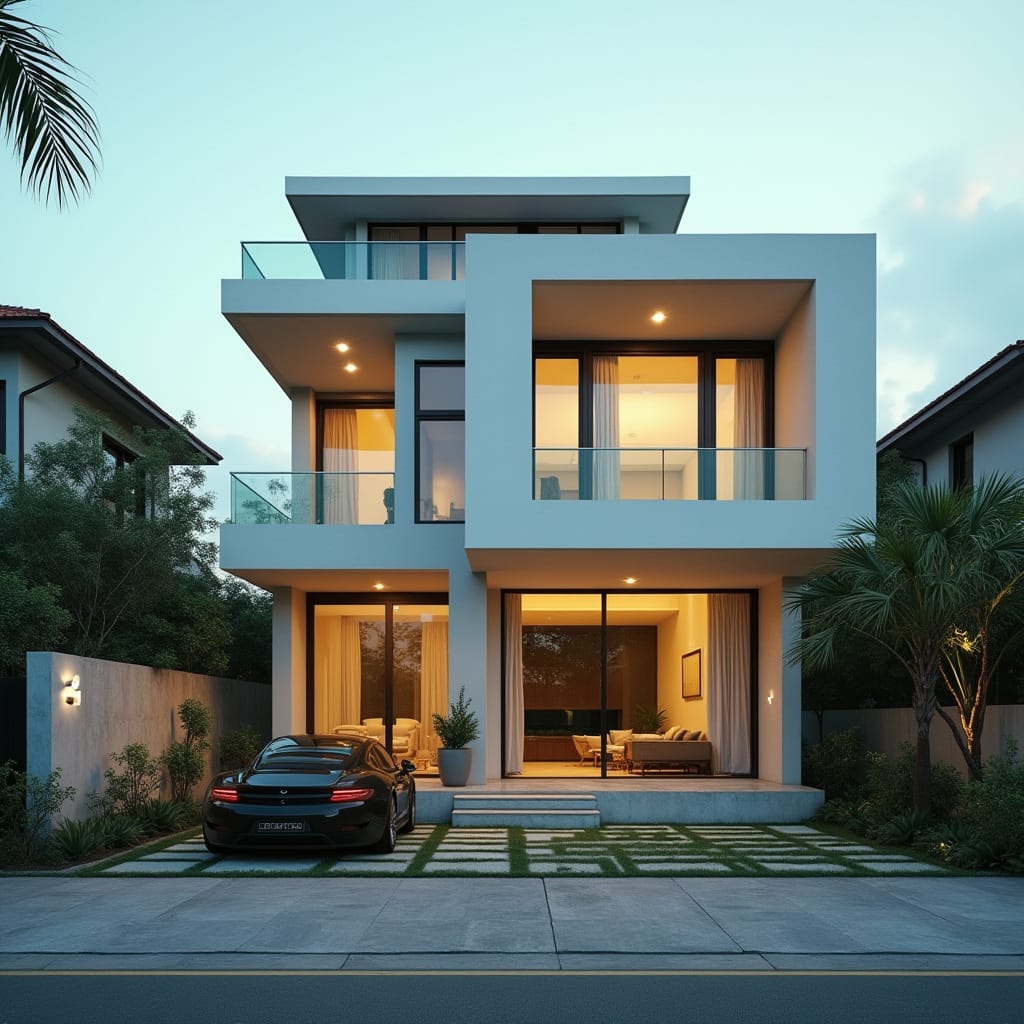
The most important room in a Jamaican house may not be the polished kitchen, the formal living room or the bedroom with the sea view. It may be the unassuming room downstairs with its own bathroom. The half-finished space beside the garage. The guest suite with an outside entrance. The upstairs floor that can operate independently from the one below.
These are not simply additional rooms. They are options built in concrete.
Across Jamaica, buyers are looking more carefully at homes that can accommodate parents, adult children, returning relatives, tenants and changing family circumstances. It does not mean that every large house will sell for a premium. Nor does it mean that American findings about multi-generational homes can be transplanted wholesale into the Jamaican market.
Jamaica does not presently have sufficiently comprehensive public sales data to prove that a second kitchen or separate entrance adds a fixed percentage to a property’s value. The American claim that multi-generational homes command a national premium cannot therefore be repeated here as established fact.
What can be said is that adaptable homes can appeal to more types of buyers. In a market where affordability remains tight and construction is expensive, that broader usefulness matters.
“The strongest Jamaican homes are not simply designed for the family as it looks today. They anticipate how that family may change, return, grow older and rebuild its life tomorrow.” — Dean Jones, founder of Jamaica Homes and Realtor Associate
This is not a foreign housing trend
Multi-generational living is not a new fashion arriving from overseas. It has been part of Jamaican life for generations.
A grandparent may occupy one bedroom while helping to care for younger children. An adult son or daughter may remain at home while saving to purchase land. A relative may return from Britain, Canada or the United States and occupy a section of the family property. One household may live upstairs while another uses the ground floor.
Sometimes, several generations share one dwelling. Elsewhere, a family yard contains a main house, a smaller structure, an unfinished addition and perhaps the foundations of another plan altogether.
These properties often tell the story of the family that built them. One generation laid the foundation. Another cast the upper floor. A third installed windows, tiled a bathroom or added a veranda. The work may have taken decades, interrupted by school fees, migration, illness and the ordinary demands of life.
Government housing policy has itself recognised larger and multi-generational households. In describing Jamaica’s New Social Housing Programme, the Government identified larger families and households containing several generations among those considered for assistance. Jamaica Information Service
Demographic change adds another dimension. The Planning Institute of Jamaica has pointed to growth in the elderly dependent population, increased life expectancy and continued international migration among skilled Jamaicans. Planning Institute of Jamaica
That creates a distinct Jamaican housing question: how do families care for older relatives, welcome returning members and preserve independence without maintaining several entirely separate properties?
Part of the answer may be a house designed to do more than one job.
Buyers are paying attention to possibility
A six-bedroom house is not necessarily more useful than one containing four bedrooms. Size alone is a crude measurement.
A large property can be badly arranged, expensive to maintain and entirely dependent on stairs. A smaller home may prove far more adaptable if it includes a ground-floor bedroom, an accessible bathroom, independent access and space for a kitchenette.
The real attraction is not simply square footage. It is the range of lives the house can support.
Can an older parent live there safely without climbing stairs? Can an adult child occupy one section while saving towards a deposit? Can a returning relative stay for several months without taking over the household? Could a caregiver live nearby? Could part of the building eventually provide legitimate rental income?
A Jamaican spare room, after all, is rarely allowed to remain existentially spare. Before long, it has acquired a cousin, a barrel, a small business or a tenant.
That flexibility can distinguish one property from another, especially when two homes are similarly priced.
A conventional listing may describe a property as having five bedrooms and four bathrooms. That is factually useful but imaginatively barren. It tells the buyer how many rooms exist, not what the building can accomplish.
A better description might identify a self-contained ground-floor suite, separate access, two living areas, provision for a second kitchen or accommodation capable of being occupied without sacrificing the privacy of the main household.
“A room has a construction cost, but flexibility has a life value. When one space can support family care, private living or legitimate income, the buyer is not only purchasing walls; they are purchasing options.” — Dean Jones
More bedrooms are not enough
A genuinely multi-generational home must provide separation as well as connection.
A ground-floor bedroom with a full bathroom may be invaluable to an older occupant. A kitchenette can allow different generations to keep their own routines. Separate access provides independence, while an internal connecting door can preserve security and family contact.
Practical details matter: dependable water storage, safe parking, natural light, proper ventilation, accessible bathrooms and utility arrangements capable of serving the expected number of occupants.
The words “self-contained” should also mean something.
A dark room beneath a house is not transformed into an apartment merely because someone has installed a sink and placed a refrigerator in the corner. A converted garage with poor ventilation, improvised wiring and no suitable emergency exit creates liability, not value.
Owners should establish whether additions were properly approved and whether the physical layout corresponds with available plans. Restrictive covenants, strata rules, planning requirements and building approvals may affect whether a section can lawfully be occupied or rented separately.
This is particularly important in Jamaica, where many houses have evolved in stages. Extensions may have been built years apart by different contractors, and the paperwork may not have travelled as faithfully as the concrete.
Before advertising three independent units, the seller should know whether there are, legally and practically, three independent units.
Income potential must survive contact with arithmetic
For some buyers, the attraction is not that several generations will occupy the property immediately. It is the possibility that one section could help carry the cost of ownership.
A self-contained flat might accommodate a long-term tenant, a returning relative or, where permitted and commercially sensible, short-term guests. That flexibility can be compelling when a buyer is considering mortgage payments, insurance, maintenance and utilities.
But “income-generating” has become one of the most casually applied phrases in property advertising.
A room that might be rented is not the same as a proven rental business. Sellers should avoid presenting ambitious monthly figures without considering local demand, access, parking, condition, utility costs and comparable rents. Short-term rental projections require greater caution still. Gross booking revenue is not profit, and projected occupancy has an unfortunate habit of behaving differently once placed in the real world.
The responsible approach is to describe what the property can physically support and provide credible local rental evidence where available. The buyer can then test the figures against financing costs and operating expenses.
A flexible property may provide income. It should not depend on imaginary tenants to make the purchase sensible.
Good design can protect family relationships
Multi-generational living is often presented as an uncomplicated picture of grandparents helping with children, adult children caring for parents and everyone sharing costs around one large table.
That picture is attractive. It is also incomplete.
Privacy matters. So do noise, bathrooms, storage, parking, visitors and the question of who used the last of the cooking gas.
A successful shared home allows people to be together without forcing them to conduct their entire lives in one another’s company. Separate sitting areas, bathrooms and entrances can protect family relationships as effectively as any generous dining room.
An older parent may want family close while retaining the freedom to receive visitors privately. A younger couple may welcome lower housing costs without wanting every movement observed. A returning relative may need space to adjust after years abroad.
The best design recognises that independence is not a rejection of family. It is often what makes prolonged family living possible.
“Family living works best when closeness is chosen, not imposed by the floor plan. A well-designed home gives people the comfort of being near one another and the dignity of still having a door they can close.” — Dean Jones
Resilience has become part of the specification
Jamaican buyers are also judging homes by how they function when ordinary life is interrupted.
A house designed for several occupants places greater demands on water, electricity, drainage, parking and maintenance. A separate apartment is of limited use if the property’s water storage was designed for half the number of people now expected to live there.
Sound roofs, secure windows, water tanks, pumps, effective drainage, backup-power readiness and properly installed solar systems are becoming more meaningful parts of the buying decision. These elements may not photograph as seductively as imported tiles, but tiles have never kept the lights on or supplied water to a household.
Sellers should retain plans, approvals, receipts, warranties, servicing records and photographs of concealed construction work. A buyer confronted with an extension wants to know not only that it exists, but that it was competently attached to the rest of the building.
Resilience is no longer merely about enduring a dramatic event. It is about whether a household can continue functioning through outages, repairs, financial pressure and sudden changes in family need.
Large does not automatically mean valuable
Not every oversized or subdivided Jamaican house will achieve a higher price.
Value still depends on location, access, title, condition, construction quality, approvals, neighbourhood demand and realistic pricing. A sprawling house with substantial maintenance requirements may attract fewer purchasers than a smaller property that has been intelligently planned.
There can also be a considerable gap between construction cost and market value. Owners often extend homes for deeply personal reasons. The next buyer may not value those alterations in quite the same way.
The relevant question is not simply how much the owner spent. It is how many credible buyers in that location need what was created — and what else they could purchase for the same money.
A separate entrance may be valuable. Three kitchens may be useful. Seven bedrooms may sound impressive. None of them can rescue unclear ownership, serious structural defects or an asking price detached from the local market.
Flexible accommodation should strengthen a valuation case, not replace one.
Sell what the house can do
When an adaptable home is brought to market, its flexibility should be explained clearly.
Photography should show how the spaces relate to one another rather than presenting an incomprehensible procession of bedrooms. A floor plan can be extremely useful. Buyers need to understand which rooms are on each level, whether access is internal or external, where the kitchens and bathrooms are located and whether utilities are shared.
The listing must also distinguish between an existing facility and future potential. A completed, approved self-contained flat is not the same as a storeroom that might one day be converted. Honest descriptions do more than protect the seller. They give serious buyers confidence.
The Jamaican home most likely to stand out may therefore be neither the largest nor the most lavish.
It will be the house that understands the uncertainty of real life: a parent growing older, a child returning home, a relative arriving from overseas, an income changing or a family needing to occupy space differently.
Such a property may accommodate an older parent today, a young couple tomorrow and a tenant several years from now. It may allow a family to pool resources while preserving privacy. It may help an owner remain in place rather than selling each time life changes direction.
That is not merely extra space.
It is adaptability given walls, doors and a roof — and in Jamaica, that may be one of the most valuable forms a home can take.

Visit our YouTube Community ↗