

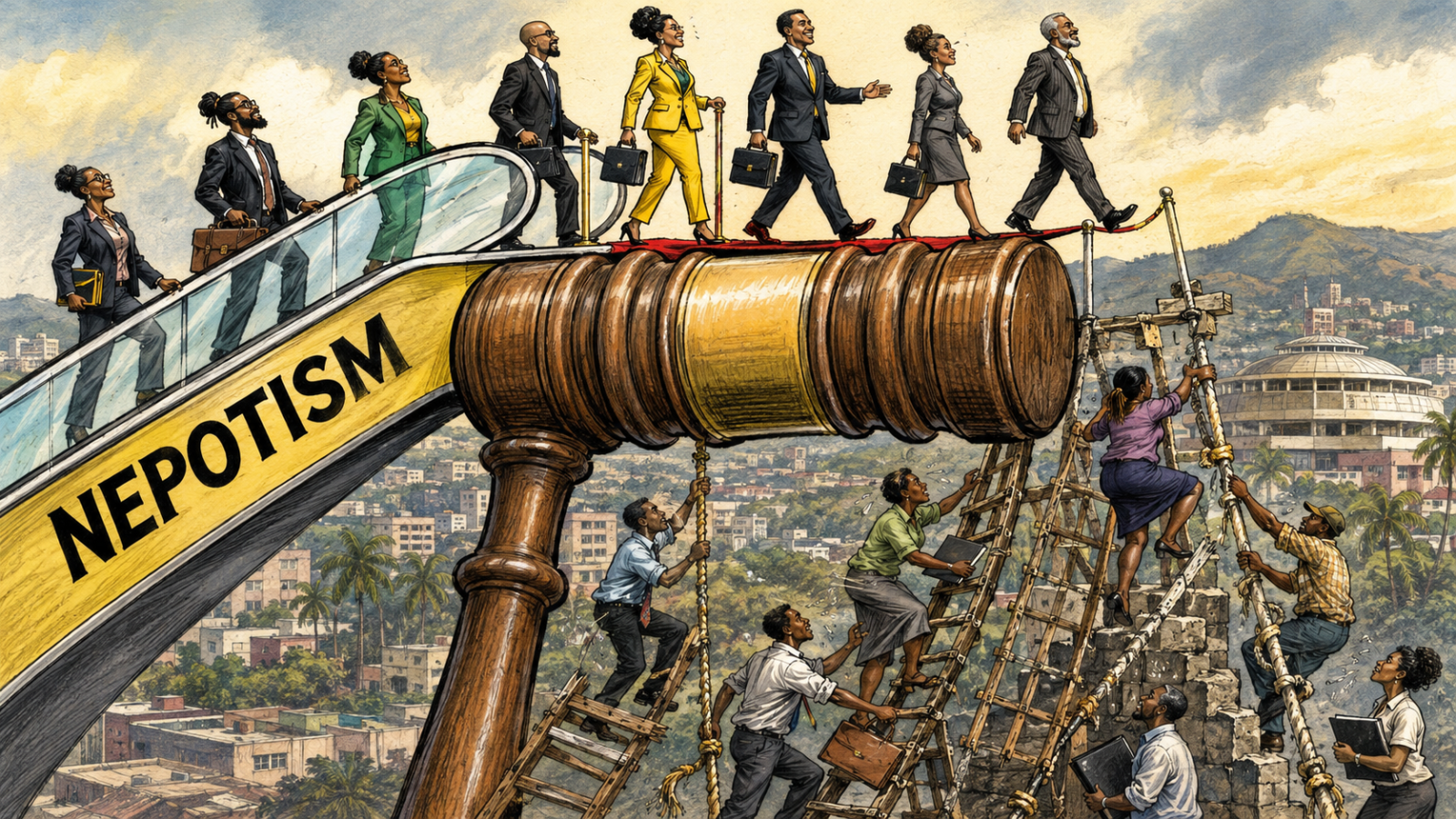
Jamaica does not suffer from a shortage of intelligence, ambition or qualified people. It suffers, too often, from something considerably more difficult to measure: the fear of what capable people might disturb.
This fear rarely announces itself. It does not arrive wearing a badge marked “resistance to change.” It enters quietly. It appears in the meeting that leads nowhere, the unanswered proposal, the strangely narrow job specification or the decision already made before the interview begins. It hides behind procedure, familiarity and the reassuring phrase: “That is how we have always done it.”
Sometimes it has another name: nepotism.
Jamaicans frequently speak about “links.” From childhood, many are taught that qualifications alone will not open the door. A degree may bring someone to the building, but a link gets them past reception. Five degrees cannot compete with the right telephone call.
Networks are not inherently wrong. Every economy runs partly on relationships, reputation and trust. A recommendation from someone credible can help an employer distinguish between two apparently equal candidates. The problem begins when relationships stop supporting merit and start replacing it.
That is the point at which a link becomes a lock.
Having led a major multimillion-pound change programme for Cranfield University, alongside numerous projects and programmes throughout my career, I have seen resistance to change in several forms. A programme director does more than administer schedules and attend meetings. The role involves identifying what needs to change, assembling the right projects, directing their delivery and persuading people to leave behind systems in which they may have become deeply comfortable.
Buildings can be redesigned. Processes can be rewritten. Budgets can be reallocated. People are more complicated.
Change professionals understand that resistance is universal. It exists in Britain, Jamaica and almost every organisation in between. Where people have worked in the same way for years, even an obvious improvement can feel like an invasion. The existing system may be inefficient, but it is familiar—and familiarity has an extraordinary ability to disguise itself as stability.
In Jamaica, however, resistance can become entangled with a smaller labour market, fewer senior opportunities, powerful personal networks and an understandable anxiety about economic security. A new person does not always enter an organisation as a potential asset. Sometimes, before they have even taken their seat, they are assessed as a potential threat.
“Jamaica has no shortage of people capable of transforming institutions. The tragedy is that we sometimes spend more energy containing talented people than allowing them to contribute,” says Dean Jones, founder of Jamaica Homes and a real estate professional.
When Competence Becomes Uncomfortable
Many accomplished professionals will recognise the coded warnings:
Do not appoint the person you may struggle to manage.
Do not appoint someone with more qualifications than you.
Do not appoint the candidate whose experience may expose weaknesses in the existing team.
Do not appoint the person who might eventually take your position.
These concerns are rarely written into an interview assessment. They do not need to be. They operate beneath the official process, shaping decisions while leaving very little evidence behind.
The strongest candidate may consequently become the most threatening candidate. Experience is reframed as arrogance. Independence becomes “not being a team player.” Directness is labelled aggression. New thinking is dismissed as a failure to understand the culture.
And so the organisation appoints the safer person: someone familiar, manageable and unlikely to rearrange the furniture.
The result is not necessarily immediate collapse. That would be easier to diagnose. Instead, the institution continues functioning just well enough to avoid reform. Meetings continue. Reports are produced. Targets are adjusted. Everyone remains busy, yet the fundamental problems survive untouched.
It is rather like repairing a badly designed house by repainting the front door. The colour may be delightful, but the roof is still leaking.
This is where nepotism becomes more damaging than the appointment of one relative or friend. It creates a self-protecting structure. People appoint those who will preserve the existing equilibrium. Those appointees later do the same. Eventually, the organisation becomes internally loyal but externally ineffective.
“The real cost of nepotism is not simply that one person receives an opportunity unfairly. It is that an organisation may lose the person who could have changed its future,” Jones says.
The Architecture of Fear
Fear-based organisations develop an unmistakable architecture. Information is tightly controlled. Decisions pass through small circles. New ideas are welcomed ceremonially but resisted operationally. Responsibility is distributed widely enough that no single person can be held accountable when nothing happens.
Those at the top may sense that performance is weak without fully understanding why. Instructions are issued, but somewhere between leadership and delivery, they become diluted, delayed or quietly buried.
Each level protects its territory.
Managers protect their roles. Teams protect familiar processes. Individuals protect access to information. Suppliers protect relationships. Professional networks protect the arrangements from which their members benefit. The entire structure becomes so effectively sealed that honest feedback can no longer travel upwards.
From the top, the organisation appears frustratingly slow. From within, everyone has learned that moving too quickly—or asking the wrong question—can make them visible for all the wrong reasons.
This is not because Jamaicans are uniquely resistant to progress. That would be an unfair and intellectually lazy conclusion. Jamaica is full of adaptable, inventive people who have excelled across the world. The more difficult question is why some of that ability encounters such resistance when it attempts to operate at home.
Limited opportunities partly explain it. Where senior jobs, significant contracts and commercial openings are scarce, people may guard what they have with extraordinary intensity. Professional survival becomes territorial. The person approaching the ladder is not viewed as another climber; they are seen as someone who may remove it.
But protecting individual positions ultimately weakens the wider economy. An organisation cannot become more competitive by continuously excluding the people most capable of challenging it.
Real Estate and the Closed Circle
The same patterns appear in Jamaican real estate.
Property should be a sector defined by transparency, professional cooperation and trust. A home or parcel of land is often the largest asset a Jamaican family will ever own. Buyers, sellers and investors depend upon agents, attorneys, valuers, surveyors, developers, financial institutions and government agencies to perform their roles properly.
Yet real estate can also become fertile ground for gatekeeping and low-level obstruction. Information may be withheld. Professional courtesies may disappear when a commission is at stake. A capable newcomer can be treated as an intruder. A transaction may be frustrated not because the deal is defective, but because someone fears losing control, recognition or income.
There are excellent practitioners throughout Jamaica’s property industry. There are also practices that survive primarily because they are protected by relationships and silence. The distinction matters.
Competition is healthy. Sabotage is not.
A professional should win business through service, knowledge, responsiveness and integrity—not by obstructing another professional, concealing material information or exploiting personal access to close doors.
“A property market cannot mature while opportunity depends upon who can block whom. Professionalism begins when the client’s interest becomes more important than protecting somebody’s private territory,” Jones says.
The effects extend beyond individual transactions. Diaspora buyers become suspicious. Investors encounter unexplained delays. Sellers struggle to distinguish genuine advice from personal manoeuvring. Younger professionals learn that technical competence may matter less than allegiance to the correct circle.
That is not merely an ethical problem. It is an economic one.
Jamaica Cannot Protect and Progress at the Same Time
A country cannot call for innovation while punishing those who challenge established practices. It cannot lament the departure of its brightest people while making professional advancement dependent upon obedience, familiarity and family connection.
Nor can Jamaica encourage members of the diaspora to return with knowledge, investment and international experience, only to treat their contribution as a threat to existing arrangements.
People arriving with different experience will sometimes ask uncomfortable questions. They may identify inefficient systems. They may expect greater accountability. They may refuse to accept that a six-month delay is simply “how things go.”
Not every imported idea will suit Jamaica, of course. International experience does not grant anyone automatic wisdom, and local knowledge must never be dismissed. But ideas should be judged on evidence and relevance—not rejected because of who proposed them or whose comfort they disturb.
The challenge is to build organisations strong enough to hire people who may be more knowledgeable than their managers in particular areas. That is not a managerial failure. It is precisely what intelligent leadership looks like.
Secure leaders recruit strength. Insecure leaders recruit reassurance.
Jamaica must also become more honest about nepotism. Calling it “links” can make the practice sound charming and culturally inevitable. But when access repeatedly overrides merit, the country pays through weaker institutions, slower delivery, poorer service and lost talent.
“Leadership is not proven by keeping capable people beneath you. It is proven by building something strong enough to continue rising after you are gone,” Jones says.
Opening the Door
The answer is not to eliminate relationships from business or professional life. That would be impossible. The answer is to ensure that relationships do not become a substitute for standards.
Recruitment should be genuinely competitive. Major appointments and contracts should withstand scrutiny. Conflicts of interest should be declared. Performance should be measured against outcomes rather than proximity to power. Organisations should create safe routes for staff to challenge failing processes without damaging their careers.
Most importantly, leaders must become comfortable with talent.
The confident chief executive does not fear the brilliant programme director. The serious agency does not undermine the high-performing agent. The capable manager does not reject a candidate for being exceptionally qualified. They understand that another person’s strength can enlarge the organisation rather than diminish their own authority.
Jamaica is too small to keep wasting capable people and too ambitious to remain governed by closed circles. Every qualified professional shut out for being unfamiliar, independent or potentially disruptive represents more than a personal disappointment. It represents knowledge, investment and momentum the country has chosen not to use.
The island does not need fewer links. It needs more bridges: bridges between experience and opportunity, between the diaspora and local institutions, between established leaders and emerging talent, and between the Jamaica we defend out of habit and the Jamaica we might construct with courage.
The question is not whether change will disturb the existing equilibrium. It will.
The more important question is whether that equilibrium deserves to survive.

1 Comment
Pingback: When Talent Becomes a Threat: Jamaica’s Quiet War Against Change - Jamaica Homes News
Visit our YouTube Community ↗