


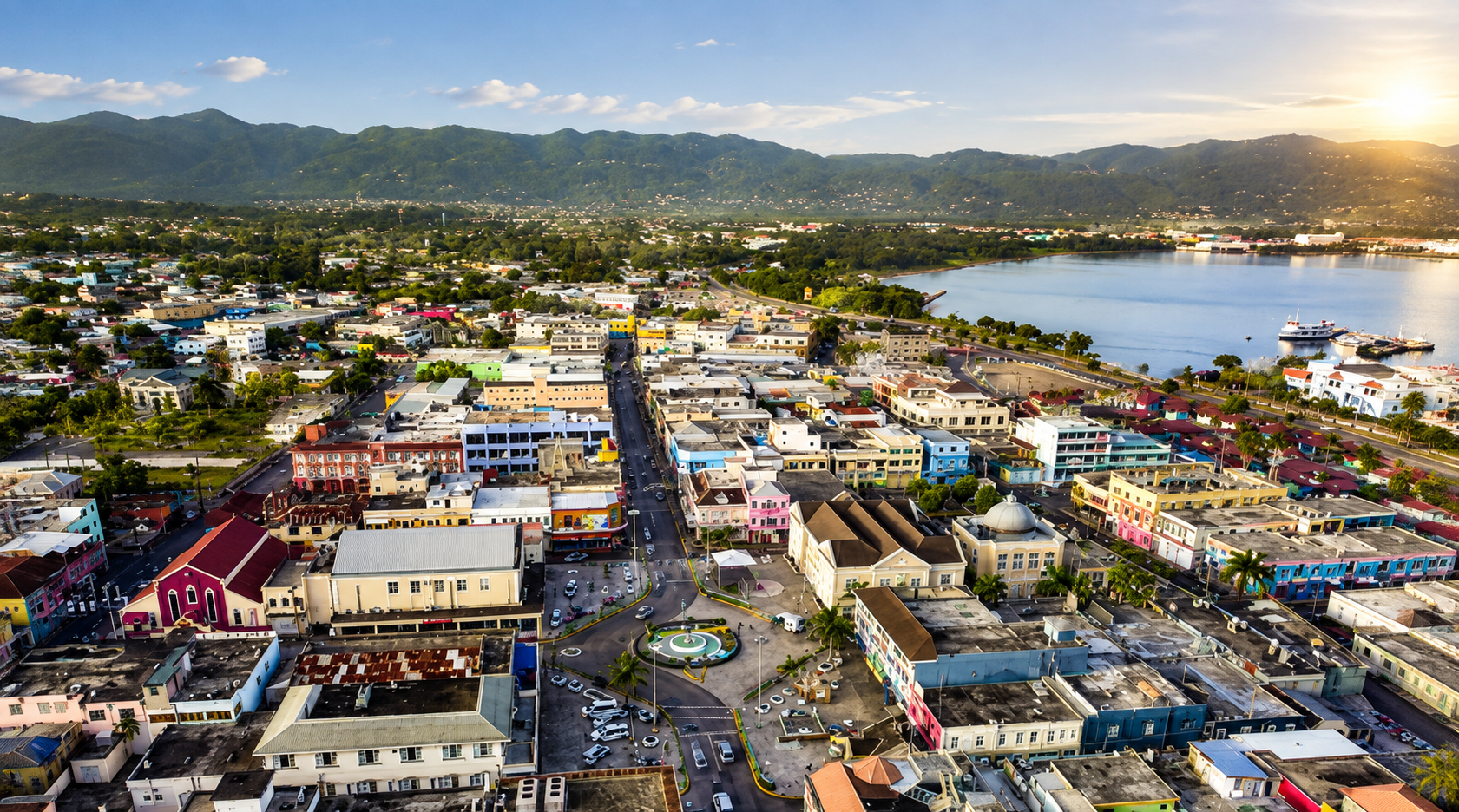
Montego Bay could be heading towards one of its most significant physical transformations in decades, with the Government confirming that plans are advancing to redesign sections of the city, including its waterfront, Freeport and the wider tourism corridor.
The initiative remains at an early stage, with detailed designs and implementation arrangements still being developed. However, the direction already outlined points to something considerably broader than a tourism beautification project. It raises fundamental questions about how land, transport, public space, commercial property and future development will fit together in Jamaica’s second city.
A different vision for Montego Bay
The Ministry of Tourism said architects are working alongside the Urban Development Corporation, Port Authority of Jamaica and Factories Corporation of Jamaica on proposals for the city and waterfront.
The Government has described the concept for the Freeport area by reference to major mixed use waterfront districts in Miami, while earlier plans outlined for Montego Bay included commercial, retail and residential development and a more integrated coastal corridor stretching from Freeport towards Harmony Beach Park and the Hip Strip.
That distinction matters.
Montego Bay has long operated as several places simultaneously. It is an international tourism centre, a working city, a residential market, a commercial hub and an important gateway for western Jamaica. Development has often occurred in individual pockets rather than as one coherent urban system.
A serious waterfront strategy could begin joining some of those pieces together.
Property could sit at the centre of the change
For Jamaica’s real estate market, the most important part of the announcement is not architectural appearance. It is what redesign eventually means for the use and value of land.
Large scale improvements to roads, public spaces, waterfront access, pedestrian areas and commercial districts can influence where businesses want to locate, where developers consider building and where households want to live.
Montego Bay is already one of Jamaica’s most active property markets, with demand influenced by tourism, business activity, overseas purchasers, short term accommodation, long term rentals and local housing needs.
Changing the physical structure of the city could therefore create new development opportunities, but it could also increase competition for well located land.
The outcome will depend heavily on what is eventually proposed, which areas are included and how existing communities and property owners are treated.
At present, those details have not been released.
Freeport could become much more than a gateway
Freeport is particularly significant because of the amount of commercial, tourism, port and development activity concentrated in and around the area.
The Government has previously outlined ambitions for a landmark mixed use development incorporating commercial, retail and residential components, while connecting the wider coastal corridor more effectively.
If that direction proceeds, Freeport could increasingly develop as an urban district in its own right rather than simply an arrival point for cruise passengers and a collection of separate commercial and tourism properties.
That would have implications for neighbouring land.
New residential demand could emerge around improved commercial districts. Existing commercial sites could become candidates for redevelopment. Properties previously regarded as peripheral could become more strategically located as roads, pedestrian routes and public spaces change.
This is how major urban projects often reshape property markets. The first visible change may be infrastructure, but the deeper change is frequently the way people begin to value location.
The Hip Strip is also under review
The Government has indicated that a meeting is planned for 2 October to consider the future of Montego Bay’s Hip Strip, involving the Office of the Prime Minister and other stakeholders.
Previous plans have included progressively making parts of the lower roadway more pedestrian oriented while improving traffic capacity elsewhere in the corridor.
For property owners and businesses, this could be significant.
Walkability can change the economics of an area. Restaurants, shops, entertainment businesses, hotels and smaller commercial properties often operate differently when visitors can move comfortably between destinations without depending entirely on vehicles.
But successful pedestrian districts require more than attractive paving and landscaping.
Traffic movement, parking, servicing, drainage, public transport, security and access for surrounding communities all become part of the property equation.
A waterfront can look impressive on a rendering. The real test is whether the city behind it works.
Infrastructure is already changing
The redesign discussion is arriving as major road infrastructure around Montego Bay is also advancing.
The Montego Bay Bypass was reported earlier this month to be about 90 per cent complete and scheduled for completion in September, while other road projects in the wider area are also progressing.
This makes the timing of the waterfront proposals particularly important.
Roads determine how development spreads. They influence travel times, open previously difficult locations to investment and can alter the relative attractiveness of residential and commercial areas.
Montego Bay therefore appears to be entering a period in which transport investment and urban redevelopment could begin interacting with each other.
That could produce opportunities, but careful planning will be essential to prevent development from simply shifting congestion or putting additional pressure on already stretched communities.
Public access will matter
There is another issue that deserves attention as the plans develop, access to the waterfront.
Government and municipal officials have publicly reaffirmed the importance of unrestricted public beach access in Montego Bay and Ocho Rios, while the Urban Development Corporation has been given responsibilities relating to major waterfront and urban projects.
As valuable coastal land is redeveloped, the relationship between private investment and public space will become increasingly important.
Montego Bay needs investment, but it is also a Jamaican city in which residents must be able to participate in the places being created around them.
The strongest waterfront developments are rarely successful because of one hotel, apartment tower or shopping complex. They work when streets, beaches, parks, businesses, homes and public spaces begin functioning as parts of the same place.
Montego Bay is part of a wider shift
The plans also sit within a broader change in the Government’s approach to urban development following Hurricane Melissa.
Black River is already being considered for substantial climate resilient redevelopment following severe damage during the hurricane, including relocation from vulnerable coastal locations and changes to housing, infrastructure and land use.
The Ministry of Tourism has also identified Falmouth as another town expected to form part of the wider redevelopment programme.
The emerging direction appears to be towards looking at towns as complete systems rather than treating roads, housing, tourism facilities, drainage and commercial development as unrelated projects.
For Jamaica, that could be an important change in thinking.
What happens next
Much remains unknown about Montego Bay’s redesign.
No final masterplan, development timetable, detailed land requirements or complete financing structure has yet been publicly presented. The National Reconstruction and Resilience Authority, which is expected to play a role in coordinating major reconstruction and resilience projects, only recently began reviewing projects referred to it for sequencing and implementation.
Property owners and investors should therefore be cautious about assuming that every proposal discussed will proceed exactly as currently envisaged.
What is clear is the direction.
Montego Bay is being considered not merely as a tourism destination requiring improvement, but as an urban area capable of substantial physical restructuring.
If that process is handled carefully, the effects could reach far beyond the shoreline. They could influence where homes are built, where businesses invest, how land is valued and how residents interact with one of Jamaica’s most economically important cities.
For real estate, the story is only beginning.
Follow Jamaica Homes on Youtube @jamaicahomes and Instagram @jamaica_homes and on Facebook @jamaicahomesnews Send us a message or email us at onlinefeedback@jamaica-homes.com or editor@jamaica-homes.com

Visit our YouTube Community ↗