


A £1.4 billion insurance loss in London might sound a long way from Kingston, Montego Bay or Mandeville.
It isn’t.
Lloyd’s of London, one of the world’s most important insurance markets, has set aside about £1.4 billion for losses arising from the continuing conflict in the Middle East, while its chief executive has issued a much broader warning about the increasingly unpredictable world in which insurers, businesses and governments are now operating.
For Jamaica, the number itself is not necessarily the most important part of the story.
The alarm bell is.
Lloyd’s chief executive Patrick Tiernan says the world is becoming “structurally disorderly”, rather than merely passing through another temporary period of volatility. His concern reaches far beyond war. He points to pressure on physical infrastructure, global trade, financial systems, cyber networks, energy security and supply chains, with several risks increasingly capable of occurring at the same time.
That should sound familiar in Jamaica.
This is a small, import-dependent island economy rebuilding after a major hurricane, buying much of what it consumes from overseas and exposed to international movements in fuel, shipping, finance, insurance and construction materials.
A shock does not need to happen in Jamaica to eventually arrive at a Jamaican front door.
The warning is already travelling
The Middle East conflict has disrupted energy infrastructure and shipping routes, including traffic through the Strait of Hormuz. Lloyd’s says transits through the Strait remain significantly below their pre-crisis level and is monitoring the potential secondary effects through energy prices, inflation, supply chains and affordability.
By September 17, Brent crude remained above US$100 a barrel as markets continued to react to disruptions and threats to Middle Eastern energy infrastructure.
Jamaica does not need to speculate about what elevated international fuel costs can do.
The Bank of Jamaica has already warned that unresolved Middle East hostilities are expected to keep international fuel prices elevated in the near term, placing upward pressure on electricity and gas prices locally. It has also pointed to the likelihood of secondary increases in transport and other goods and services.
That eventually becomes a property story too.
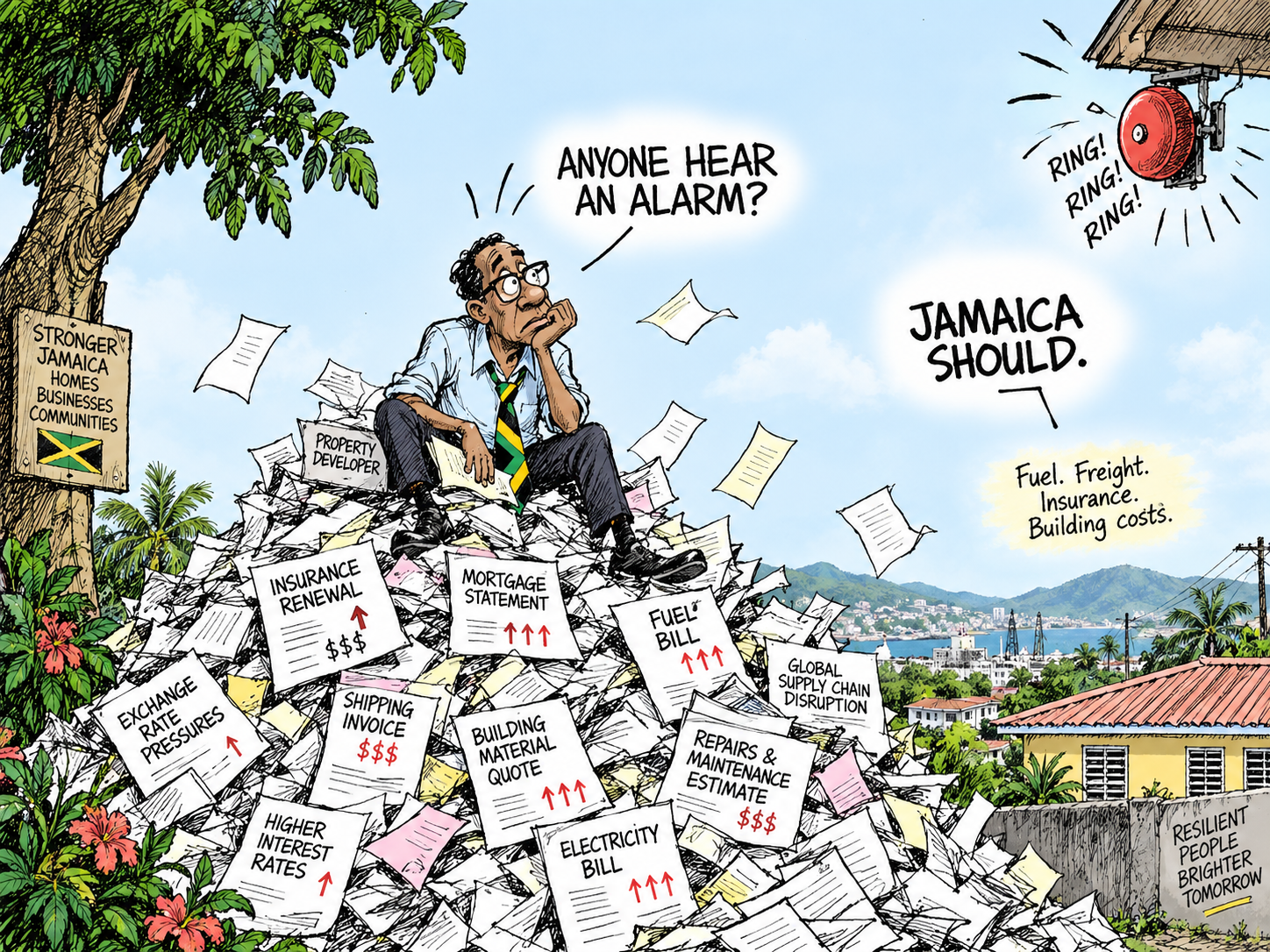
Developers use fuel. Trucks use fuel. Construction materials have to be transported. Imported products have to cross oceans. Contractors price uncertainty into jobs. Households have finite disposable income, and mortgage affordability becomes more difficult when food, electricity and transportation are taking larger bites from salaries.
A geopolitical conflict thousands of kilometres away can therefore eventually appear in the price of a bag of cement, a contractor’s quotation, an electricity bill or the monthly calculation a family makes before deciding whether it can afford a mortgage.
Dean Jones, founder of Jamaica Homes, believes that connection deserves much more attention.
“If anyone is hearing an alarm, Jamaica should be. We tend to look at wars, shipping problems and international insurance losses as things happening somewhere else. But an island economy imports those problems remarkably efficiently. They arrive through fuel, freight, materials, insurance and ultimately the cost of living.”
Then there is insurance
For Jamaican property owners, perhaps the more interesting part of the Lloyd’s story is not the war itself but what it says about the insurance system carrying increasingly complicated risks.
Lloyd’s remains financially strong. It reported gross written premiums of £34.7 billion for the first six months of 2026, an underwriting profit of £1.9 billion and profit before tax of £3.5 billion. That pre-tax profit was down from £4.2 billion in the equivalent period last year, while investment returns fell to £1.8 billion from £3.2 billion.
So this is not a story about Lloyd’s being in financial trouble.
It is a story about the risks landing on insurers becoming more interconnected.
Jamaica has very recent experience of why that matters.
Following Hurricane Melissa, Jamaican insurers received a near sixfold increase in reinsurance funds as overseas reinsurers helped meet claims. Financial Services Commission data showed reinsurance contract assets increasing by J$77.7 billion, largely reflecting recoveries associated with the hurricane.
Reinsurance is effectively insurance for insurers. It allows a relatively small domestic market to transfer part of the risk of a catastrophic Jamaican event to much larger international pools of capital.
That international connection is enormously valuable.
But it also means Jamaica does not exist in its own insurance bubble.
When global insurers and reinsurers are simultaneously considering hurricanes, floods, fires, wars, cyber-attacks, damaged ships, disrupted energy infrastructure and other major risks, the cost and availability of capital become matters worth watching.
It does not automatically mean Jamaican property insurance premiums will suddenly rise because Lloyd’s has suffered Middle East losses. Insurance pricing is considerably more complicated than that, and Lloyd’s itself says the Middle East event is not presently expected to constitute a capital event for its market.
But the direction of travel matters.
The price of rebuilding
This comes at an awkward time for Jamaica.
Thousands of families, businesses and property owners are still dealing with the financial consequences of Hurricane Melissa. Construction costs remain important, insurance adequacy matters enormously and every increase in imported energy or materials can affect the cost of repairing, replacing or developing property.
There is some protection for certain homeowners. The National Housing Trust said in August that peril insurance premiums for its mortgagors would remain unchanged for the September 2026 to August 2027 period despite the hurricane and increased construction costs.
But the broader property market is larger than the NHT portfolio.
Commercial buildings, privately insured homes, apartment developments, hotels, industrial properties and major infrastructure all participate in a much wider insurance and reinsurance ecosystem.
Jones says this is where Jamaica needs to broaden the way it thinks about housing affordability.
“Affordability is not simply the advertised price of a house. It is the mortgage, insurance, electricity, transportation, maintenance and the cost of repairing that building when something goes wrong. If several of those costs rise together, a property can become unaffordable without its sale price moving by one dollar.”
That is the uncomfortable mathematics of a more disorderly global economy.
Property markets do not live on islands, even when they are on one
There has long been a temptation in Jamaican real estate to concentrate almost exclusively on local supply and demand.
How many houses are being built?
How much is land selling for?
What mortgage rate can a buyer obtain?
How many purchasers are in the market?
All matter.
But increasingly, the answer to what happens to Jamaican property may also be found in oil markets, shipping lanes, bond markets, international insurance syndicates and global construction supply chains.
Lloyd’s is warning that many of the assumptions on which the insurance industry has operated for decades are becoming less dependable. It cites not one new threat but several familiar threats increasingly interacting with one another.
For a country such as Jamaica, that interconnectedness can be particularly significant.
Higher oil prices can increase electricity and transport costs.
Higher transportation costs can feed into construction.
More expensive reconstruction can increase the value at risk for insurers.
Insurance pressures can affect the cost of holding property.
Inflation can influence interest-rate decisions.
Interest rates can influence mortgages.
And somewhere at the end of that chain is an ordinary Jamaican family trying to work out whether there is enough money left at the end of the month to buy, build or repair a home.
The world economy has always been connected. What appears different now is the number of pressure points capable of moving at once.
“Jamaica cannot control the Strait of Hormuz, international bond markets or the global reinsurance cycle,” Jones said. “What the country can do is understand its exposure and plan accordingly. Resilience is no longer just about putting stronger roofs on houses. It is also about building an economy, a housing system and household finances capable of absorbing shocks that may begin thousands of miles away.”
Perhaps that is the bigger message buried inside Lloyd’s £1.4 billion bill.
The alarm is not predicting that catastrophe is about to arrive in Jamaica.
It is warning that the distance between an international crisis and a Jamaican household has become remarkably short.
And these days, when the global alarm sounds, it is probably worth listening.
Follow Jamaica Homes on Youtube @jamaicahomes and Instagram @jamaica_homes and on Facebook @jamaicahomesnews Send us a message or email us at onlinefeedback@jamaica-homes.com or editor@jamaica-homes.com

Visit our YouTube Community ↗