

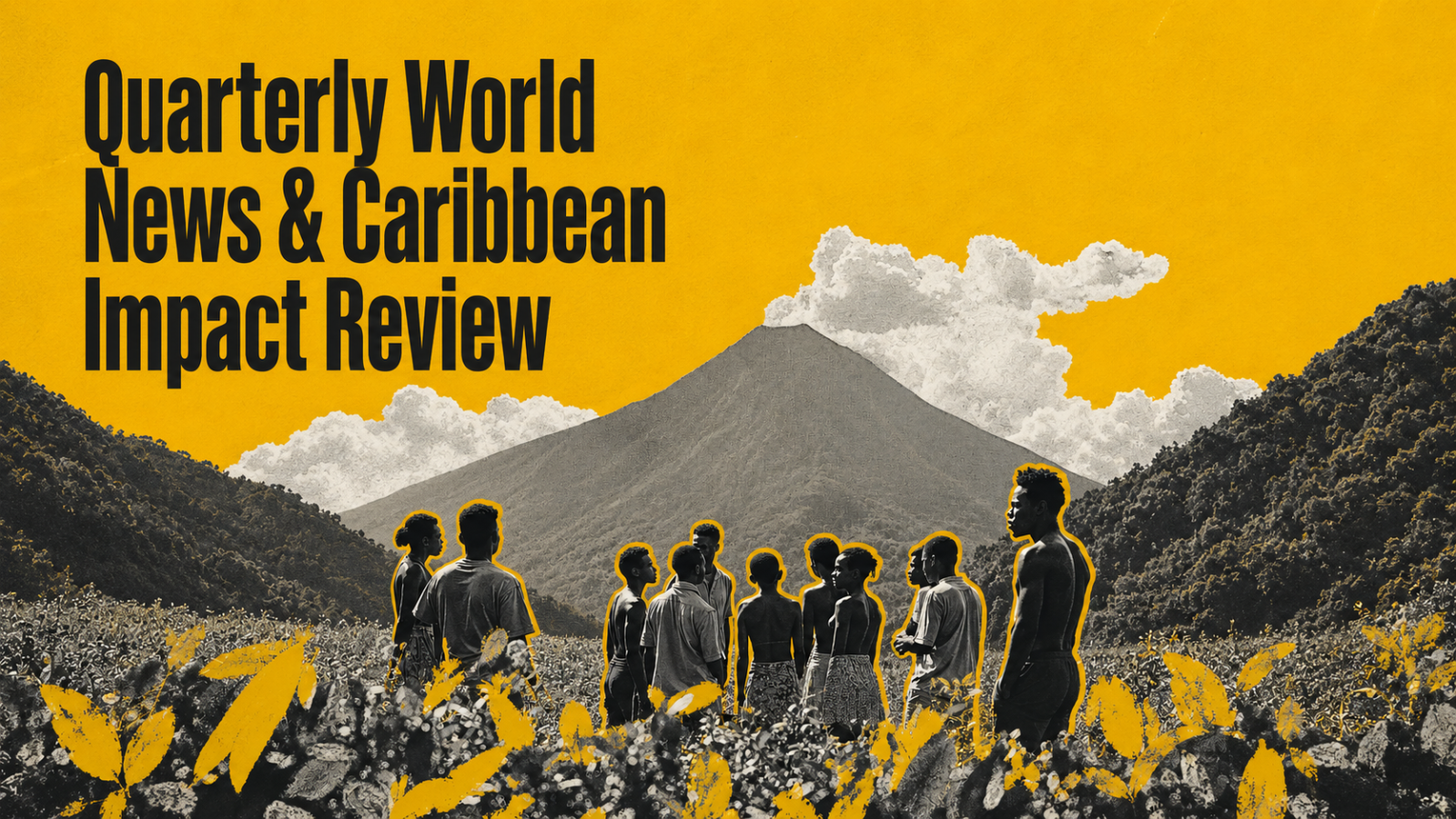
Jamaica Homes Global Conflict & Caribbean Impact Review | Published 3 April 2004 | Reporting Period: 3 January – 2 April 2004
Quarterly Briefing
- Ten bombs explode on four commuter trains in Madrid during the morning rush hour on March 11, killing 191 people and wounding more than 1,800; Spain’s deadliest peacetime terrorist atrocity occurs three days before general elections; the Aznar government’s insistence that ETA was responsible, contradicted within hours by emerging evidence of an Islamist network, is seen as a politically motivated misrepresentation; the governing Popular Party loses the election on March 14 to the Socialists under José Luis Rodríguez Zapatero, who had campaigned against the Iraq War.
- Jean-Bertrand Aristide, Haiti’s elected president, is forced from power and departs Haiti on February 29 on a US aircraft under circumstances that remain disputed; the US, France and Canada say he resigned voluntarily; Aristide, speaking from the Central African Republic to which he was transported, says he was kidnapped by American forces; an armed rebellion by former military and gang leaders had pushed toward Port-au-Prince in the days before his departure; a US-led multinational force deploys to stabilise the country.
- Iraq’s insurgency intensifies through the first quarter; Fallujah, west of Baghdad, emerges as a focal point of Sunni resistance; the killing and mutilation of four American private security contractors on March 31 — their bodies dragged through the streets and hung from a bridge over the Euphrates — produces international outrage and demands within the US military for a decisive response; the images are broadcast worldwide and become defining symbols of the deteriorating security environment.
- Libya formally completes the process of surrendering its weapons of mass destruction programmes, following Colonel Gaddafi’s December 2003 announcement; the handover of nuclear, chemical and biological materials and equipment to the United States and United Kingdom is confirmed; Libya’s rehabilitation as a legitimate state proceeds, with EU sanctions lifted and US engagement deepening; the episode is cited by advocates of negotiated disarmament as a model for North Korea and Iran.
- The Israeli government announces on April 1 that it has accepted a plan proposed by Prime Minister Sharon for a unilateral withdrawal from all Israeli settlements in the Gaza Strip; the plan, known as the Gaza Disengagement, is controversial within Israel and viewed sceptically by Palestinian leaders who fear it will preclude any negotiated settlement on the West Bank; the US signals support for the disengagement concept; implementation remains contingent on internal Israeli political processes.
- Caribbean economies are watching the continued rise in oil prices with concern; crude has risen from approximately $32 per barrel in January to above $35 by late March; Jamaica’s external accounts face growing pressure; remittances from the diaspora provide ongoing income support to hundreds of thousands of households but cannot compensate for the structural impact of higher import costs across the economy.
Prologue: The Quarter That Changed Spain
The Madrid bombings of March 11 were the largest terrorist attack in European history since the Lockerbie disaster in 1988. The killing of 191 commuters on four trains on a single Thursday morning, three days before Spain’s general election, produced a political shockwave whose reverberations will be felt for years. The Aznar government’s decision to attribute the attack to ETA — despite evidence within hours pointing to an Islamist cell — was seen by the Spanish electorate as an attempt to prevent its Iraq policy from being blamed for the attack. The electoral backlash removed from power the coalition that had sent Spanish troops to Iraq and installed a government that had promised to bring them home.
Madrid’s Lesson and Its Limits
The question the Madrid bombing forced was one that governments across the Western alliance were reluctant to confront directly: whether participation in the Iraq War had increased or decreased the terrorism risk to their own populations. The Zapatero government acted on the assumption that withdrawal from Iraq would reduce Spain’s profile as a target; it announced the withdrawal of Spain’s 1,300 troops from Iraq within days of taking office. Other coalition members — the United Kingdom, Australia, Poland, Italy — debated the same question internally while publicly maintaining that capitulation to terrorist pressure would encourage further attacks. The Caribbean, not a party to these debates, watched with concern that the transatlantic alliance underpinning US security guarantees was under pressure.
Haiti: A Caribbean Crisis at Washington’s Doorstep
Aristide’s departure from Haiti on February 29 removed the country’s elected president in circumstances of profound ambiguity. The armed rebellion that had pushed toward Port-au-Prince included former members of FRAPH, a paramilitary organisation with a documented history of human rights abuses during the 1991-1994 military government; the idea that this force represented a democratic correction was difficult to sustain. CARICOM governments, which had proposed a power-sharing formula between Aristide and his opponents as recently as the days before his departure, expressed profound discomfort with the outcome; several called for an inquiry into whether the US had facilitated the removal of a democratically elected Caribbean head of government.
For Jamaica, the Haitian crisis carried particular weight. Haiti’s implosion brought security concerns — arms and drugs trafficking, potential waves of irregular migration — that fell most heavily on its nearest neighbours. The US-led Multinational Interim Force that deployed after Aristide’s departure stabilised Port-au-Prince but could not address the underlying governance failure. A UN peacekeeping mission was being planned to replace it; the political question of who would lead Haiti’s transition remained contested. Haiti’s recurring instability was becoming a structural feature of Caribbean geopolitics rather than a periodic crisis.
Looking Ahead
The killing of the four US contractors in Fallujah on March 31 — the last day of this reporting period — sets the stage for a military response that will define Iraq’s trajectory through the spring; a major operation against the city is widely anticipated. Spain’s new government will withdraw from Iraq in June; whether other coalition partners follow will shape the war’s dynamics. Haiti requires sustained international attention that current commitments are unlikely to provide. Caribbean oil import costs are rising with crude prices that show no sign of retreating; the remainder of 2004 will test the region’s fiscal resilience.
Jamaica Homes Global Conflict & Caribbean Impact Review is published quarterly, examining how wars, geopolitical tensions and major international crises have shaped Jamaica, the Caribbean and their economies.
Follow Jamaica Homes on Youtube @jamaicahomes and Instagram @jamaica_homes and on Facebook @jamaicahomes Send us a message or email us at onlinefeedback@jamaica-homes.com or editor@jamaica-homes.com
Support independent Jamaican journalism.
- 1Our journalists cover housing, politics and community — stories that directly affect Jamaican lives.
- 2We have no billionaire owner and no advertisers calling the shots. Every story is decided by our editors.
- 3It costs less than a cup of coffee a week, and takes less time to subscribe than it took to read this article.
Support Jamaica Homes News today.
- Save 17% compared to monthly
- All articles unlocked
- Weekly newsletter
- Priority support
By subscribing you agree to our Privacy Policy and Terms.
