

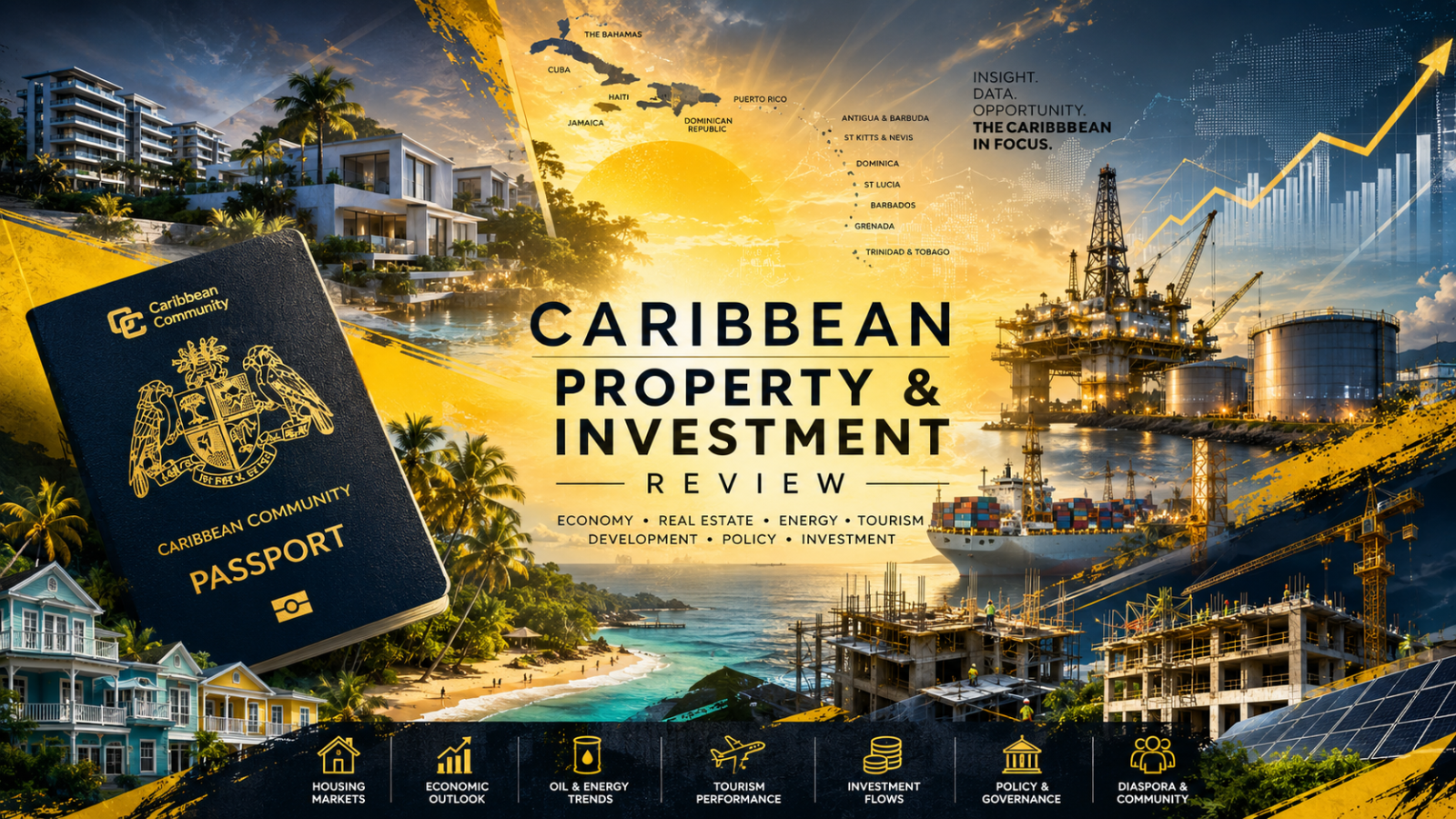
Publication Date: 3 September 2012 | Coverage Period: 3 August – 2 September 2012
Morning Briefing
- The Dominican Republic’s luxury residential market recorded its strongest August in five years, with foreign buyer enquiries up sharply across Cap Cana and Casa de Campo developments.
- Trinidad & Tobago’s Ministry of Finance confirmed energy revenues for the first half of 2012 exceeded budget projections, underpinning continued investor confidence in the twin-island republic.
- Jamaica’s newly elected PNP government under Prime Minister Portia Simpson Miller continued dialogue with the International Monetary Fund, with structural reform benchmarks under active discussion.
- The Atlantic hurricane season entered its climatologically peak window — August through October — with the National Hurricane Center tracking several tropical disturbances of interest to Caribbean property holders.
- Barbados reported a modest uptick in UK-sourced property enquiries, though prices on the west coast remained under gentle downward pressure as vendors adjusted to post-2008 demand levels.
- St Kitts & Nevis Citizenship by Investment programme continued to attract high-net-worth applications, with the Nevis Island Administration signalling new luxury villa developments approaching launch.
Dominican Republic: Luxury Development in Full Stride
The Dominican Republic consolidated its position as the Caribbean’s most dynamic luxury property market during August 2012. Cap Cana, the vast 30,000-acre master-planned resort community on the eastern tip of Hispaniola, reported strong pipeline activity from North American and European buyers seeking branded residence units attached to five-star hotel brands. The appeal of the DR’s relatively low entry prices compared with comparable Turks and Caicos or Cayman Islands product continued to drive enquiry volumes well above prior-year levels.
President Danilo Medina, who assumed office following his May 2012 election victory, had moved quickly to signal continuity in the open-investment posture that characterised his predecessor’s administration. The government’s CONFOTUR tourism investment incentive framework — which grants import duty exemptions and income tax holidays to qualifying hotel and resort projects — was actively promoted at international roadshows during the summer months. Several major hospitality groups were understood to be finalising site selection decisions for new properties along the northern coast near Playa Dorada and Cabarete.
Infrastructure investment complemented the private sector momentum. The expansion of Punta Cana International Airport’s terminal capacity proceeded on schedule, reinforcing connectivity from key source markets in the United States, Canada, and western Europe. For property investors, the combination of improving air access, a deep pipeline of branded luxury product, and government incentives created a compelling near-term entry thesis — particularly for buyers willing to commit during the construction phase in exchange for developer pricing.
Trinidad & Tobago: Energy Revenues Sustain Investment Appetite
With Brent crude trading in a range broadly supportive of government revenue projections, Trinidad & Tobago entered the final third of 2012 in a position of relative fiscal strength compared with most Caribbean neighbours. Prime Minister Kamla Persad-Bissessar’s People’s Partnership administration had maintained energy sector spending and continued to direct capital toward infrastructure improvement, creating downstream opportunities for construction, real estate, and professional services sectors.
Tobago, the smaller of the twin islands, drew particular attention from international leisure property investors during the coverage period. The island’s uncrowded beaches, relatively undeveloped coastline, and improving air links from London Gatwick via British Airways offered a proposition distinct from the more intensively developed eastern Caribbean markets. Tobago House of Assembly planners were reviewing development applications in the Speyside and Charlotteville areas, where boutique eco-lodge and villa concepts were attracting interest from European buyers seeking authenticity over mass-market resort infrastructure.
Port of Spain’s commercial property market remained active. Demand for grade-A office space from financial services, legal, and energy-sector tenants kept vacancy rates low, and several mid-scale residential developments in the east-west corridor reported healthy pre-sales. For regional investors, Trinidad’s role as the commercial hub of the southern Caribbean — with established capital markets, a functioning stock exchange, and a sophisticated professional class — gave it a resilience that smaller, tourism-dependent islands could not match.
Jamaica: Reform Path and the Property Market
Jamaica’s fiscal position remained the dominant backdrop for property market sentiment on the island. Prime Minister Portia Simpson Miller’s PNP government, elected in December 2011, inherited a debt-to-GDP ratio among the highest in the world and was navigating complex negotiations with the IMF toward a formal programme that would unlock multilateral support in exchange for fiscal consolidation commitments. The discussions, while not yet concluded, set the tone for cautious confidence among both domestic and international investors.
In practical terms, the upper end of the Jamaican residential market — particularly in the Kingston 6 and 8 neighbourhoods, and in coastal parishes such as Portland and St Elizabeth — retained appeal for diaspora buyers and a small cohort of lifestyle-motivated international purchasers. The depreciation of the Jamaican dollar against major currencies, while a source of economic concern domestically, made USD-denominated pricing look increasingly competitive for overseas buyers. Tourism linkage properties near Montego Bay and Negril continued to generate rental income sufficient to support investment cases, despite the island’s broader economic headwinds.
Hurricane Season: Risk Assessment for Property Holders
The 2012 Atlantic hurricane season, forecast by NOAA to be a near-normal to above-normal season, reached its climatological peak during the August coverage period. Property holders across the Caribbean were reminded that insurance adequacy, structural resilience, and documented pre-storm asset condition were the three pillars of effective hurricane risk management. For investors with coastal or low-lying properties, elevation certificates and flood zone designations merited annual review rather than one-time assessment.
The broader insurance market for Caribbean property had undergone significant repricing since the active 2004–2005 hurricane seasons. Catastrophe bond markets and reinsurance capacity had largely stabilised by 2012, though premiums for certain high-exposure zones — particularly the Turks and Caicos, northern Bahamas, and western Cuba — remained elevated. Investors considering new acquisitions were advised to factor insurance cost trajectories into their underwriting assumptions, particularly given ongoing debate among climate scientists about the long-term influence of sea-surface temperatures on storm intensity.
Caribbean Leaders This Month
Cap Cana, Dominican Republic — The master-planned resort continued to demonstrate the strongest foreign buyer velocity of any single Caribbean development community, with luxury villa and condo launches drawing committed interest from North American retirees and European second-home buyers alike.
Maraval, Trinidad — Residential property in this sought-after Port of Spain suburb maintained its premium status, with limited supply and strong professional-class demand from the energy and financial sectors keeping prices firm through the summer months.
Tobago’s Windward Coast — Quiet but notable buyer interest from European lifestyle purchasers marked this stretch of unspoiled coastline as an emerging destination for those seeking an authentic Caribbean experience at price points below better-known islands.
Montego Bay Hotel Strip, Jamaica — Despite national economic pressures, the hotel and resort corridor maintained occupancy levels and provided a platform for short-term rental investors willing to manage currency and operational risk.
West Coast Barbados (Sandy Lane Corridor) — While headline prices softened modestly, ultra-prime product at the top of the market attracted sporadic but high-value transactions from buyers for whom Barbados’s lifestyle credentials remained undiminished.
St Kitts Citizenship by Investment — The programme’s real estate option continued to generate structured demand for approved villa developments on St Kitts and Nevis, underpinning a segment of the market largely insulated from conventional price cycles.
Cabarete, Dominican Republic — The north coast kite-surfing and lifestyle hub attracted a younger, active-travel demographic of buyer, diversifying the DR’s buyer profile beyond the luxury resort market and creating a distinct investment sub-market with its own pricing dynamics.
Overall Performer: Dominican Republic. Across metrics of buyer enquiry, development pipeline, infrastructure investment, and government incentive clarity, the DR stood apart from its Caribbean peers during the August 2012 coverage period as the market best positioned to capture foreign capital in the near term.
Looking Ahead
The peak of the Atlantic hurricane season will continue to demand attention from Caribbean property holders through the coming weeks. Investors are encouraged to review insurance documentation, confirm property manager contingency protocols, and monitor National Hurricane Center advisories. A single significant storm makes landfall and the narrative around Caribbean property investment shifts meaningfully — preparedness is not merely prudent, it is commercially rational.
Jamaica’s IMF negotiations are expected to continue through the coming months. A successful programme agreement would represent a significant positive signal for the island’s investment environment, potentially unlocking multilateral financing that stabilises the fiscal position and creates the conditions for a gradual recovery in domestic confidence. Market participants with Jamaica exposure should follow developments closely.
The Dominican Republic’s momentum appears durable through the balance of 2012 and into 2013. The northern tourist season — which drives peak activity for both hotels and residential resellers — begins in earnest in late autumn, and current pipeline levels suggest that developer and secondary market activity will remain elevated. Investors considering entry into the DR market would do well to act ahead of the season’s pricing peak.
The Caribbean Property & Investment Review is published monthly for professional investors and high-net-worth individuals active in Caribbean real estate markets. All market commentary reflects conditions during the stated coverage period. This publication does not constitute financial or legal advice.
Follow Jamaica Homes on Youtube @jamaicahomes and Instagram @jamaica_homes and on Facebook @jamaicahomesnews Send us a message or email us at onlinefeedback@jamaica-homes.com or editor@jamaica-homes.com
Support independent Jamaican journalism.
- 1Our journalists cover housing, politics and community — stories that directly affect Jamaican lives.
- 2We have no billionaire owner and no advertisers calling the shots. Every story is decided by our editors.
- 3It costs less than a cup of coffee a week, and takes less time to subscribe than it took to read this article.
Support Jamaica Homes News today.
- Save 17% compared to monthly
- All articles unlocked
- Weekly newsletter
- Priority support
By subscribing you agree to our Privacy Policy and Terms.

Visit our YouTube Community ↗