

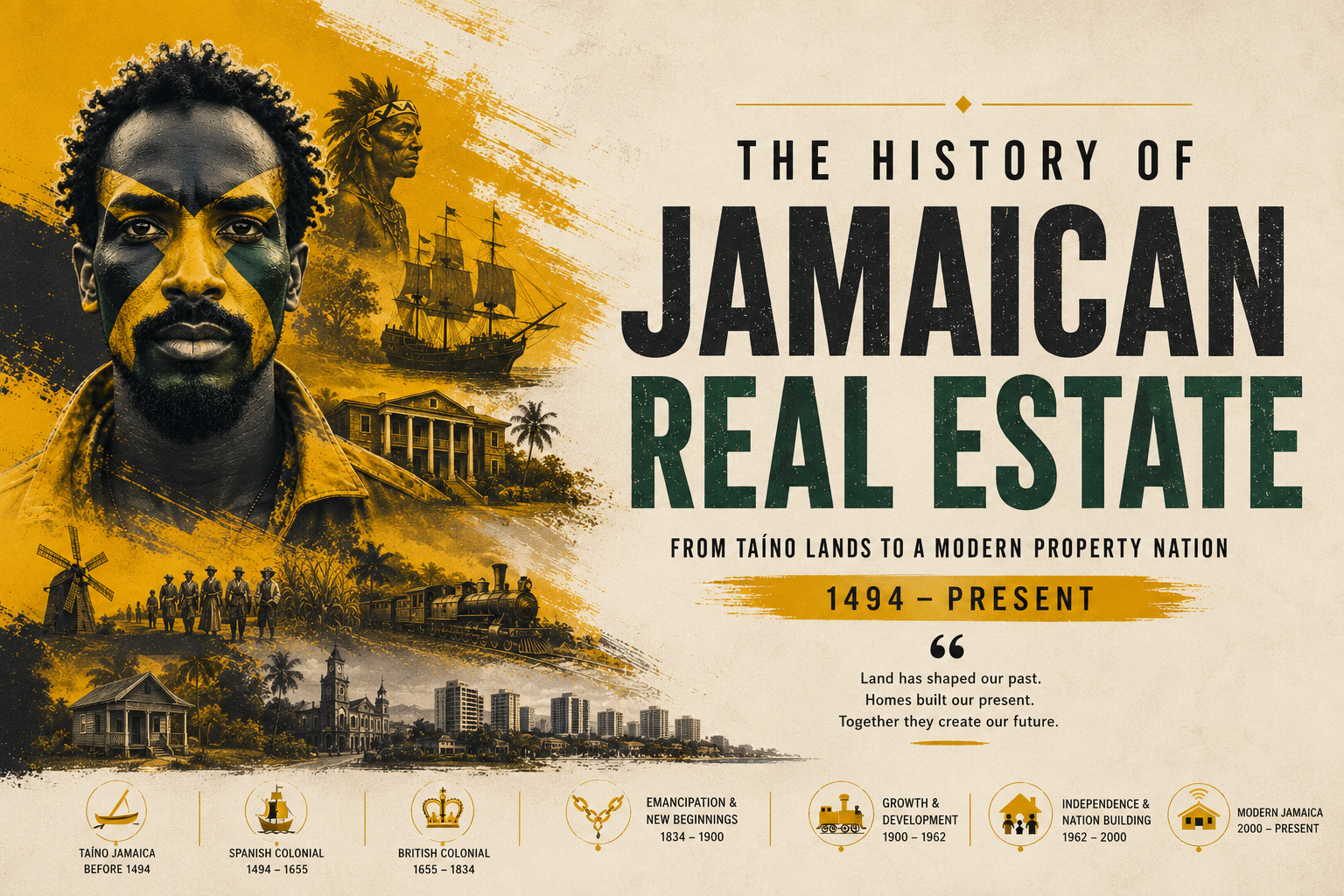
- Baptist missionaries bought plantation land to sell plots to freed families.
- Sligoville, founded 1835, became Jamaica’s first true free village.
- Over 200 free villages were established across inland Jamaica by 1865.
- Freed families purchased quarter-acre lots for as little as £3–£10.
- The movement created Jamaica’s first organised Black homeownership wave.
- Dozens of these historic settlements remain identifiable across Jamaica today.
On the first day of August 1838, the apprenticeship period that had prolonged the indignities of slavery ended across the British Caribbean. In Jamaica, nearly 320,000 formerly enslaved men and women became legally free. Within days, many of them walked off the estates. Planters predicted economic ruin. What they had not anticipated was that some of the most consequential property transactions in Jamaican history were already underway — orchestrated not by merchants or colonial officials, but by Baptist preachers armed with title deeds and a theology of land as liberation.
The Free Villages Movement that flourished between 1838 and 1865 represents the foundational chapter of Black landownership in Jamaica. It was simultaneously a religious project, a political act, and a real estate revolution. Its legacy is written not only in the landscape of the Jamaican interior, where hillside settlements bearing names like Kettering, Wilberforce, and Buxton still exist, but in the very concept that ordinary Jamaicans might own the land beneath their feet.
Before Emancipation: The Ground Is Prepared
The story of the free villages does not begin in 1838. It begins in 1835, three years before full freedom, in the misty hills above Spanish Town, where the Reverend James Mursell Phillippo of the Baptist Missionary Society purchased a tract of land and established what is widely recognised as Jamaica’s first free village: Sligoville, named in honour of the Marquess of Sligo, the then-Governor of Jamaica and an advocate of emancipation.
Phillippo’s vision was prophetic. He understood that legal freedom without economic independence was hollow. An enslaved person freed but left landless and dependent on a former master for housing and wages had merely exchanged one form of bondage for another. Land, Phillippo argued in his writings and sermons, was the material foundation of true liberty. Sligoville was his proof of concept — a planned community of small freehold lots, each sold at a price that a determined labourer could save toward, on land that no planter could revoke.
The Baptist Missionary Society, which had operated in Jamaica since 1814, had built a network of congregations across the island. These churches were not merely spiritual institutions; they were social infrastructure. And their ministers — men who had witnessed slavery intimately and opposed it publicly — were uniquely positioned to act as land brokers, community planners, and advocates for the newly freed.
William Knibb and the Politics of Purchase
No figure looms larger over the Free Villages Movement than the Reverend William Knibb. Born in Kettering, Northamptonshire, in 1803, Knibb arrived in Jamaica in 1825 as a young missionary and was rapidly radicalised by what he witnessed. He became the most prominent British abolitionist voice from within the Caribbean, travelling to England in 1832 to testify before Parliament and famously declaring, upon emancipation, “The monster is dead!” before his congregation at Falmouth.
But Knibb was not content with spiritual celebration. By 1838 he had turned to land. Working through the Baptist Missionary Society and using funds raised in Britain — including donations from British nonconformist congregations who viewed the project as a moral obligation — Knibb began purchasing parcels of plantation land across Trelawny, St Ann, and adjoining parishes. These were often the least productive margins of sugar estates, land that planters were sometimes willing to sell rather than maintain, or land acquired through debt foreclosure.
Knibb subdivided these parcels into quarter-acre lots — a size calculated to support a kitchen garden and a modest house — and offered them to freed families at prices typically ranging from £3 to £10 per lot. Payment could be made in instalments. In many cases, the Baptist church held the title in trust until the purchase was complete, at which point a formal deed was transferred to the family. It was, in effect, a nineteenth-century community land trust operating on Baptist principles.
By the time of Knibb’s death in 1845, he had been instrumental in establishing dozens of villages. The village of Kettering in Trelawny was named for his English birthplace. Others bore the names of abolitionists and allies: Wilberforce, Clarkson, and Sturge, honouring the architects of British antislavery. These were naming acts of political meaning — a permanent inscription of the abolitionist project onto the Jamaican landscape.
The Architecture of a Free Village
The free villages followed a broadly consistent pattern that distinguished them from the estate villages — the tied housing on plantation land — that characterised most rural settlement in pre-emancipation Jamaica. A Baptist chapel invariably stood at the centre, serving as church, school, and community hall. Around it, lots were laid out in rough grids or along the contours of hill slopes. Each family held its own freehold title, a document of almost sacred importance that freed people preserved carefully across generations.
James Phillippo documented the development of these communities in his 1843 book Jamaica: Its Past and Present State, one of the most detailed primary accounts of the post-emancipation transition. He recorded that within a few years of full freedom, thousands of formerly enslaved people had purchased land through the village schemes, building modest but permanent homes and establishing provision grounds that freed them from dependence on the plantation wage.
The economic logic was deliberate. Planters throughout the 1838–1865 period attempted to compel freed people back to estate labour by inflating rents for estate housing, creating what historians have called the “rent and wages” trap. A freed family paying rent to a planter for their cottage was effectively bound to that estate. The free villages broke this mechanism entirely: a family with their own freehold lot paid no rent and owed the planter nothing.
Colonial records held at the British National Archives, Kew, and documented by scholars at the University of the West Indies Mona, indicate that by 1845 — just seven years after full emancipation — an estimated 19,000 to 23,000 formerly enslaved people had acquired small freeholds across Jamaica, the overwhelming majority through free village schemes. By 1865, the number of small freehold properties in Jamaica had risen dramatically from near-zero among Black Jamaicans to figures some historians place above 50,000 individual lots.
Geography of Freedom: The Villages of the Jamaican Interior
The free villages were concentrated in particular geographic zones that reflected both the availability of land and the reach of the Baptist network. Trelawny — Knibb’s base — became one of the densest areas of free village settlement. St Ann, Portland, Manchester, and St Elizabeth also saw substantial development. These were overwhelmingly inland and upland parishes, a consequence of the fact that the most productive coastal and valley lands remained firmly in planter hands.
This geographic concentration had lasting consequences for Jamaican land tenure and real estate. The interior highlands became associated with peasant smallholding — the small farmer economy that would remain the backbone of rural Jamaica through independence and beyond. The coastal lowlands, by contrast, remained plantation territory longer, only gradually transferring to other uses as the sugar economy declined across the latter nineteenth century.
The Jamaica National Heritage Trust (JNHT) has identified a significant number of surviving free villages as heritage sites, recognising that their planned layouts, chapel buildings, and burial grounds represent an irreplaceable record of post-emancipation social history. The Jamaica Archives and Records Department (JARD), housed at Spanish Town, holds land transaction records, deeds, and Baptist church registers from this period that constitute the documentary foundation of Black freehold in Jamaica — the earliest paper trail of ordinary Jamaican families owning property.
The National Library of Jamaica (NLJ) holds newspaper accounts from the period, including coverage in The Morning Journal and The Baptist Herald that tracked the development of free village schemes with a detail and enthusiasm that reflected their political significance. These accounts — many of which have been digitised and made accessible through NLJ resources — provide a ground-level view of the transactions, the community meetings, the chapel dedications, and the occasional legal disputes that attended the creation of these settlements.
Resistance, Reaction, and the Limits of Freedom
The planter class understood immediately what the Free Villages Movement meant. Every freed family that secured a freehold lot was a family that could refuse to work for estate wages, hold out during harvest, or leave entirely. The Colonial Office in London received a steady stream of complaints from Jamaican planters throughout the 1840s and 1850s, characterising the Baptist missionaries as subversive agitators who were destroying the island’s agricultural economy by facilitating the desertion of the labour force.
These complaints were not without political consequence. Colonial administrators periodically sought to obstruct land sales, impose land taxes designed to disadvantage small holders, and restrict the registration of freehold titles. The 1840s saw several administrative attempts to limit the legal standing of Baptist land trusts, most of which were resisted by the missionary societies through legal challenge and lobbying in London.
The Morant Bay Rebellion of 1865 — sparked in no small part by the grinding poverty and land insecurity that still afflicted much of the rural Black population — brought this era to a violent close. The brutal suppression of the rebellion under Governor Edward John Eyre, the execution of national hero Paul Bogle, and the subsequent abolition of the Jamaican assembly and imposition of Crown Colony government fundamentally altered the political landscape. The pace of free village establishment slowed markedly after 1865, and the optimism of the immediate post-emancipation decades gave way to a harder period of colonial consolidation.
Yet the villages established between 1838 and 1865 endured. They were too numerous, too widely distributed, and too firmly rooted in individual freehold title to be undone by political change. The deeds held by Jamaican families in those communities represented property rights that could not simply be legislated away.
Legacy: The Roots of Jamaican Homeownership
The Free Villages Movement is the origin point of a distinctly Jamaican relationship with land and homeownership. The cultural emphasis on “owning your own place” — a value that runs deep in Jamaican society and manifests in diaspora communities in Britain, Canada, and the United States with remarkable consistency — has roots in the post-emancipation era, when land was literally the difference between freedom and dependency.
Scholars at the University of the West Indies, including historians in the Department of History and the Sir Arthur Lewis Institute of Social and Economic Studies, have traced the lineage of Jamaican peasant freehold through the free village era into the twentieth century land reform debates, the Land Authorities established after independence, and the current frameworks governing rural and peri-urban land ownership in Jamaica. The Jamaica Information Service (JIS) has documented numerous communities that can trace continuous habitation and freehold descent from the original free village grants of the 1838–1865 period.
In the context of contemporary Jamaican real estate, the free village legacy is visible in several structural patterns. The prevalence of family land — informally held freehold property jointly claimed by the descendants of a common ancestor — is widely understood by legal scholars and land economists as a direct descendant of the free village freehold, transmitted across generations through informal inheritance rather than formal probate. This has created both a profound cultural attachment to property and a complex set of legal challenges around title registration that the National Land Agency (NLA) continues to address through titling programmes.
The Baptist missionaries who negotiated these transactions were, in a very real sense, Jamaica’s first community land developers — not seeking profit, but applying the tools of the real estate market to a project of social transformation. William Knibb, James Phillippo, and their colleagues purchased land, subdivided it, structured payment terms for low-income buyers, held title in trust, and transferred ownership upon completion of payment. The mechanics of what they did would be recognisable to any modern affordable housing developer.
Walking the Villages Today
To travel through the Jamaican interior today — through Trelawny’s Queen of Spain Valley, through the hills above Ocho Rios in St Ann, through the communities of Manchester — is to move through a landscape shaped by decisions made between 1838 and 1865. The village names are still there. The Baptist chapels, many rebuilt over generations but still occupying their original lots, still anchor community life. The provision grounds have become more varied, the cottages replaced by concrete block houses, but the fundamental structure of a community of smallholders on individual freeholds, gathered around a church, reflects a plan that is nearly two centuries old.
The Jamaica National Heritage Trust maintains records of many of these communities. Historical mapping projects undertaken by UWI researchers and supported by the British National Archives have reconstructed the original village layouts of several key settlements, allowing comparison with current satellite imagery that reveals, with striking clarity, how persistent these planned communities have been.
In Sligoville — that first village, the prototype for everything that followed — residents can still point to land their families have held since the 1830s. The chapel that Phillippo built is long gone, replaced and rebuilt in the intervening years, but the community it anchored remains. It is the oldest continuously inhabited free village in Jamaica, and perhaps the oldest monument to Black landownership in the Western hemisphere.
Conclusion: Land as the First Form of Freedom
The Free Villages Movement of 1838 to 1865 was not merely a chapter in Jamaican religious or social history. It was the foundational act of Jamaican real estate — the moment when property ownership became, for the first time, a possibility for the majority of the island’s population rather than the exclusive domain of a colonial planter elite.
The men and women who saved £3 or £5 or £10 to purchase a quarter-acre in Kettering or Wilberforce or Sligoville were not simply buying land. They were buying permanence, security, and the right to remain. They were making the single most consequential financial decision that most of them would ever make, and they were making it in circumstances of profound precarity, against the active resistance of a planter class that understood, correctly, what Black landownership meant for the plantation economy.
The contemporary Jamaican housing market — its cultural values, its legal complexities, its deep attachment to freehold ownership, its particular pattern of peri-urban small lot development — cannot be understood without understanding what happened in those hill villages after August 1838. The history of Jamaican real estate begins not with colonial land grants or commercial development, but with a freed woman in Trelawny, handing over carefully saved coins to a Baptist minister, and receiving in return a document that said: this land is yours.
Sources and further reading: James M. Phillippo, Jamaica: Its Past and Present State (1843); Philip Curtin, Two Jamaicas: The Role of Ideas in a Tropical Colony (1955); Swithin Wilmot, “The Politics of Samuel Clarke” (1995); National Library of Jamaica digital newspaper archives; Jamaica Archives and Records Department, Spanish Town; British National Archives, CO 137 series (Jamaica Correspondence); Jamaica National Heritage Trust heritage register; University of the West Indies, Mona, Department of History working papers.
Follow Jamaica Homes on Youtube @jamaicahomes and Instagram @jamaica_homes and on Facebook @jamaicahomes Send us a message or email us at onlinefeedback@jamaica-homes.com or editor@jamaica-homes.com
Support independent Jamaican journalism.
- 1Our journalists cover housing, politics and community — stories that directly affect Jamaican lives.
- 2We have no billionaire owner and no advertisers calling the shots. Every story is decided by our editors.
- 3It costs less than a cup of coffee a week, and takes less time to subscribe than it took to read this article.
Support Jamaica Homes News today.
- Save 17% compared to monthly
- All articles unlocked
- Weekly newsletter
- Priority support
By subscribing you agree to our Privacy Policy and Terms.
