


After struggling to sell his J$42 million house in Jamaica, Sean flies to Britain convinced that property investment overseas offers better opportunities. A few viewings, one mortgage conversation and an unexpected lesson in British taxation later, he begins to question everything.

KINGSTON, Jamaica — Sean has had enough.
For weeks, buyers have questioned the J$42 million asking price on his three-bedroom house in Greater Portmore. One offered J$37 million. Another suggested J$38 million. Somebody walked through the property, inspected every cupboard and announced that it was overpriced.
Sean was offended.
“Everybody want something for nothing,” he complained.
Then, scrolling through British property websites, he discovered houses advertised for £150,000, £175,000 and £180,000.
Sean leaned back.
“Wait deh. So me can buy house a England for that?”
Two weeks later, he was on a plane to London.
If Jamaicans could not appreciate the value of his property, perhaps he would become an international investor instead.
There was only one problem.
Sean had compared property prices without comparing property markets.
Welcome to England, Sean
His cousin collected him from Heathrow.
“Me see some nice houses online. £175,000. Buy one, rent it out and collect pounds every month.”
His cousin glanced across.
“You check the stamp duty?”
“The what?”
“Mortgage rates? Insurance? Maintenance? Rental regulations?”
Sean looked through the window.
“Brethren, me just land.”
Their first viewing was a two-bedroom terraced house in the Midlands, advertised for £175,000.
The kitchen was modern, although smaller than expected. The garden could accommodate four chairs, a washing line and one ambitious barbecue.
Sean looked outside.
“So where people park?”
“On the street,” the agent replied.
“Both cars?”
“If you find space.”
Back in Portmore, Sean had a driveway, fenced yard, water tank and enough room to entertain half his family.
Suddenly, those features seemed considerably more valuable.
The Price Was Only the Beginning
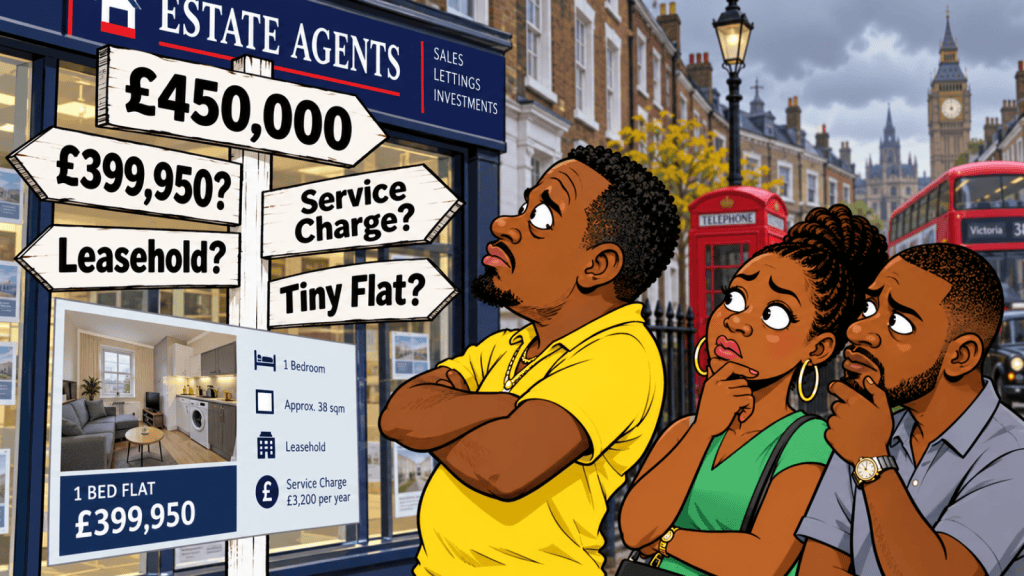
The agent suggested the property might rent for approximately £950 monthly.
“Now we talking!”
That represented £11,400 annually, a gross rental yield of approximately 6.5 per cent.
Then came the calculations.
Assuming Sean qualified for a 75 per cent loan-to-value mortgage, he would need £43,750 as a deposit.
An illustrative interest-only mortgage of £131,250 at 5.5 per cent would cost approximately £602 monthly, excluding fees.
That left £348 before insurance, management charges, maintenance, vacant periods and tax.
And he had not purchased the house yet.
Depending on his circumstances, England’s additional-property stamp duty rates and non-UK-resident surcharge could make the upfront tax bill substantial.
“So before me collect one month’s rent, me spending money like somebody renovating Buckingham Palace?”
His cousin laughed.
“Welcome to property investment.”
The Mortgage Had Other Ideas
Sean assumed having a deposit was enough.
The mortgage broker disagreed.
What was his income? His credit history? His residency status? Could he prove the source of his funds? Would the rent satisfy the lender’s affordability requirements?
“In Jamaica, me have property and business interests,” Sean explained.
“That’s helpful, but we still need to establish whether you qualify.”
Sean was discovering that British lenders had their own calculations.
The opportunities were real, but so were the restrictions.
His money did not automatically make him mortgageable.
The Tenant Has Rights Too
At another viewing, Sean asked what would happen if the tenant stopped paying rent.
The letting agent explained the legal procedures.
“So me can’t just tell them to leave?”
“No.”
England’s rental reforms, effective from May 2026, introduced significant changes to tenancy arrangements and possession procedures.
Landlords must follow the law, meet property standards and fulfil their responsibilities.
Sean considered the implications.
Back in Jamaica, he had been worrying about whether somebody would pay J$42 million.
In Britain, he was discovering that owning a rental property involved considerably more than collecting rent and possessing a front-door key.
The Bargain That Wasn’t
On his third day, Sean found a property advertised for £120,000.
“Now this is what me come for!”
The photographs looked promising.
The viewing told another story.
Damp walls. An ageing boiler. A questionable roof. Several repairs requiring investigation.
“How much to fix everything?”
“Depends what the surveys find,” his cousin replied.
“Five thousand?”
“Could be more.”
“Ten?”
“Possibly.”
Sean folded his arms.
“Every time me ask a question, the price go up.”
The lesson was becoming unavoidable.
A cheap property is not necessarily a good investment. Nor is an expensive property automatically poor value.
Jamaica Was Looking Different
That evening, Sean sat in his cousin’s kitchen, watching rain against the window.
He opened photographs of his Portmore house.
Three bedrooms. Two bathrooms. Driveway. Fenced yard. Water storage. Space to extend, subject to approval.
He thought about the British properties he had inspected.
Jamaica had its challenges: financing costs, legal expenses, insurance, maintenance, title complications and hurricane resilience.
Britain had different pressures: taxation, older housing stock, landlord obligations, mortgage restrictions and potentially expensive repairs.
Neither country guaranteed profits.
Neither market was automatically cheaper.
And neither rewarded investors simply for believing a property should be worth more.
Sean was beginning to understand something he had resisted at home.
The asking price was only the beginning of the conversation.
Then Came the Phone Call
On his fifth evening, his Jamaican real estate agent called.
“Sean, remember the buyer who offered J$38 million?”
“Yes.”
“He’s still interested. Would you reconsider?”
Sean studied his British investment calculations.
He had travelled thousands of miles searching for better value, only to discover the same questions Jamaican buyers had been asking him.
Was the property worth the money?
Could the numbers work?
Were there better alternatives?
“Tell him forty million,” Sean replied.
“Sean, he offered thirty-eight.”
“Well, see if him can improve it.”
For the first time, Sean was negotiating rather than defending a number.
Not because his house had suddenly lost value, but because he was beginning to distinguish between what he wanted and what the market might support.
Two Countries, One Lesson
Britain can offer genuine investment opportunities. So can Jamaica.
But comparing a £175,000 house in England with a J$42 million property in Portmore without considering size, condition, currency, financing, taxation, rental demand and ownership costs is not meaningful analysis.
Investors need to examine actual returns, not attractive advertisements.
A mature British property market does not eliminate risk. Equally, strong housing demand in Jamaica does not guarantee that every asking price is justified.
The principle remains the same wherever property is purchased.
Research carefully. Calculate everything. Understand the risks. Negotiate intelligently.
Sean Comes Home
At Heathrow, Sean received a message from his cousin.
Still thinking about buying in England?
Sean replied:
Yes. But me going to do proper research first.
Moments later, his Jamaican agent messaged.
Buyer has increased the offer to J$39 million. Can we talk?
Sean opened the photograph of his house.
The driveway looked wider. The garden looked greener. Even the water tank seemed more impressive.
He called his agent.
“Tell me something. If we agree forty million, can this deal close?”
Sean had finally stopped being a man defending an asking price and started becoming a seller interested in completing a transaction.
As his flight boarded, he glanced at one last British listing.
£175,000. Excellent investment opportunity.
He smiled and closed his phone.
“Excellent opportunity for who?”
Sean is a fictional character illustrating real property-market decisions. Financial examples are illustrative and do not represent actual mortgage offers or guaranteed investment returns.

Visit our YouTube Community ↗