


KINGSTON, Jamaica — The land belongs to the family. Everybody knows it. Grandfather worked it. His children built houses on it. The grandchildren grew up there. Property taxes have been paid for decades.
But ask who legally owns it and suddenly nobody seems quite so certain.
Grandfather died without leaving a will. One child moved to England. Another built a house on the property. Several relatives have since died. Nobody properly administered the estate. Everybody believes they have a claim.
The land has remained in the family for generations. Yet the family may struggle to establish who has the authority to sell it or pass it to the next generation.
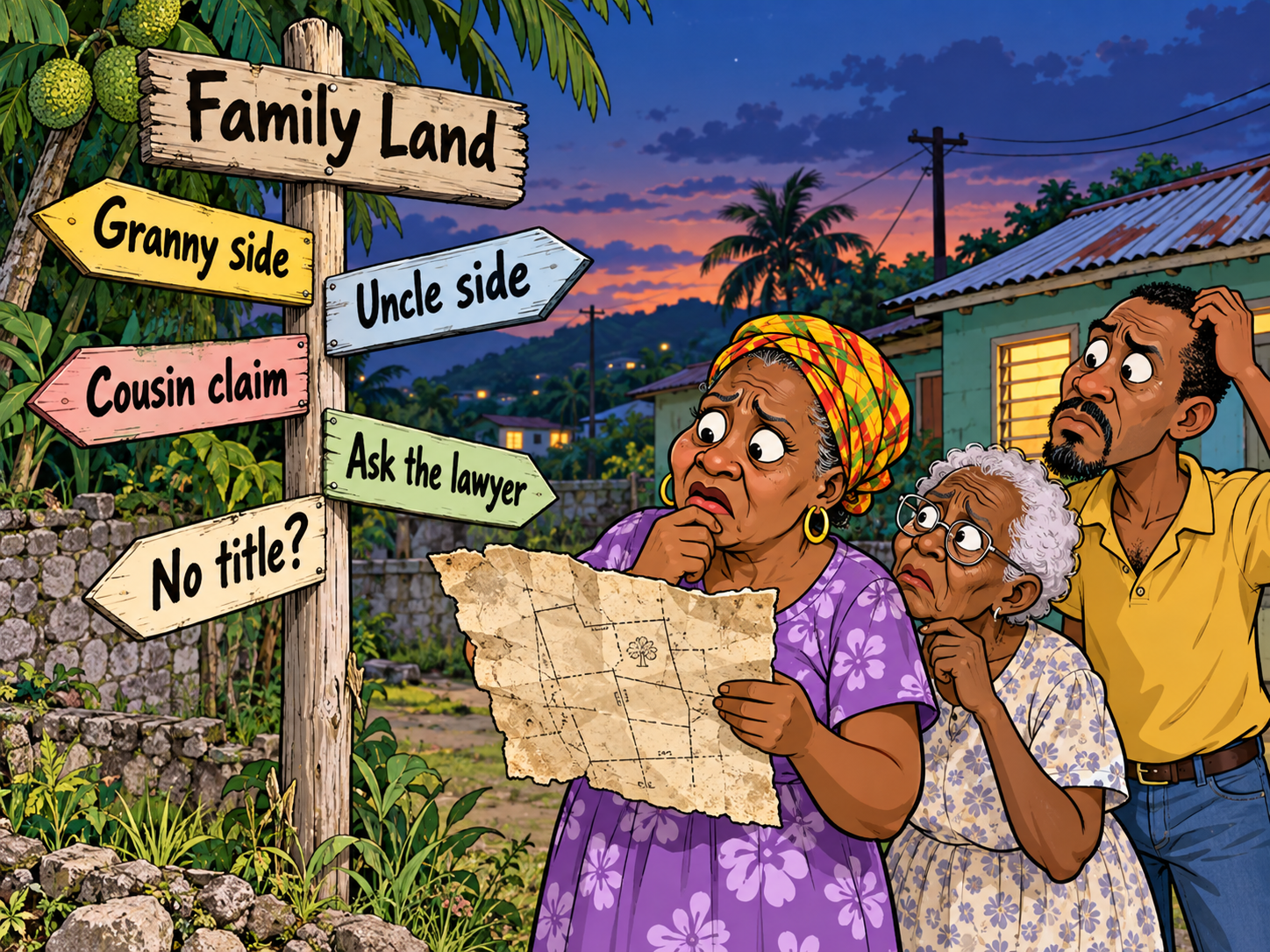
This is one of Jamaica’s quieter property problems.
And it is costing families more than they realise.
Everybody’s Land. Nobody’s Responsibility.
Across Jamaica there are properties occupied by successive generations whose ownership arrangements remain unresolved.
Some families have registered titles. Others rely on old conveyances or documents that have never been properly regularised. Some have little more than family understandings and memories of who originally purchased the land.
Not every untitled property is illegally occupied. Nor does the absence of a registered title necessarily mean nobody owns it.
But uncertainty can become expensive.
A family might have sufficient land to build several houses or establish a business. Yet when someone seeks financing or proposes a sale the unresolved ownership becomes an obstacle.
Suddenly everyone must agree.
Except nobody agrees.
One relative remembers a promise made forty years ago. Another insists that grandfather intended the land to be shared equally. Someone else argues that the person who remained in Jamaica deserves more because they maintained the property.
And somewhere overseas another beneficiary discovers that decisions have been made without their knowledge.
What was once a family asset becomes a family argument.
The Property Tax Illusion
One of the most dangerous misunderstandings surrounding Jamaican land concerns property tax.
There are people who believe that paying property taxes for twenty or thirty years establishes ownership.
It does not.
Tax receipts may support an application for registered title. The National Land Agency specifically identifies them among the documents that can accompany registration applications.
But paying taxes is not the same as proving legal ownership.
That distinction becomes particularly important when several relatives claim an interest in the same property.
Consider a person who has paid the taxes and maintained family land for decades. From their perspective they have fulfilled the responsibilities that other relatives ignored.
But another beneficiary may still possess a legitimate legal interest.
The tax receipts cannot automatically settle the disagreement.
Jamaica has families who can produce decades of payment records but cannot produce an uncontested answer to the simplest question.
Whose land is it?
The Dead Cannot Sign the Documents
Death can turn an informal family arrangement into a legal problem that lasts generations.
A property owner dies. The children continue living on the land. Nobody immediately deals with probate or letters of administration.
Perhaps there is no money for legal fees. Perhaps the relatives agree that nothing needs changing because everybody knows the property belongs to the family.
Then another generation passes.
Some beneficiaries die. Others migrate. Marriages and new family relationships complicate the picture.
Eventually someone wants to sell.
But the person whose name appears on the title has been dead for thirty years.
Living in a property does not automatically give someone authority to dispose of a deceased owner’s estate.
Inheritance rights depend on the legal circumstances. A valid will may determine distribution. Where there is no valid will Jamaica’s intestacy legislation becomes relevant.
The consequences can be substantial.
A family may own an asset worth millions while lacking the legal arrangements needed to make practical decisions about it.
The tragedy is that the problem often becomes more expensive with every passing generation.
The Relative Who Stayed Behind
Perhaps the most uncomfortable disputes arise between those who remained in Jamaica and those who went overseas.
One relative lives on the land. They maintain the boundary. They clear the vegetation. They repair buildings and pay expenses.
Another lives in London or Toronto and considers the property part of the family’s inheritance.
Both may believe their position is entirely reasonable.
The overseas relative sees an inherited asset.
The person in Jamaica sees decades of unpaid work.
When the property becomes valuable these competing perspectives can turn into open conflict.
Who should receive the proceeds of a sale? Should the person who maintained the property receive compensation? What happens when someone builds a substantial house on land legally belonging to a parent or another relative?
These are not merely financial questions.
They involve family loyalty and competing expectations of fairness.
And sometimes the greatest difficulty is that people have been relying on promises nobody ever properly documented.
A promise made around the dinner table may carry enormous emotional weight.
But it is not necessarily sufficient to establish a legal entitlement.
When Twelve Years Changes Everything
Jamaica’s adverse possession laws add another layer of complexity.
Under the Limitation of Actions Act a period of twelve years can become significant where the legal requirements for adverse possession are established.
But twelve years of occupation does not automatically make someone the owner.
Courts examine the nature of possession and whether the occupier demonstrated the necessary intention to possess the land.
Occupation with the owner’s continuing permission raises different legal considerations.
And disputes can become particularly complicated where the parties are relatives or co-owners.
Jamaica’s Supreme Court has repeatedly considered these questions.
In Warren v Administrator General for Jamaica in 2024 the court examined adverse possession involving registered co-owners and a deceased owner’s estate.
In Cousins v Passley in 2025 the court considered disputed possession and interests connected to a deceased registered proprietor.
The legal principles demonstrate why families should not assume that ownership arrangements can remain unresolved indefinitely without consequences.
Yet adverse possession should not be portrayed as a simple mechanism for taking family land.
Each case depends on its facts.
The broader lesson is that land ownership must be understood and properly managed rather than left to assumptions.
A Nation Struggling to Put Its Land in Order
This is not merely a private family problem.
Jamaica has spent years attempting to improve land registration.
National Land Agency estimates have placed the proportion of unregistered land parcels at approximately forty per cent. Registration levels vary considerably across parishes.
The economic implications are substantial.
A property that cannot readily be transferred or used as security may represent wealth that its occupants struggle to access.
And the Government recognises the problem.
In May 2026 Jamaica launched a land administration modernisation project supported by up to US$9 million from the Korea International Cooperation Agency.
The programme aims to strengthen technical capacity and modernise land information systems.
In September 2026 the Government also announced plans to increase annual title production through electronic titling.
Minister Robert Montague indicated that the National Land Agency’s current maximum capacity was approximately 8,000 titles annually. The proposed electronic system could increase that capacity to more than 25,000.
These developments matter.
But digitising a land registry cannot automatically settle a dispute between five relatives who disagree about their inheritance.
A modern computer system cannot determine what grandfather intended if the necessary evidence does not exist.
Technology may make registration more efficient.
It cannot manufacture family agreement.
The Inheritance That Never Becomes Wealth
Jamaicans have long understood the importance of owning land.
For many families property represents independence and the opportunity to leave something meaningful behind.
That ambition deserves respect.
But there is a contradiction in spending a lifetime acquiring property while making little provision for what happens after death.
Parents may believe they are securing their children’s future.
Yet without clear arrangements they may be leaving those children an argument.
A property can remain unsold for years while relatives disagree. Buildings deteriorate. Taxes and maintenance costs continue. Opportunities are lost.
And the next generation inherits the same uncertainty.
This is not an argument that every family should sell ancestral land.
Quite the opposite.
If the land is important enough to protect it should be important enough to organise its ownership properly.
Families should establish what documents exist. Understand who holds legal interests. Address outstanding estates and seek appropriate professional advice before problems multiply.
Those intending to leave land to children should make arrangements that reflect their wishes and the applicable law.
And those building houses on family property should understand their legal position before investing their life savings.
A house constructed on land whose ownership is disputed can become a costly mistake.
The Family Name Is Not a Title Deed
Perhaps Jamaica needs to reconsider what it means to leave property behind.
A successful inheritance is not simply land that remains in the family.
It is land that the next generation can legally hold and responsibly manage.
That requires more than sentiment.
It requires documentation. Clarity. Planning. And sometimes difficult conversations while the people who know the property’s history are still alive.
There is no shame in seeking legal assistance.
The greater danger is allowing uncertainty to deepen because nobody wants to upset the family.
Jamaica has spent generations teaching its people the importance of owning land.
But ownership is more than occupation. More than a family understanding. More than a property tax receipt kept in a drawer.
A family can spend a lifetime protecting land from strangers while failing to protect it from uncertainty within its own walls.
And perhaps that is the most uncomfortable truth.
The greatest threat to generational wealth is not always losing the land. Sometimes it is failing to establish who has the right to inherit it.
Follow Jamaica Homes on Youtube @jamaicahomes and Instagram @jamaica_homes and on Facebook @jamaicahomesnews Send us a message or email us at onlinefeedback@jamaica-homes.com or editor@jamaica-homes.com

Visit our YouTube Community ↗