


- Corrupt land allocation by government agencies deprives legitimate claimants of property rights
- The Integrity Commission investigates public officials who acquire property inconsistent with their declared income
- MOCA has jurisdiction to investigate corruption involving land transactions and government officials
- Victims of corrupt land decisions can challenge administrative allocations by judicial review in the Supreme Court
- State land that is improperly transferred can in principle be recovered by the Crown even after subsequent disposals
The allocation of state land in Jamaica — through the National Housing Trust, the Housing Agency of Jamaica, the Sugar Company of Jamaica Holdings, and other bodies — has been the subject of persistent allegations of corruption and political manipulation. Legitimate applicants who have waited years in queues for affordable housing lots have found that parcels to which they were entitled were instead allocated to politically connected individuals, extended family members of officials, or persons who had not applied through the proper channels. The mechanisms through which these allocations are made — administrative decisions by agency boards rather than open competitive tender — provide limited transparency and substantial scope for the exercise of improper influence. While individual cases are difficult to prove without access to internal records, the pattern of findings by the Auditor General’s Department and parliamentary committees over successive administrations suggests that corrupt land allocation is a recurring rather than exceptional problem in the administration of public land.
Private Land Grabs and the Role of Enforcement
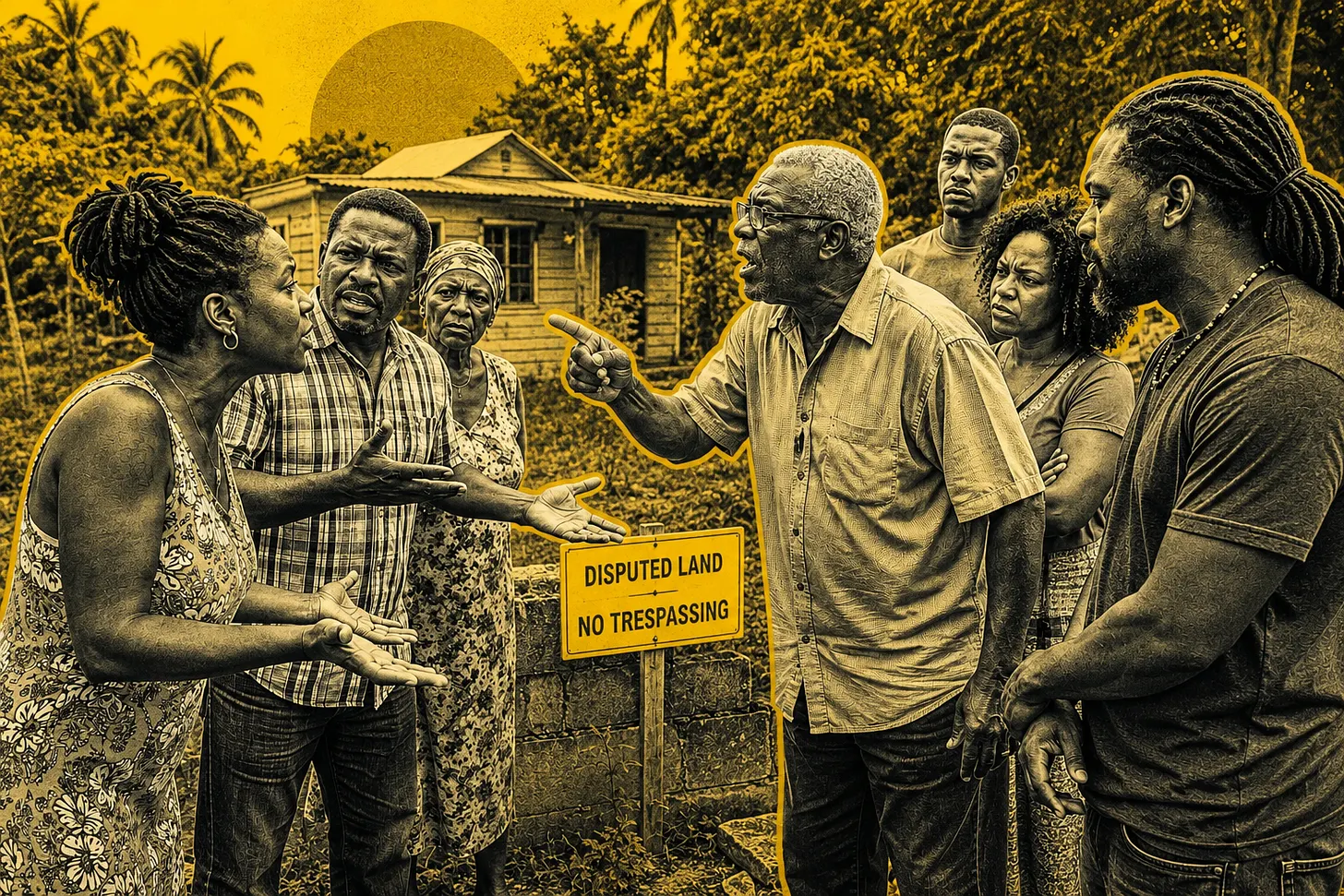
Beyond the allocation of state land, private landowners — particularly those with undocumented title or informal occupation rights — have been displaced from land they have occupied for generations by persons with political connections who use those connections to obtain favourable administrative decisions or to deter enforcement action against unlawful occupation. In documented cases, occupants of long-established communities on private or Crown land have been displaced after the land was acquired by connected parties at undervalue through opaque transactions. The Proceeds of Crime Act empowers law enforcement to investigate and forfeit assets — including land — that represent the proceeds of corruption or fraud, and MOCA has jurisdiction to investigate public officials whose property holdings are inconsistent with their declared income under the Integrity Commission Act. However, the evidentiary standard for establishing corruption in land transactions is high, and victims who lack resources to sustain extended litigation are at a significant disadvantage.
Remedies for Victims of Corrupt Land Allocation
A person who has been denied a rightful land allocation through a corrupt administrative process can challenge the decision by way of judicial review in the Supreme Court, seeking an order quashing the allocation decision and requiring the agency to reconsider the application properly. The test for judicial review is whether the decision was unlawful, irrational, or procedurally unfair — not whether a different official would have made a different decision — and a successful application does not automatically result in the land being awarded to the claimant, but it does require the process to be recommenced lawfully. Complaints about public officials involved in corrupt land allocation should be made to the Integrity Commission and to MOCA in writing, with supporting documentation where available. The Office of the Contractor General (now the Integrity Commission’s procurement arm) also monitors government contracts, including land sale agreements, for irregularities. Landowners displaced by private parties who used improper influence should report the matter to both MOCA and to an attorney who can advise on civil remedies.
Follow Jamaica Homes on Youtube @jamaicahomes and Instagram @jamaica_homes and on Facebook @jamaicahomesnews Send us a message or email us at onlinefeedback@jamaica-homes.com or editor@jamaica-homes.com

Visit our YouTube Community ↗