


Kingston, Jamaica, 30 June 2026
A registered land title is, on paper, just a document. In practice, it is the difference between a home that can anchor a family’s financial future and one that cannot, a distinction Hurricane Melissa has brought into sharp focus across western Jamaica.
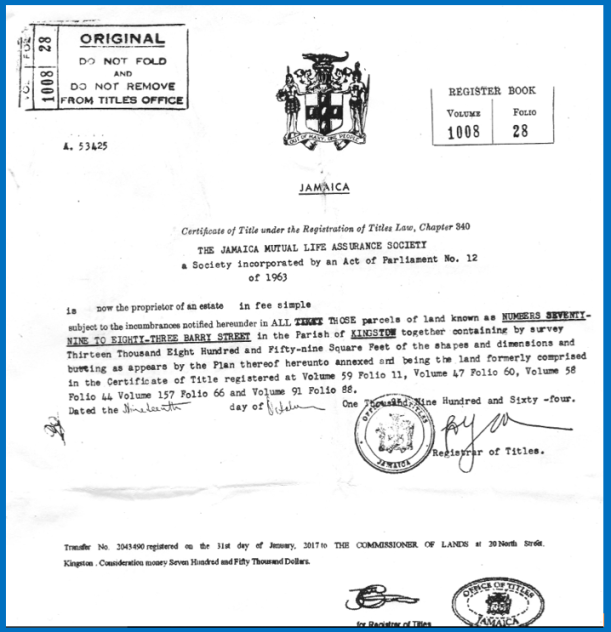
For generations, land ownership has functioned as Jamaica’s primary vehicle for building wealth and stability, families aspiring to secure a piece of land not just for shelter but as a legacy to pass down. At the centre of that aspiration sits one critical piece of paper, the certificate of title, which transforms occupation of land into a recognised legal and financial asset.
The practical consequences of missing that document became visible in the weeks after Melissa struck last October. In several communities across the west, families found themselves unable to rebuild not because they lacked the will or even the materials, but because their land tenure was unclear or entirely undocumented. Without a registered title, there was no clean legal basis on which to access disaster relief financing, file an insurance claim, or even establish definitively who had the right to rebuild on a given plot.
From conveyancing to disaster preparedness
That experience has reframed land titling, in the eyes of policymakers and ordinary Jamaicans alike, as something closer to disaster preparedness than routine conveyancing. A registered title provides legal recognition that allows a property owner to participate fully in the formal economy, accessing financing to build or improve a home and protecting the family against disputes that might otherwise surface during a crisis, when emotions and stakes are both highest.
The financing dimension carries particular weight in Jamaica’s current housing climate. With banks increasingly weighting their lending books toward mortgages, secured against registered property, an untitled home effectively sits outside the formal credit system. Its owner cannot easily borrow against it to fund repairs, expansion, or education for the next generation, regardless of how long the family has occupied the land or how much they have invested in it over the years. The Crown land enforcement crackdown underlines the same point from a different angle: without clean title to a legally transferable property, neither security nor value can be extracted from land. For the latest policy position on this, see No More Free Pass on Crown Land.
The inheritance trap
Inheritance presents an equally pressing concern. Property passed down without clear title frequently becomes family land in the informal sense, jointly understood to belong to multiple descendants but never formally divided or individually registered. That arrangement can work reasonably well for a generation or two, but it tends to fracture under pressure, particularly when one branch of a family wants to sell, develop, or borrow against a share of land that several relatives nominally hold but none can singularly prove. The full complexity of family land as Jamaica’s most economically frozen asset is examined in Family Land Is Jamaica’s Frozen Wealth.
The government’s response, most visibly through the newly launched Land Administration Capacity Enhancement Project with South Korea, represents an acknowledgment that closing this gap requires sustained institutional investment rather than periodic registration drives. But policy alone cannot fully solve a problem rooted as much in family history, missing documentation and rural land custom as in bureaucratic capacity.
For Jamaican families weighing whether to begin the titling process on inherited or long-held land, the calculation has shifted. What once felt like an optional, even burdensome administrative task increasingly looks like a prerequisite for financial security, particularly in a country where the next major hurricane is a matter of when, not if. Secure ownership, in that sense, has become less about asserting a claim and more about protecting a family’s future against a risk that has already proven itself real. The government’s latest enforcement action on Crown land — including the permanent bar on settlement for new squatters — underlines the same urgency. The full story is in New Squatters on Crown Land Will Never Qualify for Settlement.

5 Comments
Pingback: Why a Land Title Has Become a Matter of Survival, Not Paperwork – Jamaica Loop News
Pingback: New Squatters on Crown Land Will Never Qualify for Settlement, Montague Warns – Jamaica Homes News
Pingback: NaRRA’s Hidden Clause: How Jamaica’s Reconstruction Law Could Strip Coastal Communities of Their Land – Jamaica Homes News
Pingback: Family Land Is Jamaica’s Frozen Wealth. Land Reform Has Not Yet Thawed It. – Jamaica Homes News
Pingback: Hurricane Melissa: What Jamaica Got Wrong, What It Got Right, and What Must Change Before the Next Storm Arrives - Jamaica Homes News
Visit our YouTube Community ↗