


Special Heritage Edition · 26 Hope Road, Kingston 10
From Church Glebe to National Treasure
Nearly 360 years of land, ambition, loss, rescue and reinvention on one of Kingston’s most famous corners.
Drive through the junction of Hope Road and Trafalgar Road today and you pass embassies, glass towers, banks and a steady river of traffic. Then, set back behind wide lawns and old trees, a white Georgian mansion appears as though the twentieth century forgot to arrive. That is Devon House, and the story of the ground it stands on is far older, and far stranger, than the ice cream queue suggests.
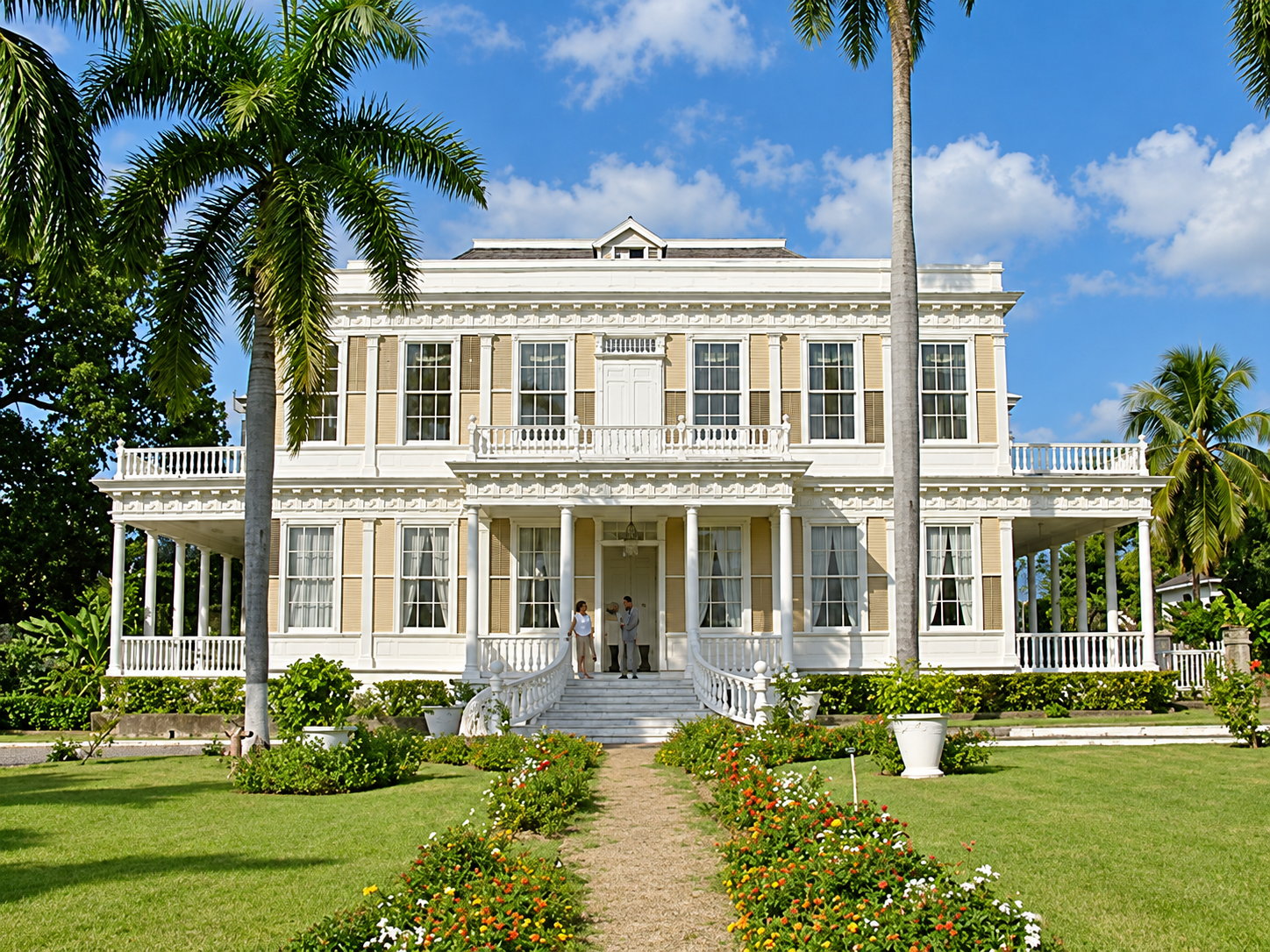
This is the complete story, from the Liguanea Plain before the English, through a 17th-century church grant, the rise of Jamaica’s first Black millionaire, a near-demolition in the 1960s, and the debates still shaping the property in 2026.
Part 1: Before the mansion (pre-1655 to 1750)
Long before anyone called it Devon, the land was part of the Liguanea Plain, the broad, gently sloping fan of soil between the Blue Mountain foothills and Kingston Harbour. The Taíno people who first settled Jamaica fished, farmed and lived across the island’s south coast, and the plain’s rivers and gullies made it fertile country. Spain held Jamaica from 1494 until 1655, when an English expedition seized the island and began parcelling out land to soldiers, planters and the Church of England.
The first documented chapter of the Devon House site begins with the Church. According to Devon House’s own history, in 1667 King Charles II granted 600 acres of glebe land to the Reverend Zellers, the first cleric appointed to the parish of St Andrew. That glebe ran from the St Andrew Parish Church at Half Way Tree north to Sandy Gully, took in Old Church Road and the grounds of today’s King’s House, and bordered Trafalgar Penn to the south, where the British High Commission now sits.
The terms of the grant were very much of their time: Jamaica Great Houses records that the clergy paid a rent of a penny an acre and were expected to take up arms for the Crown in the event of war or insurrection. Part of this glebe became known as Devon Pen. In colonial Jamaica a “pen” was a livestock farm that supplied cattle, mules, dung and provisions to the sugar estates, and by the 1770s nearly every large plantation relied on one.
Did you know?
The very first rector of St Andrew was paid in land, not cash, and that land became the foundation for much of uptown Kingston: King’s House, Devon Road, Waterloo Road and the Devon House lawns all sit on the old church glebe.
Part 2: The rectory years (c.1750 to 1879)
Around 1750, the St Andrew Parish Church built a rectory on Devon Pen. For roughly 128 years it housed the parish’s rectors, through the height of the sugar economy, the slave rebellions, Emancipation in 1834 and full freedom in 1838, and the Morant Bay Rebellion of 1865. By the late 19th century the old rectory was rundown, and the Church was ready to sell.
Part 3: The man who built it, George Stiebel (c.1820–1896)
George Stiebel’s life reads like an adventure novel. He was born in Kingston around 1820–21, the son of Sigismund Stiebel, a German-Jewish merchant, and his housekeeper, a woman of African descent who, given the date, may well have been enslaved. His father raised him in the main house and later backed him in business. Unhappy at school, the teenage George ran off and was found working in a carpenter’s yard; his father then apprenticed him to a shipbuilder. By 19 he was helping rebuild the Ferry Inn on Spanish Town Road.
With his father’s help he bought a ship in his early twenties and grew it into a small fleet of three, trading across the Caribbean and the Americas. Jamaica Great Houses reports that in 1844 he began running guns to enslaved people in Cuba, was jailed there, and escaped with help from a guard who, like him, was a Freemason. He was also briefly imprisoned in Santo Domingo during Spain’s 1861 annexation of the Dominican Republic.
He married Magdalen Baker, daughter of a Moravian missionary, in 1851, after the couple waited years for her disapproving parents’ blessing. They had two children, Sigismund and Theresa. Then disaster struck: all three of his ships were lost, and Stiebel reportedly swam ashore on the Venezuelan coast with nothing but a money belt strapped to his waist.
The Venezuelan gold that built Devon House
Stranded, Stiebel became a peddler, then partnered with Antonio Liccioni, a Corsican mule-train operator from Ciudad Bolívar. On 18 January 1870 the two men and ten others formed the Compañía El Callao to reopen an old Spanish mine near the Yuruari River, with Stiebel as chairman. It became one of the great gold strikes of the century.
El Callao by the numbers
Output rose from about 100 kg of gold in 1871 to a peak of roughly 5.6 tonnes in 1886, when El Callao ranked as the world’s leading gold producer. By 1892 it had fallen to about 1 tonne, and the vein was exhausted by 1912. Source: Jamaica Great Houses.
Stiebel came home in 1873 a very rich man, but to grief: his son Sigismund had died while he was away. He moved the family to London for a time, bought a house on Wimpole Street and sent Theresa to finishing school in France. Back in Jamaica he went on a buying spree through his cousin Leopold Schloss: the Lloyds and Retreat sugar estates, a wharf on Church Street, the Mullett coffee property and Minard Pen in Brown’s Town, St Ann. Popular history holds that he stopped at 99 properties because owning 100 or more was not permitted, a claim that is widely repeated but hard to verify.
Part 4: Building the dream (1879 to 1896)
In 1879 Stiebel closed the purchase of 53 acres of Devon Pen from the Church of England, and in 1881 he commissioned Charles P. Lazarus to build a mansion on the foundations of the old rectory. (Devon House dates the sale itself to 1881; some sources give the acreage as 51.) The result was a two-storey, timber-and-brick house in what architects call Jamaican Georgian: classical symmetry and proportion, adapted for the tropics with jalousie windows, deep wrap-around verandahs and cross-ventilation.
Inside were a ballroom, library, gaming room, sitting rooms, sewing room, dining room and bedrooms, with Wedgwood-style ceilings, carved fanlights and a sweeping single staircase. The kitchen stood in a separate building at the back, a fire precaution common to wooden great houses of the era. The estate was a small world of its own:
| In Stiebel’s day | What it is today |
|---|---|
| Carriage house, stables & blacksmith shop | Restaurant and shops (the Grog Shoppe) |
| Servants’ and staff quarters | The Courtyard Shops |
| Detached kitchen with brick ovens | Devon House Bakery / Brick Oven |
| Tennis court on the east lawns | Part of the car park |
| Private racecourse for his horses | Part of the car park |
The house quickly became the centre of Kingston society. Stiebel lived there with Magdalen, Theresa and her husband Richard Hill Jackson, a solicitor who became Mayor of Kingston, along with the Jacksons’ six children. Stiebel served as Custos of St Andrew, helped fund the 1891 Jamaica International Exhibition, and was made a Companion of the Order of St Michael and St George (CMG) by Queen Victoria.
Millionaire’s Corner
By the late 1800s the Hope–Trafalgar–Waterloo junction held three grand homes owned by three of the island’s richest men. Only one survives.
George Stiebel · Still standing, national monument
Louis Verley · Demolished, now apartments
Daniel Finzi · Now the YMCA
The 1890s brought a cascade of loss. Magdalen died on 12 October 1892. In 1895 Theresa’s young son Douglas died of typhoid, and within a week Richard Hill Jackson died too. George Stiebel died at Devon House on 29 June 1896 and was buried at the St Andrew Parish Church in Half Way Tree, close to the rectory lands where his story on Devon Pen began. Curiously, his death came just as El Callao itself was entering its decline.
Part 5: The quiet decades (1896 to 1965)
Theresa Stiebel Jackson kept the house until her death in 1922. In 1923 it was sold to Reginald Melhado, a successful Jewish Jamaican entrepreneur, but the deal covered only 11 acres. Roughly 40 acres were carved off and subdivided, and that subdivision is literally why Devon Road and Waterloo Road exist. The Stiebel furniture was sold at public auction.
How the land shrank
Bars drawn to scale. Today’s grounds are about one-fifth of Stiebel’s estate and under 2% of the original glebe.
In 1928 the house passed to Cecil Lindo, a shrewd businessman whose interests included the purchase of J. Wray & Nephew and the Monymusk estate, investments that tied Devon House to the history of Jamaican rum. Lindo lived there until his death in 1960 at age 89. His widow Agnes moved to New York, and the great house stood empty.
Part 6: The rescue (1965 to 1968)
Empty mansions on prime land rarely stay standing in a growing city, and Abbey Court across the road had already fallen. Developers drew up plans for a high-density condominium scheme that would have meant tearing down Devon House or gutting its interior. When Edward Seaga, then Minister of Development and Welfare, heard of the plan, he issued an interim preservation notice under the National Trust Act to stop it. Architect Patricia Green, writing in The Gleaner, recounts that one of the developers complained to Seaga that Jamaicans did not want development.
The Government acquired the property for the nation in 1967 and placed it under the Jamaica National Heritage Trust. Tom Concannon, an English architect in the Government Town Planner’s office, led the restoration. His team measured and followed old foundations to rebuild outbuildings and enclose what became the courtyard. Devon House officially opened to the public on 23 January 1968.
Seaga’s big idea was that heritage should pay its own way. Rather than a dusty museum, the house would anchor a showcase of Jamaican craftsmanship, food and drink, with the earnings funding preservation. That vision produced the crafts shops, the Grog Shoppe, the Devon Duppy drink and the brand that would make the property famous far beyond Jamaica: Devon House I Scream.
Part 7: Gallery, royal visit and monument (1974 to 2002)
In 1974 Prime Minister Michael Manley opened Devon House as the home of the National Gallery of Jamaica, and much of the original furniture was moved out. When the Gallery relocated downtown in the early 1980s, a second, complete refurbishment followed under Concannon, aiming to recreate the feel of a grand Jamaican home of the 1860s–1870s with Jamaican, Caribbean, English and French antiques and fine local reproductions. Devon House dates this work to 1982, and the refreshed mansion was opened by Queen Elizabeth II.
In 1990 the Jamaica National Heritage Trust declared Devon House a National Monument. In the 1990s, after the state crafts company Things Jamaican was wound down, management passed to the Devon House Development Company, which became fully operational in February 2002 and still runs the site under the Ministry of Tourism.
Part 8: Ice cream, gastronomy and controversy (2002 to today)
In 2011 National Geographic’s book Food Journeys of a Lifetime named Devon House the fourth-best place in the world to eat ice cream, with Devon Stout as the signature flavour. Demand grew so fast that in 2016 ground was broken for a larger I Scream shop on the east lawns, funded with about J$28 million from the Tourism Enhancement Fund. In 2017 Tourism Minister Edmund Bartlett launched Devon House as Jamaica’s first Gastronomy Centre, and in 2021 the house marked its 140th anniversary.
The modern era has also brought fierce debate. In March 2022 ground was broken on a J$70-million courtyard upgrade with new paving, gazebos, pergolas, a new ice cream shop and restrooms. When the work was unveiled that December, a Gleaner editorial attacked the loss of grass and old trees, while columnist Carolyn Cooper defended the redesign as elegant and practical. The row showed how deeply Jamaicans feel ownership of the place.
In late 2023 a bust of George Stiebel was unveiled in the redesigned courtyard, finally putting the builder’s face at the heart of the site that carries his legacy. And the surrounding neighbourhood keeps changing: in January 2026 The Gleaner reported a 19th-century Georgian-style home on Waterloo Road, sitting on land once part of Devon Pen, listed at US$3.4 million (J$550 million) for just over half an acre and pitched as a commercial site. It is a reminder of what the 11 protected acres would be worth on the open market, and of what Seaga’s 1965 decision kept off it.
The complete timeline
Taíno communities live across Jamaica’s south coast and plains.
Spanish rule; England captures Jamaica in 1655.
Charles II grants 600 acres of St Andrew glebe to Rev. Zellers, including Devon Pen.
St Andrew Parish Church builds a rectory on Devon Pen.
George Stiebel born in Kingston.
Stiebel marries Magdalen Baker.
El Callao mining company formed in Venezuela with Stiebel as chairman.
Stiebel returns to Jamaica a wealthy man.
Buys 53-acre Devon Pen; mansion built on the rectory foundations by Charles P. Lazarus.
Magdalen dies (1892); grandson and son-in-law die (1895); Stiebel dies 29 June 1896.
Sold to Reginald Melhado with 11 acres; ~40 acres subdivided into Devon and Waterloo Roads.
Sold to Cecil Lindo.
Lindo dies; house left vacant.
Demolition threatened; Edward Seaga issues preservation notice.
Government acquires Devon House for the nation.
Officially opened to the public.
Opened by Michael Manley as the National Gallery.
Complete refurbishment; reopened by Queen Elizabeth II.
Declared a National Monument.
Devon House Development Company becomes operational.
National Geographic ranks it the world’s 4th-best place for ice cream.
Launched as Jamaica’s first Gastronomy Centre.
140th anniversary; J$70m courtyard redesign and public debate; Stiebel bust unveiled.
145 years since construction, still standing on Millionaire’s Corner as uptown Kingston rises around it.
Why Devon House still matters
Devon House is more than a pretty building. It holds several Jamaican stories in one place: the colonial Church as landowner, the pen system that fed the sugar economy, a mixed-race son of an enslaved woman becoming the richest man in the colony, Jamaica’s Jewish merchant families, and a newly independent nation deciding that its heritage was worth more than a condo block. For a city where historic homes have so often given way to towers, it remains the clearest example of what Kingston chose to keep.
26 Hope Road, Kingston 10 · Guided mansion tours run daily; the courtyard, bakery, restaurants and I Scream are open into the evening. Check devonhouseja.com for current hours and tour prices.
A note on dates: sources differ on some details, including whether Stiebel bought the land in 1879 or 1881, whether the estate was 51 or 53 acres, and whether the first sale was in 1922 or 1923. Where they conflict we have followed Devon House’s official history and noted alternatives.
Sources: Devon House – Property History; Jamaica Great Houses – Devon House; ACIJ/IOJ Fact Sheet; Gleaner, Pieces of the Past; Gleaner, Patricia Green; JIS; Jamaica Observer; Gleaner, Jan 2026.

Visit our YouTube Community ↗